49 works in this view — arrow keys or swipe to move between them.
Dance in Art
La leçon de danse
Unknown artist
- Collection:
- Prints depicting dance
- Source:
- New York Public Library
- Rights:
- Public domain — free to use, share and adapt.
- Recorded as:
- Public Domain
For dance historians, this image provides rare direct visual evidence of how Regency ballroom dancing was actually taught: the arm positions, the role of the violin, the mixed-gender instruction, and the upright carriage that distinguished early 19th-century English social dance from both the courtly dances that preceded it and the later Victorian ballroom style. For art historians, it exemplifies the Regency era's fascination with capturing fashionable life in motion, treating the dance lesson as a window onto class, gender, and the commercialization of taste.
What you are looking at
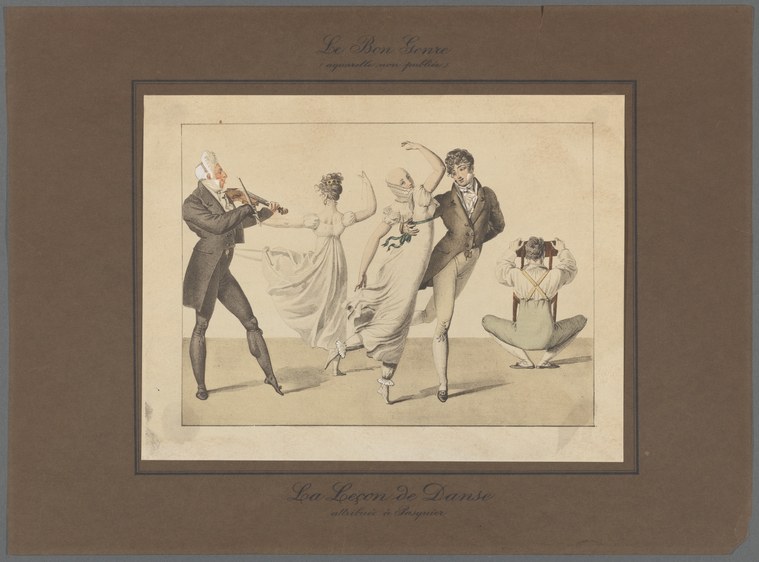
A dancing master instructs four young dancers in what appears to be a studio or ballroom. The master, at left, plays a violin while watching his pupils. Two female dancers in flowing white muslin gowns stand in the center, their arms raised in graceful positions; one has lifted her skirt slightly, revealing her legs and shoes. Between them stands a young male dancer in dark breeches and coat, also with arms raised. A fourth figure—possibly a young student—sits or crouches at the right, also in dark clothing. The composition is spare and intimate, rendered in pen and wash on a cream ground with a warm-toned border, suggesting a teaching moment rather than a performance. The figures are slim and elongated, typical of Regency-era illustration, and their postures suggest active instruction rather than a finished dance.
The dancing
The dancers display the upright carriage and raised arms characteristic of early 19th-century ballroom dancing. Both women hold their arms at shoulder height or slightly higher, with elbows bent and hands delicate—a frame for elegant turning. The male dancer mirrors this arm position. Their legs are straight and their weight appears to rest on the balls of the feet. The violin-playing master, shown in profile, gestures with his bow as if conducting or punctuating the movement. None of the figures are in closed partner hold; instead they dance singly or in lines, with the master maintaining oversight from the perimeter.
The dance depicted
This is a scene of Regency-era ballroom instruction, most likely depicting the quadrille, cotillion, or country dance that formed the curriculum of fashionable dancing masters of the period (1800–1830). The violin and the master's active role are typical of how these dances were taught: the master played, called steps, and corrected posture. The raised-arm positions and the upright frame match the arm carriage of quadrilles and cotillions documented in dance manuals of the era. The presence of mixed male and female dancers in a teaching setting suggests instruction in social dances meant for ballroom performance among the gentry.
How it was made
This is a watercolor and pen drawing on paper, a common format for dance instruction imagery and theatrical scenes of the period. The medium allowed for rapid notation of movement and gesture while preserving fine detail in the dancers' costumes and the master's expression. The wash technique creates soft modeling in the figures' clothing and the space around them, while the pen defines edges and the master's features with precision. Such drawings were often reproduced as engravings for publication, making them accessible as instruction aids or satirical commentary on fashionable culture.
About this work
This is a Regency-era study of a ballroom dancing lesson, depicting a master instructing young gentlemen and ladies in the postures and positions of contemporary social dance. The scene captures a moment of active teaching rather than performance or social dancing itself—the master is in control, demonstrating and correcting through music and example. The elegant, elongated figures and the focus on arm position and carriage reveal the aesthetic priorities of Regency dance instruction: grace, verticality, and the display of the body in motion within strict formal bounds.
The image belongs to a substantial body of satirical and instructional imagery about dance that circulated in Britain from the 1790s onward. Dancing masters were frequent subjects of both serious instruction treatises and comic print culture, and scenes of their pupils being corrected or struggling with positions were popular. This work, whether instructional or gently humorous, documents a crucial moment in the history of social dance—the formalization and commercialization of ballroom technique in the years after the Napoleonic Wars.
How to look at it
Notice first the master's active role: he is not passive but conducting through music and gesture, his body angled to see all four pupils at once. The dancers are not yet dancing together but practicing positions—their arms and posture are already in ballroom frame, but their feet and lower bodies suggest they are standing still or moving through a slow exercise rather than executing a lively turn. The woman on the left has lifted her skirt just enough to show her shoes and ankles, a practical move for a lesson but also a moment the artist chose to capture—it reveals the dancing master's concern with footwork and suggests the slight informality of the studio setting. The elongated proportions of the figures are characteristic of Regency fashion plates and dance imagery, emphasizing the verticality and grace that the dancing master is instilling.
The period
The early 19th century saw an explosion of printed images about fashion, social life, and manners in Britain. The Regency period (1811–1820, but culturally broader) coincided with the rise of lithography and the growth of satirical and fashion print culture. Dancing masters were celebrities in this world—their studios were gathering places for the gentry, and their methods were subjects of both serious instruction and mockery. At the same time, the quadrille (imported from the French court) was becoming the dominant ballroom form in Britain, displacing older country dances and cotillions. The formalization of technique, including the precise arm and leg positions shown here, was part of a broader professionalization and commodification of social dance.
The artistic treatment of dance in prints and drawings of this period often combined instruction with gentle satire—the exaggerated poses and the vulnerability of the learner made for compelling imagery. Publishers recognized a market for both serious dance manuals with instructional plates and popular satirical prints mocking fashionable follies.
Where it lives
This work is held in the New York Public Library's collection of prints depicting dance. It is an example of the popular instructional and satirical imagery about ballroom dancing that circulated widely in Britain in the early 19th century, likely as a standalone print or part of a larger series on fashionable life.
Dance in this work
Questions about this work
Who was the dancing master and who are the students?
The artist and specific identities of the figures are not recorded in the available documentation. The image is generic enough to represent a type—the fashionable dancing master and his genteel pupils—rather than a specific, named lesson.
What dance are they learning?
The arm positions and upright frame are consistent with the quadrille, cotillion, or English country dance as taught in the early 19th century. The master's role and the use of the violin for instruction point to one of these ballroom dances, but the image shows a teaching moment rather than the full executed dance.
Why is one dancer sitting down?
The crouching figure at the right may be waiting for a turn, resting, or possibly serving as an illustration of an incorrect posture (a common feature of instructional prints). Without more context, the exact function is unclear.
Is this image meant to be funny?
The image could be either earnestly instructional or gently satirical—the Regency period produced both. The exaggerated elongation of the figures and the vulnerability of the learners suggest a degree of wit, but the careful attention to position and posture indicates a serious instructional purpose as well.
More dance artwork





