49 works in this view — arrow keys or swipe to move between them.
Dance in Art
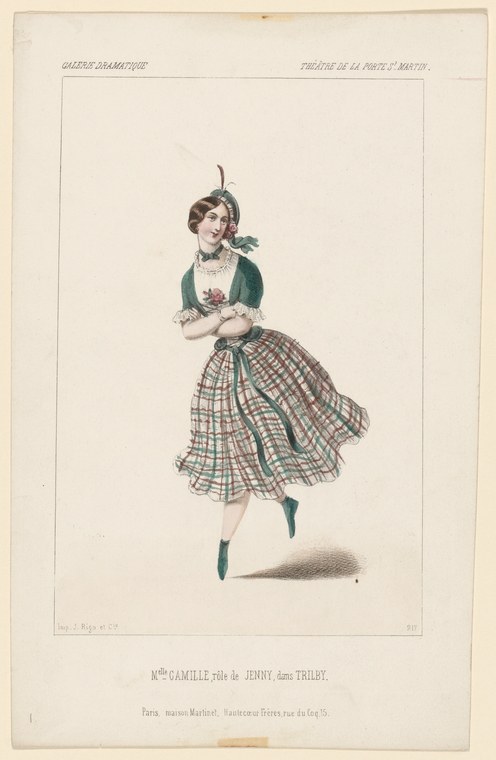
Melle. Camille, rôle de Jenny, dans Trilby.: Theatre de la Porte St. Martin
Unknown artist
- Collection:
- Prints depicting dance
- Source:
- New York Public Library
- Rights:
- Public domain — free to use, share and adapt.
- Recorded as:
- Public Domain
This print documents a specific historical performance and a style of theatrical dance that has largely disappeared from the historical record. It shows the technical and stylistic expectations of mid-nineteenth-century French commercial theater, where ballet-trained dancers performed character roles in costume comedies and plays. The archival value lies in its specificity: it preserves not just a type of performance but a name, a role, a theater, and a moment.
What you are looking at
A single female dancer is captured mid-performance in a lively, energetic pose against a plain background. She wears a dark green velvet or wool jacket fitted at the waist, paired with a full skirt in a bold plaid or tartan pattern featuring green, red, and cream tones. The skirt is caught dramatically in mid-swirl, its voluminous fabric suggesting rapid rotational movement. She wears green stockings and green shoes. A small feathered ornament—possibly a cockade or decorative plume—adorns her dark upswept hair. She holds a small bouquet of flowers in her crossed arms at her chest. Her body is animated: weight appears shifted onto one leg, the other lifted, her torso twisted slightly, her gaze directed toward the viewer with an expression of theatrical engagement. The composition is a full-length figure study, centered on the page, rendered in the hand-colored lithographic style typical of French theatrical prints of the mid-nineteenth century.
The dancing
The dancer's weight is clearly shifted onto her supporting leg, with the other foot lifted and angled behind or beneath her, suggesting a balletic or theatrical posture rather than a vernacular one. Her arms are held at mid-body with a gentle curve, cradling the flowers rather than extended in a classical frame. Her torso shows a slight twist and counterbalance, the head held erect and turned toward the viewer. The pose conveys both grace and liveliness—not a static classical position but a captured moment of theatrical movement, somewhere between a curtsy and a hop.
The dance depicted
This appears to be a theatrical dance from a mid-nineteenth-century French stage production, specifically the role of Jenny in the play *Trilby*. The costume and pose suggest either a character dance or a theatrical interlude rather than classical ballet or pure pantomime. The tartan skirt, green velvet jacket, and small flowers suggest a Scottish or rural character, consistent with romantic-era theatrical conventions. The energetic, off-balance posture and the direct engagement with the audience indicate a style of performance that blended balletic technique with theatrical character work—closer to the dances that appeared in opéras comiques and vaudeville than to the formal vocabulary of the ballet stage. The identity of the performer is given in the caption but not her technique or the exact nature of the dance.
How it was made
This is a hand-colored lithograph, a reproductive print technique that allowed rapid and affordable circulation of theatrical imagery. The delicate rendering of the plaid pattern, the subtle shading in the flesh tones, and the careful attention to the flowers and feathered ornament are characteristic of the skilled hand-coloring practice of Parisian theatrical print workshops. The technique permitted fine detail while remaining economical enough for mass distribution to theater patrons and print collectors. The printer's mark and the inscription below the figure identify this as a commercial theatrical souvenir or gallery sheet, likely produced shortly after or concurrent with the stage run.
About this work
This is a mid-nineteenth-century French theatrical print documenting a specific stage performance by the dancer Mlle. Camille in the role of Jenny from a production at the Théâtre de la Porte Saint-Martin in Paris. It belongs to the vast archive of commercial theatrical prints that served both as souvenirs and as advertisements for stage productions of the era. The image captures a moment of theatrical character dance—a form that sat between classical ballet and popular entertainment, often featuring regional costume and energetic, direct performance style. The tartan costume and the rural character type reflect the Romantic-era fascination with picturesque and exotic settings, here rendered in a dance form that was both technically accomplished and accessible to general audiences.
How to look at it
Attend to the specificity of the costume and the energy of the pose. The tartan and green jacket are not generic theatrical dress but suggest a particular character type—likely Scottish or rural. Notice how the artist has captured the dancer mid-movement: weight shifted, one leg lifted, body twisted, flowers clutched—this is not a formal classical position but a moment of theatrical action. The hand-coloring is skillful, particularly in the pattern of the plaid and the subtle shading of the face; this was a craft practiced by workshops of colorists, often women, whose work made these prints visually compelling and expensive for their time. The signature and theater attribution at the bottom remind you that this is a souvenir and advertisement, not an artwork created for posterity.
The artist
The artist is not recorded in the catalogue. The print carries a printer's mark ("Imp. J. Regnier, rue St Marc [Paris]") indicating it was produced by a commercial lithographic workshop in Paris. Many such prints were created by anonymous or semi-documented artists working for theatrical publishers; they were industrial products designed for rapid circulation rather than fine-art commissions. The style and quality are consistent with the work of skilled theatrical illustrators of the 1840s–1860s whose names often went unrecorded.
The period
This print dates to the era of French Romantic theater and the height of the opéra comique and vaudeville forms. The 1840s–1860s saw an explosion of commercial theatrical imagery, as lithography made colored prints affordable and reproducible at scale. In this period, classical ballet was becoming increasingly codified and elite (the domain of the Opéra); character dances and theatrical divertissements, by contrast, were performed in commercial theaters and were often more overtly comedic and socially accessible. The tartan costume and rural character type reflect the Romantic fascination with regional and exotic settings, while the dancer's direct, unidealized pose suggests the influence of popular rather than classical aesthetic values.
Where it lives
This is a hand-colored lithograph held in the Prints collection of the New York Public Library, acquired as part of the Library's extensive holdings of theatrical prints and ephemera. Such prints were commercial products, sold in theater lobbies and print shops; their survival in institutional collections reflects both their original popularity and the NYPL's systematic collection of theatrical documentation.
Dance in this work
Questions about this work
Who was Mlle. Camille?
The catalogue record identifies her only by stage name and role. Individual dancers in commercial theater of this era were often documented in prints and playbills but rarely in detailed biographical records. She was likely a professional dancer trained in ballet technique but performing in popular theater rather than at the state-funded Opéra. The print itself is the primary historical record of her performance.
What is Trilby?
Trilby was a popular theatrical work in nineteenth-century France (the catalogue lists it as being performed at the Théâtre de la Porte Saint-Martin, a commercial theater in Paris). It existed in multiple forms—as a play, an opéra comique, and later works—often featuring musical interludes and character dances. Without a date on the print, it is difficult to determine which version of Trilby this performance belongs to, but the costume and style are consistent with the mid-nineteenth century.
Is this ballet?
No, though the dancer was likely trained in ballet technique. This is theatrical character dance, a hybrid form that used balletic vocabulary but combined it with pantomime, comedy, and regional costume. It belongs to the world of opéra comique and commercial theater rather than to classical ballet proper.
How do we know this is a lithograph?
The medium is inferred from the image itself: the delicate, even surface, the characteristics of hand-coloring, and the printer's mark at the bottom ("Imp. J. Regnier") are all typical of the commercial lithographic prints produced in Paris during this era. The catalogue record does not specify the medium, but the visual evidence is clear.
More dance artwork





