49 works in this view — arrow keys or swipe to move between them.
Dance in Art
The ball
Unknown artist
- Collection:
- Prints depicting dance
- Source:
- New York Public Library
- Rights:
- Public domain — free to use, share and adapt.
- Recorded as:
- Public Domain
This print is one of the few visual records of how ordinary educated people actually danced in the late 19th century, as opposed to how they were supposed to dance according to dance masters' manuals. It shows the real density, chaos, and informality of a ball in progress—a counterweight to the idealized symmetry of earlier dance prints. For historians, it is evidence of the transition from rigid cotillion figures to the couple-centered waltz as the dominant social dance.
What you are looking at
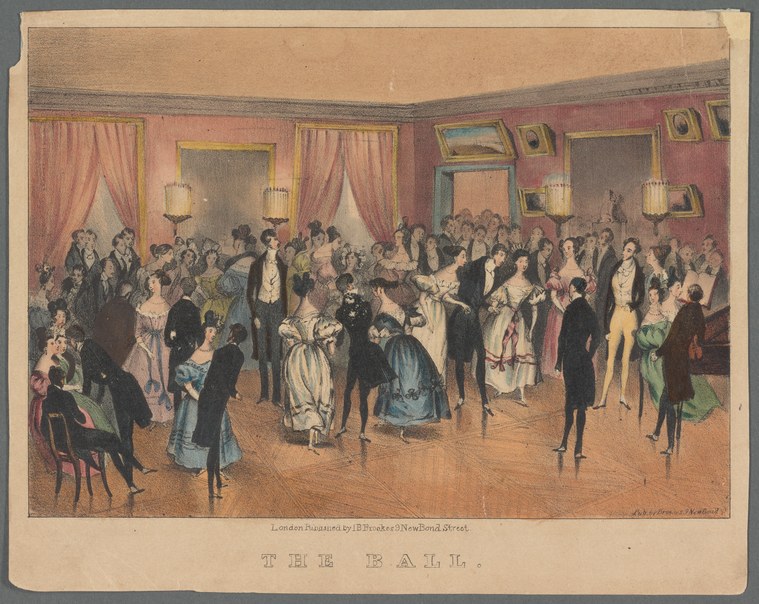
A formal ball in a grand interior lit by gas lamps, painted in the chromolithographic style of the mid-19th century. The room has rose-pink walls, tall windows with pale curtains, and framed artwork hung above. A crowd of around 80–100 figures in evening dress fills the space in no fixed formation: men in black tailcoats and white shirt fronts, women in long pale gowns with off-shoulder necklines typical of the 1870s–1880s. The figures are distributed across the floor, some standing in conversation, others in pairs or small groups. A few couples appear to be dancing or about to dance in the center and right side of the composition. The lighting is warm and even, suggesting gaslight, which flatters the pale fabrics and creates soft shadows. The overall mood is one of fashionable leisure and social mixing, with no rigid choreography visible—this is a social gathering where dance is one of several activities.
The dancing
Most figures stand or walk in social posture. Where couples are visible, they show the upright, formal frame typical of Victorian-era ballroom dancing: the man and woman face the same direction with some distance between them, the woman's arm resting on or near the man's, suggesting either a waltz, quadrille, or similar figure. Postures are upright and constrained by the stiff corseting and formal tailoring of the period. No energetic footwork or close holds are visible; the dancing shown is dignified and restrained. The woman in the center-right appears to be in motion, her skirt caught mid-turn in pale fabric.
The dance depicted
This is a formal Victorian ball, and the dances depicted are most likely waltzes, quadrilles, or other standard ballroom figures of the mid-to-late 19th century. The setting and dress suggest the 1870s–1880s. No specific named dance can be identified with certainty from the image alone, but the formal upright frame, the paired positions, and the social context point to the American-smooth and historic-gilded-age ballroom dances that dominated such events. The image captures the social function of the ball as a marriage market and site of genteel courtship rather than technical virtuosity.
How it was made
This is a chromolithograph, a color printing process that allowed multiple layers of stone or metal plates to be inked and printed in sequence. The technique is evident in the discrete color zones (pink walls, pale flesh, white shirt fronts, dark coats) and the slight registration shifts visible at edges. Chromolithography was expensive and labor-intensive, making this a work for a prosperous middle-class audience, likely published as a print for framing or album inclusion. The soft color palette and atmospheric light effects are hallmarks of the process at its height in the 1870s–1890s.
About this work
This chromolithograph depicts a fashionable social ball in America or Europe during the Gilded Age, capturing the formal ballroom culture that dominated elite and upper-middle-class social life. The work documents not the technical skill of dancers but the social choreography of courtship and class display: the formal dress codes, the segregation of activity (dancing, conversation, promenading), and the heterosexual pairing that marriage markets required. It is a historical record of how dance functioned as social ritual in the Victorian era.
The image belongs in a dance gallery because it shows dance as lived social practice rather than staged performance. The ball was where young people learned to dance, where reputations were made and broken through a missed step or an improper partner, and where the aesthetics of movement—the woman's floating skirt, the man's contained frame—were bound up with marriage, class, and gender. Without understanding the social ballroom, one cannot understand the history of waltz, quadrille, or the aesthetic of 19th-century theatrical dance.
How to look at it
Look at the distribution of figures: they are not arranged in lines or sets, as they would be for a cotillion or quadrille, but scattered across the floor in pairs and small groups. This suggests the waltz as the dominant form—a dance that requires only one couple and no fixed formation. Note the women's skirts: the slight flare and the pale color make them visible even in crowd, and the artist has caught several in motion, the hem rising with the turn. Look also at the room itself: the gas lamps, the formal furnishings, the portraits on the wall are all signs of wealth and taste, placing this ball at the apex of the social hierarchy. This is a print made to be viewed by people who danced themselves, and who would have recognized in it the familiar constraints and rituals of their own courtship.
The period
The 1870s–1880s were the apex of the Victorian ball. The waltz had been socially acceptable for 40–50 years by this date, but quadrilles, cotillions, and lancers still held their place as formal figures, especially for opening dances and for older guests. Chromolithography was reaching its technical and aesthetic peak in this period, allowing publishers to produce bright, finely-detailed prints at a price that made them accessible to the middle class. The formal ballroom was also at the moment of its greatest social authority: photography was beginning to document high society, dance instruction was codified into systems (such as the Cecchetti method in ballet, appearing contemporaneously), and the ballroom was still the primary site of genteel sociability before cinema and the telephone began to fragment urban social life.
Where it lives
The work is held in the New York Public Library's collection of prints depicting dance. The publication information printed at the foot—'London Published by J Brooks, New Bond Street'—indicates this is a British print, likely exported to America and held by NYPL as part of its 19th-century dance ephemera.
Dance in this work
Questions about this work
What dances are being shown?
The formal upright frame and paired positions visible in the image suggest waltzes, quadrilles, or lancers—the standard ballroom dances of the 1870s–1880s. No single named dance can be identified with certainty, as the print captures a whole ball in progress, with multiple dances likely happening in sequence or simultaneously.
Why are people standing around rather than dancing?
A formal ball was a social event, not a dance recital. Guests arrived, took supper, conversed, and danced in turns. The print shows the full social scene, which is precisely why it is valuable: it documents how dance functioned as one activity among many, embedded in courtship, class display, and gossip.
When was this made?
The dress, the gas lighting, the architectural details, and the chromolithographic technique all point to the 1870s–1880s. The catalogue record offers no precise date, but the image itself is consistent with the Gilded Age ballroom at its height.
Is this based on a specific event?
It appears to be a type scene rather than a record of a particular ball. Such prints were sold as popular images of fashionable life, meant to appeal to the aspirations of the middle class. The generality of the setting and the crowd suggests it was made for sale to a broad audience.
More dance artwork





