49 works in this view — arrow keys or swipe to move between them.
Dance in Art
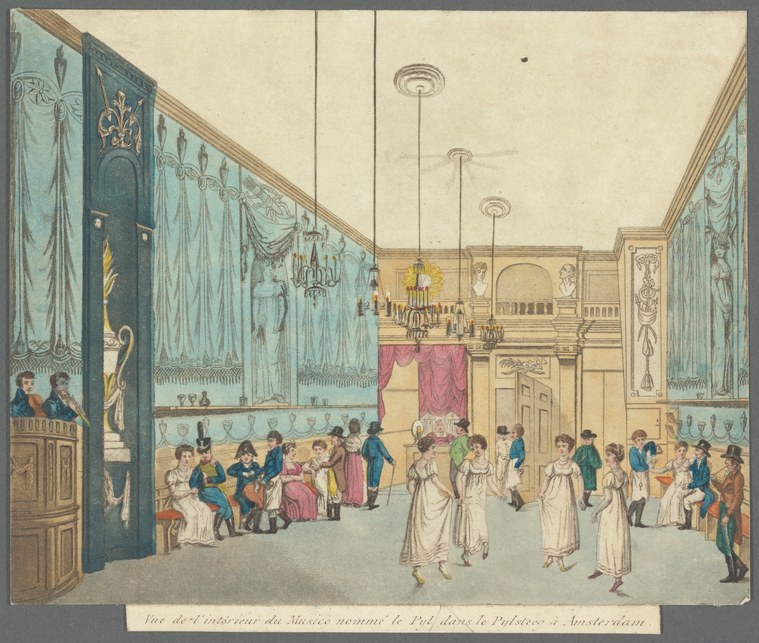
Vue de l'interieur du Musico nommé le Pyl dans le Pylsteeg à Amsterdam
Unknown artist
- Collection:
- Prints depicting dance
- Source:
- New York Public Library
- Rights:
- Public domain — free to use, share and adapt.
- Recorded as:
- Public Domain
This is one of the most valuable kinds of dance image: a documentary record of a specific venue and moment in ballroom history, made not as imaginative fancy but as a topographical view of fashionable social practice. It shows us the actual scale and formality of a Regency ballroom, the social mixing on the dance floor, and the integration of dance within a broader social event. For historians of cotillion, quadrille, or early Regency ballroom practice, this is primary evidence.
What you are looking at
An interior view of a grand ballroom or assembly hall in Amsterdam, rendered in a colored print with careful architectural perspective. The space is vast and formally proportioned, with high ceilings punctuated by three pendant light fixtures and a frieze of teal-blue wall panels decorated with gilded ornamental motifs and draped garland designs. The walls are articulated with fluted pilasters and carved medallions. A raised stage or dais occupies the far end of the room, hung with red velvet curtains. The floor is a light stone or marble. Scattered throughout are numerous figures in early-19th-century dress—men in dark coats and breeches, women in high-waisted white muslin gowns, the silhouettes characteristic of the Regency or early Empire period. Some figures cluster in conversation in small groups; others stand in open formation. The composition suggests a formal assembly or ball in progress, with multiple simultaneous activities: some couples appear to be dancing or preparing to dance in the center floor, while others socialize along the perimeter. The viewpoint is elevated and angled, as if we are observing from a gallery or vantage point within the room itself, emphasizing the scale and splendor of the venue.
The dancing
The dancers are shown in the loose, upright posture of early-19th-century ballroom dance, with women in the characteristic high-waisted Empire silhouette and men in tailored evening coats. Several pairs are visible in what appears to be closed or semi-closed ballroom position—no modern frame is evident, but the figures are oriented toward one another in the manner of the period. The dancers' bodies are upright and dignified rather than bent or flexed. Footwork is not clearly legible from this elevated vantage point. The non-dancing figures stand at ease, some with heads turned in conversation, suggesting a social event where dance is one activity among others rather than the sole focus.
The dance depicted
This is a record of fashionable ballroom assembly dancing in the early 19th century, almost certainly depicting a Regency-era or Napoleonic-era social ball in the Netherlands. The styles of dress, the formal ballroom setting, and the mixed social composition suggest quadrille, cotillion, or country dance—the dominant ballroom forms of the period. The title suggests this is a specific venue (the Pyl, a music room or assembly hall in Amsterdam), indicating the artist's intention to document a recognizable social institution rather than an imagined scene. The presence of both performers and spectators, and the loose grouping of dancers, is consistent with the cotillion or quadrille, which were often led and called.
How it was made
This is a hand-colored print, most likely a colored engraving or aquatint from the early 19th century. The technique is evident in the fine linear perspective of the architectural elements, the careful tonal modeling of light and shadow in the walls and ceiling, and the delicate application of watercolor or hand-applied pigment over a printed base. The precision of the rendering and the naturalistic but idealized presentation suggest a commercial print made for circulation among a prosperous urban audience. This was a relatively expensive and labor-intensive medium, indicating the print was intended for educated collectors and patrons interested in documentation of fashionable social life.
About this work
This is a colored engraving or aquatint documenting a formal ball or assembly in Amsterdam's Pyl music room during the Regency era (early 19th century). It captures the elegant but orderly social rituals of urban ballroom dancing, showing the architecture, dress, and social dynamics of a fashionable public assembly. The work sits at the intersection of dance history, urban history, and social documentation—a visual record of how and where people of the urban middle and upper classes danced. It matters because it preserves precise visual evidence of the setting, grouping, and comportment of early-19th-century ballroom assembly dancing, a crucial period in the development of standardized couple dances.
How to look at it
Observe the spatial composition: the artist has chosen a high, distant vantage point that lets us see the entire room at once, emphasizing the scale and formality of the space. This 'bird's-eye' perspective was common in topographical and architectural prints and conveys civic pride and documentary intent. Look at the distribution of figures—clustered in some areas, scattered in others—which reflects the reality of an assembly where some people dance, others watch or converse. The elevated viewpoint prevents us from seeing footwork or detailed hand positions; instead, we read the dance from posture, spacing, and orientation. This is a social and architectural document first, and a dance study second.
The period
The Regency era (roughly 1811–1820 in Britain, with parallel fashions across Northern Europe) saw the dominance of the cotillion and quadrille—large, geometric ensemble dances performed in ballrooms by mixed-gender couples. These dances were replacing the older contredanse and minuet, and they required formal venues with room for multiple simultaneous couples and spectators. The Pyl in Amsterdam was one of several purpose-built assembly rooms and music halls serving the prosperous merchant class of Northern Europe. The formal architectural setting shown here—the neo-classical proportions, the emphasis on visual display, the separation of dance floor from viewing area—reflects the rise of public commercial assembly as a space of social performance. Dance was integral to the fashionability and success of such venues.
Where it lives
This work is held in the NYPL Prints collection as part of a series documenting dance images. The caption and apparent date of execution suggest it was a commercial print, likely issued in the early 19th century for sale to collectors interested in urban topography or fashionable social life.
Dance in this work
Questions about this work
What dance is being shown?
Most likely a cotillion or quadrille, the dominant ballroom forms of the Regency era. The formal grouping, the gender-mixed couples, and the emphasis on geometric progression are all consistent with these ensemble dances. The elevated viewpoint makes it impossible to see specific footwork, so we identify the dance mainly from setting, dress, and social context.
Why does this image matter for dance history?
It is a rare documentary record of an actual ballroom venue and social assembly in the early 19th century. Rather than an imagined or theatrical scene, it attempts to show how and where people really danced. For historians of quadrille, cotillion, and Regency ballroom culture, this is primary visual evidence of the physical setting, the social mixing, and the formality of the practice.
What is the Pyl?
The caption identifies this as the Pyl (or Pylsteeg), a music room or assembly room in Amsterdam. It was apparently a fashionable public venue for balls and social gatherings during the Regency era. The artist's choice to title the work with this specific location suggests it was a well-known establishment, perhaps serving the city's prosperous merchant class.
How can you tell the date?
The style of women's dress—the high waistline, the flowing muslin gowns, the simple silhouette—is characteristic of the Empire and Regency periods, roughly 1800–1820. Men's dress, with tailored dark coats and breeches, matches the same era. The architectural style is consistent with Regency neo-classicism. The technique and coloring suggest an early-19th-century commercial print, though the exact date is not recorded.
More dance artwork





