49 works in this view — arrow keys or swipe to move between them.
Dance in Art
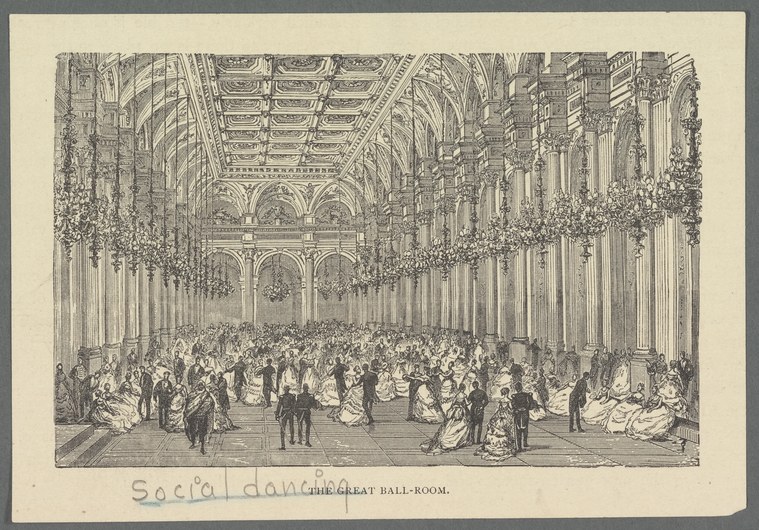
The great ball-room
Unknown artist
- Collection:
- Prints depicting dance
- Source:
- New York Public Library
- Rights:
- Public domain — free to use, share and adapt.
- Recorded as:
- Public Domain
This print is a primary visual source for understanding the material conditions of formal ballroom dancing—the scale of the spaces, the density of participation, the relationship between dancing and socializing, and the visual conventions used to represent movement and gathering in the 18th and 19th centuries. For historians of dance and etiquette, it is a record of how fashionable dancing was imagined, celebrated, and disseminated to a broad literate public.
What you are looking at
This is an engraved depiction of an elaborate formal ball in a grand neoclassical interior, likely from the 18th or 19th century. The space is vast and imposing: a coffered ceiling extends deep into the perspective, supported by a colonnade of fluted pilasters that march along both walls. Massive arched openings punctuate the far wall. Hanging garlands—swags of flora or fabric—drape from the entablature, creating a festive atmosphere. The floor is a reflective checkerboard of light and shadow.
The gathering fills the hall in clusters and couples. Hundreds of figures, rendered in careful cross-hatching to suggest depth and recession, occupy the space. Most are in formal dress: the men in dark coats and breeches, the women in voluminous skirts. Some couples are in motion—dancing—while others stand, converse, or sit on benches along the periphery. The density of the crowd is greatest in the middle distance, dispersing toward the far end of the hall. The lighting is even and clear, typical of engraved illustration, which throws the geometric order of the architecture into sharp relief and allows every figure to be legible.
The dancing
The dancing couples visible occupy a formal closed position: men and women face each other or stand beside one another, their bodies upright and restrained. The women's full skirts occupy significant space around them. Arm positions are high and controlled, consistent with the ballroom conventions of the period. The figures are small at this distance and scale, but their posture throughout suggests the measured, vertical carriage of 18th- and 19th-century social dancing rather than the rotational propulsion of later styles. The composition emphasises formation and order over individual dynamism—dancers are arranged in lines and groups across the floor rather than rotating through it.
The dance depicted
This image most likely documents a formal court or assembly ball of the late 18th or 19th century, most probably depicting either a quadrille or a cotillion—both were the dominant couple dances of European ballrooms in this era. The engraving's title, 'The Great Ball-Room', suggests it is a general representation of fashionable dancing rather than a specific documented event. The architectural setting, the dress of the figures, and the orderly disposition of dancers across the floor are all consistent with Regency or early Victorian ballroom culture. Without an inscription or clear evidence of a specific dance figure (set formations, hands-across patterns), the identification remains general, though the scene is unmistakably a formal ballroom event of rank and ceremony.
How it was made
This is an engraving, created by laboriously incising lines into a metal plate (almost certainly copper) with a burin, then inking and printing. The technique produces the fine, parallel lines (hatching and cross-hatching) visible throughout, particularly in shadow areas, the folds of fabric, and the receding floor. Engraving was expensive and labour-intensive, indicating this work was made for an educated, wealthy audience—likely published as a print or plate in a larger suite or album. The precision and finish suggest a professional printmaker of considerable skill. The even tonal range and the depth of field achieved through linear perspective mark this as a work of the 18th or 19th century, created before photomechanical reproduction. The wide circulation of such prints—as loose sheets, bound volumes, or decorative wall hangings—made them a primary visual record of fashionable life for those who could afford them.
About this work
This engraved print captures the spectacle of an 18th- or 19th-century formal ballroom at the height of its occupation. It is not a document of a specific event but rather an idealized or generic representation of what polite society did in its grand public spaces: the wealthy gathered to dance in formal couples, their bodies constrained by dress and convention, within architecture designed to frame and elevate the occasion. The work belongs in a gallery of dance art because it records how dancing bodies inhabited and moved through a specific architectural and social world—and how that world was visualized and circulated among those who aspired to inhabit it. The engraving is also an artifact of the print culture that made images of dance widely available before photography.
How to look at it
Attend first to the architectural framing: the engraver has chosen a viewpoint that emphasizes recession and grandeur, drawing the eye toward the far wall and the distant dancers, which creates a sense of occasion and scale. The dancing couples themselves are small and dispersed, suggesting that dancing was one activity among many in the ballroom—socializing, standing, observing. Notice the formality of the dress and posture: there is no dynamic rotation or exaggerated movement, but rather an orderly, vertical carriage. The engraver has frozen a moment of activity rather than capturing motion, which is typical of the period's conventions for representing dance in still media.
The period
The engraving dates most likely to the 18th or 19th century, a period in which formal ballroom dancing—the quadrille, cotillion, reel, and country dance—dominated European and transatlantic upper-class social life. Regency and Victorian era balls were major social and political events, and the ballroom was a principal space of courtship, display, and the negotiation of rank. Images of balls and ballroom dancing were popular subjects for prints and engravings, circulated to visualize fashionable life for those within the aspiring classes. The engraving's architectural grandeur and careful rendering of social order through spatial composition reflect the Enlightenment and Neoclassical aesthetic that dominated visual culture in this period.
Where it lives
This engraving is held in the Prints collection of the New York Public Library, catalogued within their broader holdings of prints depicting dance. It is a loose or bound sheet, likely part of a larger suite of ballroom or social scene prints.
Dance in this work
Questions about this work
What dance is this?
The engraving does not depict a specific identifiable dance, but rather a general formal ballroom of the 18th or 19th century. The couples are in closed position and moving in an orderly fashion, consistent with quadrilles, cotillions, or country dances of the period. Without a caption or clear evidence of dance-specific formations, we cannot be certain which dance is meant.
Why are so many people in the room but only a few dancing?
Ballroom attendance was a social occasion, not exclusively a dancing occasion. People came to display dress, negotiate rank and courtship, socialize, and watch. The engraver has captured the heterogeneous activity of the ballroom as a public space, not a stage for dancers alone.
What is the architectural style?
The interior is Neoclassical or Georgian: a colonnade of fluted pilasters, coffered ceiling, and arched openings are all hallmarks of Enlightenment-era grand architectural design. The ballroom is designed as a temple of leisure and display.
More dance artwork





