49 works in this view — arrow keys or swipe to move between them.
Dance in Art
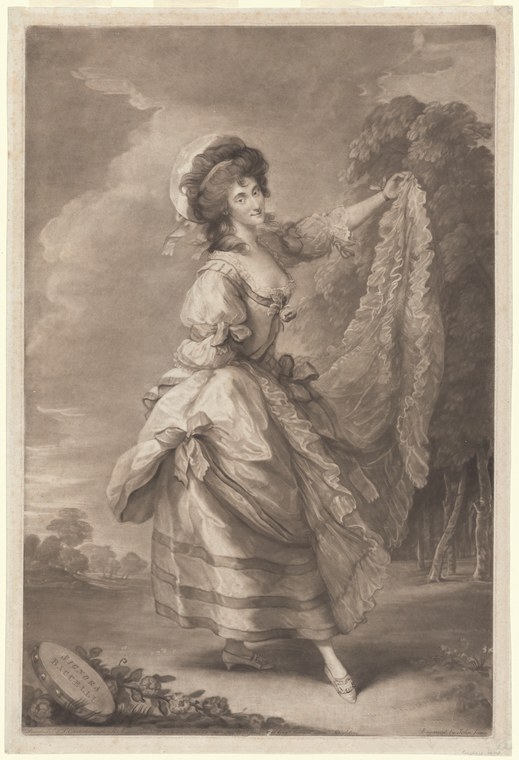
Signora Baccelli [inscribed on tambourine, lower left]
Unknown artist
- Collection:
- Prints depicting dance
- Source:
- New York Public Library
- Rights:
- Public domain — free to use, share and adapt.
- Recorded as:
- Public Domain
This print preserves a visual record of how professional solo dancers performed in the Regency theater, a period between the decline of court dance and the rise of Romantic ballet. It documents both the physical vocabulary of theatrical entertainment—the use of arms, the relationship to drapery, the posed moment—and the commercial apparatus of theatrical celebrity, showing how dancers were marketed and remembered by their audiences.
What you are looking at
A young woman in an elegant cream muslin gown stands in a theatrical pose against a darkened architectural setting, her body angled in three-quarter view as she gazes over her shoulder toward the viewer. Her dress is high-waisted in the Regency style, with puffed short sleeves and a deep rose-colored sash tied at the waist; the skirt falls in gathered folds to her ankles, and she wears pale slippers. She holds aloft a length of sheer drapery or veil in her raised right hand, the fabric catching light as it billows behind her. In her left hand she grasps a tambourine inscribed with her name. Her hair is dressed high and gathered under a white cap or turban. The background suggests a theatrical interior—a stone urn or finial visible at the right edge, classical drapery, and warm light that suggests a stage or studio setting. The overall composition is one of poised elegance and restrained movement, the figure caught between stillness and the suggestion of flowing motion.
The dancing
A single female dancer is depicted in a standing position with her weight distributed evenly, her torso twisted slightly to create a graceful S-curve. Her right arm is raised to approximately shoulder height, hand open and leading the flow of fabric; her left arm extends at waist level, holding the tambourine. The head is turned back over the shoulder in a gesture of flirtation or acknowledgment. The overall frame is open and elongated, emphasizing the vertical line of the body and the play of drapery. There is no partnering or closed hold; the dancer commands the space alone.
The dance depicted
This appears to document a solo performance within the theatrical dance traditions of the Regency era, most likely representing a moment from a pantomime or ballet d'action popular in London theaters around 1800–1820. The tambourine and flowing veil suggest a character dance or pastoral-theatrical piece rather than formal court dance. The inscription "Signora Baccelli" identifies the performer, likely referring to a professional dancer of that period. The pose—with its emphasis on graceful arm placement, the turning of the head, and the flowing fabric—shows the influence of theatrical conventions of the time, though the specific dance vocabulary is not clearly distinguishable. The work documents a theatrical performer and a moment of character or entertainment dance.
How it was made
This is an engraving or stipple engraving, a technique that allowed for fine tonal gradation and the rendering of delicate textures like muslin and diaphanous fabric. The medium's clarity and portability made it ideal for circulating theatrical celebrity images; such prints were popular souvenirs of London performances and were widely distributed and collected. The technique also allowed the artist to capture minute details of fashionable dress and the precise fall of light, making these prints valuable documents of Regency-era costuming and aesthetic ideals. The print medium suggests this was a commercial theatrical souvenir rather than a fine-art commission.
About this work
This engraved theatrical portrait documents a Regency-era performer in a character dance or entertainment piece. Signora Baccelli is captured in a pose of elegant restraint, holding a tambourine and veil—props that suggest a pastoral or exotic-themed entertainment rather than classical ballet. The work belongs to a substantial tradition of printed theatrical celebrity images that circulated among London audiences in the early 19th century, serving as both souvenirs of performances and documents of fashionable stage costume and movement. The print reveals how solo dancers of this period presented themselves to the public: through graceful, extended lines and an emphasis on fashionable dress and delicate theatrical props.
How to look at it
Observe the artist's emphasis on the vertical line of the body and the play of light on fabric—the drapery is as much a subject as the dancer herself. Notice the pose: it is not a caught moment of vigorous movement but rather a posed display, carefully composed to show off fashionable dress, graceful arm placement, and the dancer's stage presence. The turning of the head and the uplifted arm follow conventions of Regency-era portraiture, adapted here to a theatrical context. The tambourine and veil are not incidental; they are the props that define her character and costume, and the print gives them equal visual weight.
The artist
The artist is not recorded in the catalogue. The work is from a series of theatrical celebrity prints, likely produced by a London printmaker or engraver working in the stipple or mixed-technique tradition that was dominant for theatrical portraiture in this period. Such prints were often unsigned or attributed to the publisher rather than the engraver.
The period
This work dates to the early 19th century, a transitional moment in British dance history. Court dance had declined with the French Revolution, and ballet was being reimagined as a theatrical entertainment centered on professional performers and dramatic narrative. The Regency period (1811–1820) saw a flourishing of theatrical entertainment in London, with solo dancers—often from continental Europe—performing character dances and dramatic pieces. Simultaneously, the fashion for neoclassical dress (high waists, simple lines, flowing fabrics) had transformed stage costume, and dancers' bodies were presented within new aesthetic frameworks. The tambourine and veil suggest an "exotic" or "peasant" character, popular themes in the entertainment dances of the period.
Where it lives
This print is held in the New York Public Library's collection of theatrical prints and images. It is one of many such commercial engraved theatrical celebrity portraits that were produced for London audiences in the Regency era and subsequently circulated internationally.
Dance in this work
Questions about this work
Who was Signora Baccelli?
The catalogue does not provide biographical information. The name suggests an Italian dancer, likely a professional performer in London theaters during the early 19th century. Theatrical prints bearing a performer's name were commercial souvenirs sold to audiences, and the name would have been recognized by contemporaries. Without additional research, we cannot identify her specific performances or career.
What dance is she performing?
The specific dance cannot be identified from the image alone. The tambourine and veil suggest a character or entertainment dance—possibly a pastoral or "exotic" piece—rather than formal court dance or classical ballet. Such solo performances were common in Regency theater but are now known primarily through prints like this one, as the choreography was not recorded.
Why is the pose so still and formal if this is dance?
Theatrical portraiture of this period often captured a posed moment rather than a dynamic movement, emphasizing the performer's stage presence and costume. The print medium favored clarity and legibility over the suggestion of motion. Even so, the raised arm, the turn of the head, and the flow of drapery suggest the graceful, extended lines that were prized in early 19th-century theatrical dance.
What does the tambourine tell us?
The tambourine is a character prop, suggesting a peasant, pastoral, or possibly Middle Eastern or Mediterranean-themed entertainment. It was a common prop in theatrical entertainment dances of the period and would have signaled to audiences the nature of the character being portrayed. The inscription of her name on the tambourine is a theatrical touch, reinforcing the idea that this is a souvenir or promotional image.
More dance artwork





