49 works in this view — arrow keys or swipe to move between them.
Dance in Art
A county ball
Unknown artist
- Collection:
- Prints depicting dance
- Source:
- New York Public Library
- Rights:
- Public domain — free to use, share and adapt.
- Recorded as:
- Public Domain
The image preserves visual evidence of how ballroom dance functioned in 19th-century English provincial society—not as theatrical spectacle or technical display, but as a form of social regulation and courtship. For historians of dance and society, it is a primary source document of the period's conventions of hold, dress, and spatial arrangement. For viewers today, it offers a rare glimpse into the lived experience of dance for ordinary genteel people, as distinct from the ballet stage or the dancehall.
What you are looking at
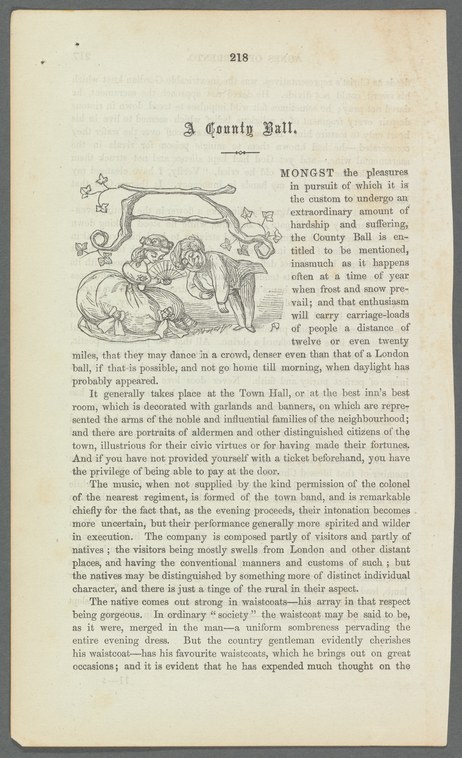
This is a wood-engraved illustration of an indoor ball at a town hall or assembly room, likely from the mid-19th century. The composition shows a crowded gathering of formally dressed figures arranged across a rectangular space. In the foreground, couples are actively dancing in closed embrace; their postures suggest the ballroom dances of the period—notably waltzes or quadrilles. The men wear dark coats and trousers; the women wear full-skirted gowns with the silhouettes and proportions typical of the 1840s–1850s. The room is depicted with architectural detail: a cornice runs along the ceiling, and the walls suggest an elegant public space. In the background, more figures stand or sit, watching the dancers or awaiting their turn. The lighting is even and naturalistic, achieved through the fine line-work characteristic of wood engraving. The overall mood is one of genteel social gathering—the occasion and decorum of a formal county ball rather than a wild or theatrical spectacle.
The dancing
The dancers in the foreground are shown in closed hold—the man's right hand at the woman's back, their left hands joined at shoulder height—the standard ballroom frame of the period. Their bodies are upright and formal, weight forward, with skirts rendered in full sweep around the women, suggesting active turning movement. The figures are arranged in pairs spaced across the floor, permitting the viewer to see distinct couples rather than a single mass. The postures of the watching figures vary: some stand with arms at rest, others gesture conversationally. The precision of the engraving allows the artist to show individual faces and the detail of dress—ribbons, pleats, and texture—which grounds the scene in observed social reality rather than stylized convention.
The dance depicted
This is a county ball, a formal social dance event typical of English provincial towns in the early-to-mid 19th century. The accompanying text (reproduced on the page) describes the custom in detail: such events took place at town halls or assembly rooms, drawing families of standing from the surrounding region, and often featured dancing that continued through the evening, with carriage-loads of guests departing at dawn. The dances themselves—quadrilles, cotillions, and waltzes—are not inscribed in the image but are legible in the closed holds and turning figures visible in the foreground. The scene documents not the dance technique itself but the social institution and conduct of dance as a marker of gentility and community.
How it was made
This is a wood engraving—a relief print made by cutting away the end-grain surface of a hardwood block to create a line-based image. The technique is visible in the regular parallel lines (hatching and cross-hatching) that create tone and shadow, and in the fine, precise linework that characterizes wood engraving at its height in the 19th century. The medium allowed for detailed illustration of social scenes and made such images affordable and reproducible for magazine and book illustration, which was the primary vehicle for this kind of work in the 1840s–1850s. The engraving's clarity and legibility would have suited reproduction in a periodical or bound narrative text.
About this work
This wood engraving documents the custom and conduct of the county ball, a formal social gathering that was a fixture of English provincial life in the early-to-mid 19th century. The work captures both the architecture of the occasion—the assembly room, the formal dress, the arrangement of couples in ballroom frame—and its social meaning: a sanctioned arena for the display of gentility, courtship, and community identity. It is one of a class of narrative illustrations that recorded the habits and ceremonies of English life during this period, and belongs in a gallery of dance art because the ball itself was the principal context in which respectable men and women encountered dance as a lived social practice.
How to look at it
Attend to the figures in the foreground and their hands and arms: the closed hold, the position of the man's guiding hand, the woman's posture and the sweep of her skirt. This hold—which we recognize as the waltz or quadrille frame—was itself a subject of social comment and moral scrutiny in the period, and the engraver's choice to render it clearly and without exaggeration is itself a statement about the respectability of the occasion. Notice too the faces and expressions of the watching figures: their composure and engagement reflect the seriousness with which the ball was regarded as a social ceremony, not a frivolous entertainment.
The period
The image dates from an era when the waltz and quadrille were the dominant ballroom dances among the English respectable classes. The mid-19th century saw the waltz establish itself as the signature dance of the ballroom, despite earlier moral objections to its close hold; by the 1840s–1850s it was fully respectable. The county ball itself was a well-established institution, particularly important in rural and provincial towns where it served as a primary venue for social and marriageable encounter among the gentry and professional classes. Wood engraving was at the height of its use for magazine and book illustration during this same period, making such scenes widely circulated and familiar to the literate public.
Where it lives
This engraving is held in the New York Public Library's Prints collection under the heading "Prints depicting dance." It is one of a substantial series of social and narrative engravings circulated in 19th-century English periodicals and books. The page number (218) visible at the top suggests it was originally part of a bound text, likely a serial or annual publication.
Dance in this work
Questions about this work
What dance were people doing at a county ball?
Primarily quadrilles and waltzes. The quadrille was an energetic four-couple formation dance; the waltz, a turning couples' dance, became increasingly common and respectable from the 1830s onward. Cotillions and occasional country dances also featured. The specific figures varied by region and occasion, but the ballroom frame shown here—closed hold, upright posture, turning motion—is consistent with waltz and quadrille technique of the period.
Why are all the dancers in formal dress?
The county ball was a formal social event, attended by families of standing in the county or provincial town. Formal dress—white gloves, dark coats, full-skirted gowns—was not only customary but mandatory; to attend in informal clothing would have been a breach of decorum. Dress was one of the visible markers of the event's status and of the participants' respectability.
What does the text tell us that the image doesn't show?
The accompanying text describes the logistical and social context: the event often lasted from evening until dawn, with guests traveling from across the region by carriage; it was a major occasion for courtship and social connection; the music was not always provided by a professional band, but sometimes by an amateur ensemble. It also notes that not all such balls were well-conducted affairs—the text hints at overcrowding and disorder as risks.
More dance artwork





