49 works in this view — arrow keys or swipe to move between them.
Dance in Art
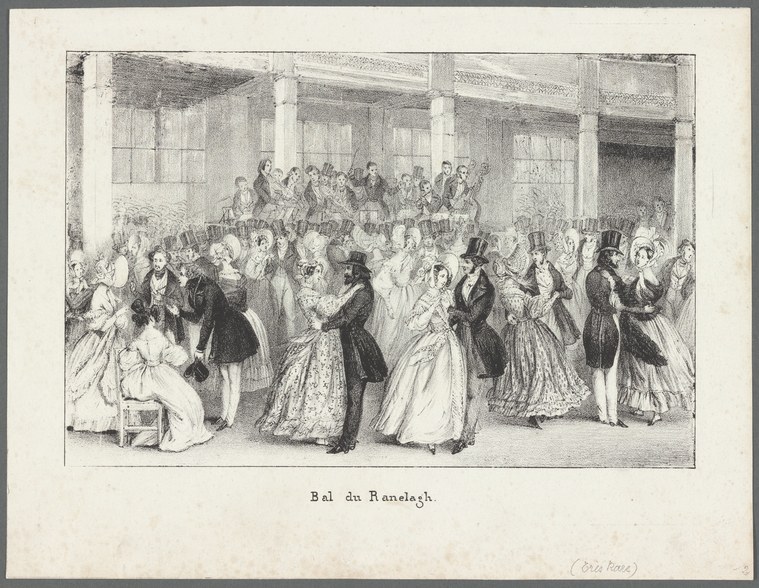
Bal du Ranelagh
Unknown artist
- Collection:
- Prints depicting dance
- Source:
- New York Public Library
- Rights:
- Public domain — free to use, share and adapt.
- Recorded as:
- Public Domain
This is visual evidence of the ballroom as a functioning social institution. It shows the actual spacing, dress, and conduct of ballroom dancing in the 18th century—not the idealized or codified versions seen in dance treatises, but how it appeared in the crowded, noisy reality of fashionable social life. For anyone studying the history of partnered social dance, the ballroom, or the culture of pleasure gardens, this is a primary source.
What you are looking at
A crowded indoor ball or reception in what appears to be an 18th-century aristocratic setting, with high ceilings supported by columns and large windows. The engraving captures a dense throng of well-dressed figures in formal attire—men in dark coats and breeches, women in full-skirted white or pale gowns typical of the period. At the center and left foreground, couples are engaged in dancing or conversation, while others stand in clusters throughout the space. The composition is dense and layered, with some figures elevated on a platform or stage at the rear, suggesting this is a formal dance event rather than an intimate gathering. The scene conveys the social chaos and energy of a fashionable public entertainment.
The dancing
The dancers visible in the foreground appear to be in closed-position ballroom holds, facing one another in a manner consistent with partnered social dancing of the era. The women's weight appears centered over their skirts, which fall in full columns from the waist. The men stand upright with arms extended to hold their partners. No pointe shoes or elevated rises are visible; the feet remain grounded. The composition shows multiple couples interspersed with standing onlookers, which was typical of the formal ball format where not everyone danced simultaneously.
The dance depicted
This depicts a formal ball (bal) in the 18th-century French aristocratic tradition. The Ranelagh was a public pleasure garden in Chelsea, London, famous in the 1740s-1770s for hosting masquerades and dances; this print likely documents one of those celebrated events. The dancing appears to be social courtly dance—quadrilles, cotillions, or minuets—the standard repertoire of the ballroom. The setting and dress indicate this was a venue where London's fashionable elite gathered to participate in or witness fashionable dancing, though the crowded nature suggests some viewers attended primarily to observe the scene rather than dance themselves.
How it was made
This is a black-and-white engraving or etching, established from the tonal marks, fine line work, and the distribution of light and shade characteristic of 18th-century printmaking. The technique allowed fine detail in costume and setting while the monochrome treatment emphasizes composition over color—appropriate for a work circulating among the educated classes as a record of contemporary social life. The size and finish suggest this was a commercial print, likely sold individually or in a series documenting fashionable society.
About this work
This engraving records a ball at Ranelagh Gardens, one of London's most celebrated public pleasure venues during the mid-18th century. The scene is dense with the formal social rituals of aristocratic dancing—couples in ballroom holds, standing onlookers in fashionable dress, the architectural grandeur of the venue itself. It documents not just the dance itself but the entire social spectacle of the ball: who attended, how they dressed, how the space was arranged, what the moment of dancing meant to fashionable society. The work sits at the intersection of social history, fashion history, and dance history, offering evidence of how ballroom dancing functioned as a primary mode of elite courtship and social display in the Georgian era.
How to look at it
Attend first to the density and heterogeneity of the crowd: this was not an orderly progression of couples but a crowded, vibrant social scene where dancing, conversation, and observation mingled. Note the full skirts and upright carriage of the women, the formal stance of the men, and the closed hold between partners—all markers of the restrained elegance of 18th-century ballroom technique. The platform at the rear may indicate a space for musicians or a vantage point, typical of ballroom design. The print captures a fleeting moment of fashionable life, not a posed tableau.
The period
Ranelagh Gardens opened in 1742 and became one of London's premier public entertainment venues alongside Vauxhall. By the 1750s-1760s, when this print was likely made, dancing at Ranelagh—particularly in the famous Rotunda—was a glamorous attraction. This coincides with the height of the cotillion and quadrille in fashionable society, before the waltz's emergence later in the century. The engraving reflects a moment when ballroom dancing was still primarily a pastime of the aristocracy and wealthy merchants, displayed in semi-public venues as a marker of status and fashion.
Where it lives
Held in the New York Public Library's prints collection documenting dance. It is catalogued as a historical dance print without attribution or precise dating, indicating it was part of a broader 18th-century corpus of prints recording fashionable society.
Dance in this work
Questions about this work
What was Ranelagh?
Ranelagh Gardens in Chelsea, London, was a public pleasure garden open from 1742 to 1803. It featured music, dancing, dining, and social spectacle in an elaborate architectural setting, particularly in its famous central Rotunda. Attendance was by subscription or ticket, making it a semi-public venue where the middle and upper classes could mingle and display their wealth and fashion. It was one of the two most celebrated pleasure gardens in Georgian London, alongside Vauxhall.
What dances are being performed here?
The formal holds and pairings visible suggest cotillions, quadrilles, or minuets—the standard ballroom dances of the 1750s-1770s. Without more specific visual cues (such as the distinctive figure of a minuet's posturing, or the linear formations of a cotillion), the engraving does not distinguish between them. All three were social dances requiring a male and female partner in close proximity.
Why are so many people just standing?
Not everyone who attended a ball danced. Attendance at fashionable venues like Ranelagh was as much about being seen, observing others, and participating in fashionable society as it was about dancing. The standing onlookers include chaperones, elderly guests, those between dances, and people who came primarily to observe the scene and display their own dress and status.
Is this a unique or rare print?
No. Multiple impressions of prints depicting Ranelagh survive in public collections. They were commercial products—affordable engravings sold to capture the public's appetite for images of fashionable life. This one is held by the NYPL as part of its broad dance prints collection.
More dance artwork





