49 works in this view — arrow keys or swipe to move between them.
Dance in Art
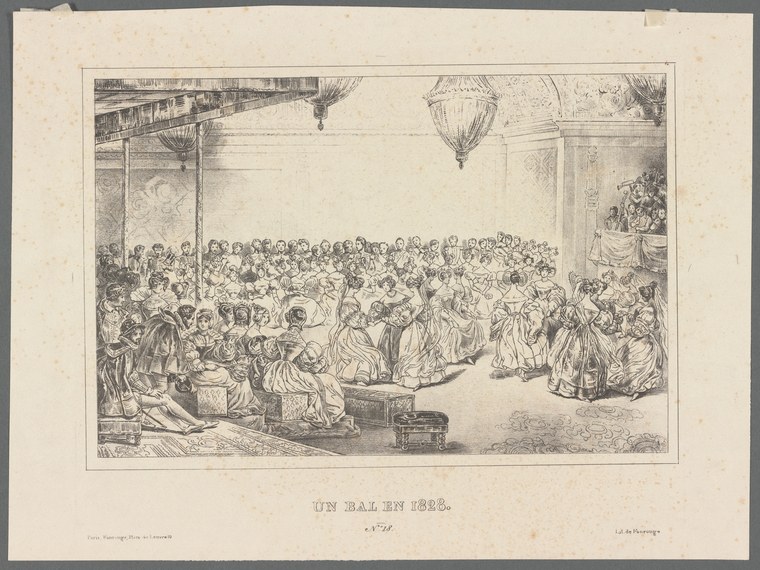
Un bal en 1828
Unknown artist
- Collection:
- Prints depicting dance
- Source:
- New York Public Library
- Rights:
- Public domain — free to use, share and adapt.
- Recorded as:
- Public Domain
For dancers and choreographers studying the ballroom tradition, this image is an irreplaceable record of how the quadrille was actually danced and staged: the posture, the spacing, the scale of the social occasion. For historians of the Regency and 1820s, it documents the centrality of dance to fashionable life and the visual conventions used to depict that life for a paying public. The sheer density of figures and architectural ambition also reveals the role of dance in constructing elite identity and social order.
What you are looking at
A grand ballroom filled with hundreds of figures in formal 1820s dress gathers to witness or participate in a ball. The composition is packed and dynamic: in the foreground, couples and groups occupy the floor in various states of movement and social arrangement. The architecture is palatial—columns support a coffered ceiling hung with large basket-form chandeliers—while a gallery above holds additional spectators. The light is even and theatrical, illuminating the full crowd without strong shadow. In the middle distance, figures cluster and intermingle; some appear to be dancing while others converse or wait. The women wear the characteristic high-waisted, ankle-length gowns of the Regency and early 1820s, many with short sleeves and elaborate skirts. The men wear tailcoats and breeches. The overall effect is one of fashionable leisure and social ceremony—this is not a street dance or folk gathering, but an elite, orchestrated event.
The dancing
The dancers visible in the foreground adopt the formal closed positions and upright frames of early-19th-century ballroom dance. Couples stand with arms at waist and shoulder height, maintaining the stiff, vertical carriage appropriate to the period. The spacing and grouping suggest a formal dance figure—possibly a quadrille or cotillion—in which sets of couples move in measured, geometric patterns. No pointe shoes or lifted extensions are visible; this is grounded social dance. The crowd is so dense that individual footwork cannot be assessed, but the overall posture and positioning is consistent with the structured, walking-based technique of the era.
The dance depicted
This is almost certainly a *quadrille* or *cotillion*—the fashionable set dances of the Regency and 1820s ballroom. The engraving depicts the social context in which such dances were performed: a formal assembly at which multiple sets of four couples would dance the same figure simultaneously, watched by an audience of non-participating guests. The title fixes the date to 1828, placing this squarely in the height of the quadrille's popularity across Europe. The scale and opulence of the setting—a great ballroom with orchestra and gallery—confirms this was elite social dance, not popular or theatrical.
How it was made
This is a fine engraving (possibly intaglio or stipple-work based on the fine tonal gradations and linear control visible in the drapery and architecture). The medium allowed for mass production of the image, suggesting it circulated widely among the ballroom-attending classes as a print for framing or for illustration in periodicals and annals of fashion. The engraver has used hatching and cross-hatching to create volume and texture—the fabrics, the architectural details, and the play of light on the crowd. The level of detail and the careful perspective suggest a skilled professional engraver working from a drawing or painting, not a casual sketch.
About this work
A monumental record of elite ballroom culture at its height, this engraving captures a moment of fashionable social dance in the late 1820s. The scene is one of orchestrated spectacle: hundreds of formally dressed guests in a palatial setting, dancing or witnessing the quadrille in all its geometric perfection. It preserves not just the aesthetic of the dance—the stiff frames, the closed holds, the formal spacing—but the entire social apparatus around it: the architecture, the hierarchy of dancers and spectators, the fashion, the formality of the occasion. This is dance as elite ritual, made visible and then reproduced for circulation among the wealthy. It belongs in any history of how dance was watched, performed, and presented in the 19th century.
How to look at it
Attend first to the architectural frame: the engraver has used the columns, ceiling, and gallery to compress hundreds of figures into a coherent space and to emphasize the formality and grandeur of the occasion. Then look at the dancers themselves—notice how even in a crowd of this density, the couples maintain upright posture and measured spacing. The artist has frozen a moment of motion (couples mid-step or mid-turn) that suggests the geometric precision of the quadrille without the blur of actual movement. Finally, observe the hierarchy: the performers on the floor, the spectators in the gallery and at the margins, and the orchestral musicians (if visible) all mark this as a spectacle designed to be watched and remembered.
The artist
The artist is not recorded in the catalogue. The print credits note only "Publ. Pinot-Clavaroche" and "Lith de Clavaroche," suggesting it may have been lithographed and published by or under the direction of a Clavaroche, likely in Paris. The level of execution indicates a professional engraver of the mid-19th century, possibly working after a drawing by a painter of fashionable scenes.
The period
The quadrille rose to prominence in Paris in the early 1800s and had become the defining dance of ballroom culture across Europe by the 1820s. It was a figure dance—danced by sets of four couples in a square formation—that allowed for social participation by large numbers of dancers and required no special training, unlike the ballet that was simultaneously developing on the theatrical stage. The 1820s saw the quadrille at its cultural zenith: it was danced at balls across Europe's elite, written about in etiquette manuals, and frequently depicted in popular prints. The Romantic era celebrated both the spectacle of the ballroom and the theatrical ballet, and prints like this one satisfied curiosity about fashionable life and served as a record of correct dress and deportment.
Where it lives
The work is held in the New York Public Library's collection of prints depicting dance. It is a printed reproduction (engraving or lithograph), likely part of a series of fashionable scenes or dance-themed prints circulating in the mid-19th century.
Dance in this work
Questions about this work
What dance are they doing?
A quadrille, the dominant ballroom dance of the 1820s. It was danced by four couples in a square, taking turns to lead different figures while the other sets watched and waited. The quadrille required no special training and was a staple of fashionable society across Europe.
Why are there so many people watching?
At a formal ball, not everyone danced at once. Multiple sets would dance the same figure in rotation, so while some couples performed, others watched from the margins or gallery. This gave non-dancers a chance to observe the fashion, the gossip, and the skill of their peers.
How do you know this is 1828?
The title of the engraving is *Un bal en 1828* ('A Ball in 1828'). The dress—women's high-waisted gowns, men's tailcoats—is consistent with the late Regency and early 1820s. The style of the interior and the decor also match the period.
Who is the artist?
The catalogue does not record the artist's name. The print credits mention Clavaroche as a publisher or lithographer, suggesting it may have been made in Paris in the mid-19th century, but the identity of the original designer remains uncertain.
More dance artwork





