49 works in this view — arrow keys or swipe to move between them.
Dance in Art
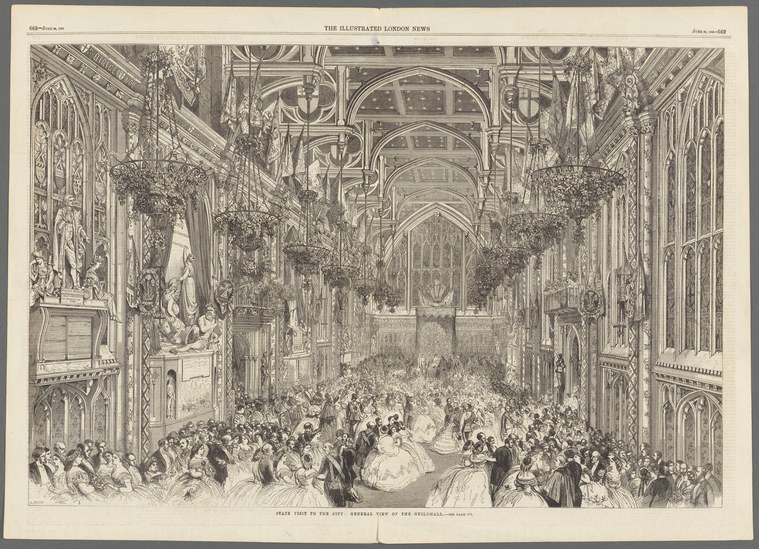
State visit to the City: general view of the Guildhall
Unknown artist
- Collection:
- Prints depicting dance
- Source:
- New York Public Library
- Rights:
- Public domain — free to use, share and adapt.
- Recorded as:
- Public Domain
It is one of the most precise visual records of an actual English civic ball in the 18th century, showing not just individual dancers but the entire social and spatial structure in which the dance was embedded—the spectatorial zones, the formal dress code, the architectural frame, and the mix of active dancers and waiting guests. For dancers and choreographers interested in the historical context and performance conditions of Regency-era ballroom forms, it provides irreplaceable evidence of scale, costume, grouping, and the integration of dance into civic ceremony.
What you are looking at
This is an engraved depiction of a grand ceremonial ball or state reception held in the Guildhall, shown from a vantage point deep within the nave looking toward the far end. The space is monumental: a Gothic interior with soaring ribbed vaults, pointed arches, and a coffered ceiling receding into perspective. Clustered garlands and floral swags hang from the columns and architectural features, festooning the entire length of the hall. The floor is crowded with hundreds of figures in formal 18th-century dress—women in wide-skirted gowns and men in coats and breeches—arranged in loose groups across the entire scene. In the center foreground, a few couples appear to be dancing or moving through a formal figure; the surrounding masses stand, converse, and observe. The lighting is even and engraved throughout, with no single source creating dramatic shadow. The artist has used fine cross-hatching to render texture and depth, making the stone architecture recede convincingly while the crowd fills the foreground with intricate detail. This is a public spectacle of considerable ceremony and scale, captured at the moment of its fullest animation.
The dancing
The dancers visible in the center employ an upright, formal posture typical of 18th-century ballroom convention. A pair in the immediate foreground moves with arms held in the composed frame characteristic of period courtly dance—no extravagant extension or reach, but a controlled vertical alignment of the body. The man's stance is square and grounded; the woman's skirt—rendered in white with fine linear hatching—dominates the volume around her lower body, suggesting the restricted stride and gliding weight-transfer the costume enforced. The surrounding figures stand mostly stationary, watching; those in motion appear to progress in lines or facing couples rather than rotating couples, suggesting the formation of a longways or quadrille-like structure. The density of the crowd and the print's vantage point make individual footwork impossible to discern, but the overall carriage and spacing confirm a formal, codified social dance rather than anything energetic or eccentric.
The dance depicted
This depicts a formal ball in the Regency or late 18th-century idiom, most likely a Quadrille, Cotillion, or English Country Dance performed at a state or civic occasion. The Guildhall's role as a ceremonial venue for civic entertainments, combined with the formal dress, the size and structure of the gathering, and the patterned movement visible in the center, all point to a set dance of the period requiring lines, formations, and symmetrical figures. The spectatorial arrangement—with many standing figures surrounding the active dancers—is consistent with the social protocol of such occasions, where not all guests danced simultaneously but instead took turns in successive sets. The artist has chosen to show the dance as the centrepiece of a much larger social display, emphasizing the grandeur of the occasion over the specifics of the choreography.
How it was made
This is an engraving, rendered in fine black line with cross-hatching to suggest tone, volume, and atmospheric depth. The technique allowed for precise architectural rendering and the repetition of numerous individual figures across a large composition—a labor-intensive but cost-effective method for producing multiple impressions for wide circulation. The vantage point and systematic recession into the distance are characteristic of 18th-century illustrative engraving, designed for publication in newspapers, journals, or commemorative prints documenting civic or royal events. The fineness of the line and the control of tonal gradation suggest skilled printmaking, likely by a professional shop, and point to this being a record of an actual or ceremonially significant occasion rather than a generic social scene.
About this work
This engraved view of the Guildhall ballroom documents a formal ceremonial gathering of the 18th century at the moment of its most animated phase: a structured social dance executed by a select group while hundreds of other guests stand, watch, and wait for their turn. It is not primarily a document of dance technique but of dance as spectacle and civic ceremony—the performance of social order and collective participation in a regulated, architectural setting. For the dance historian, it preserves the scale, dress, spatial arrangement, and formation of an era in which the ballroom dance was the central ritual of public life. The image belongs in a gallery of dance in art because it captures the moment in which dance was simultaneously performance, participation, and social theater.
How to look at it
Attend first to the architectural frame: the Guildhall's Gothic scale is meant to lend authority and grandeur to the event. Then trace the movement in the center—the pairs in formation, the direction of their progression, the spacing. Notice how the artist handles the crowd: not as a mass of undifferentiated bodies, but as distinct figures in conversation, observation, and anticipation. The composition privileges both the dancing itself and the social hierarchy of spectatorship; you are seeing not just a dance but a ceremony in which dance is a central act.
The period
The 18th century saw the codification and international dissemination of ballroom dances—particularly the Quadrille, Cotillion, and English Country Dance—as the central social practice of the educated and upper classes. Such dances were not spontaneous but carefully choreographed, often published in dance manuals, and performed in set formations in ballrooms like the Guildhall, which was the primary venue for London's grandest civic and state occasions. By the Regency period (1811–1820), the ballroom had become the space in which social hierarchy, gender relations, and national identity were ritually performed. Engravings of such events were commissioned to record and commemorate occasions of state importance, and their circulation in print form extended their cultural reach far beyond those present.
Where it lives
This print is held in the New York Public Library's collection of prints depicting dance. The catalogue records it as a state visit scene from the Guildhall, but provides no named artist, precise date, or publication information.
Dance in this work
Questions about this work
What dance is being performed here?
The formation and structure suggest a Quadrille, Cotillion, or formal English Country Dance of the 18th-century ballroom tradition. The artist has not rendered footwork or hand-holds precisely enough to identify a specific choreography, but the symmetrical grouping and linear formation are consistent with these set dances.
Who is dancing and who is watching?
In a formal ball of this period, guests typically rotated through 'sets' (groups of 2, 4, or 8 dancers), with each set performing the same dance in turn while others watched from the sides. This image captures one set in motion while the surrounding crowd waits.
Why are there so many people not dancing?
Spectating was part of the social protocol. Guests who were not currently dancing used the time to converse, observe rivals and allies, arrange courtships, and display their dress and manners. The Guildhall's scale allowed for a very large gathering.
How can you tell this is the 18th century?
The women's gowns (wide-skirted, high-waisted), men's coats and breeches, the hairstyles and hats, and the formal posture and spacing all confirm the period. The Guildhall itself has a documented history as a venue for such state occasions.
More dance artwork





