49 works in this view — arrow keys or swipe to move between them.
Dance in Art
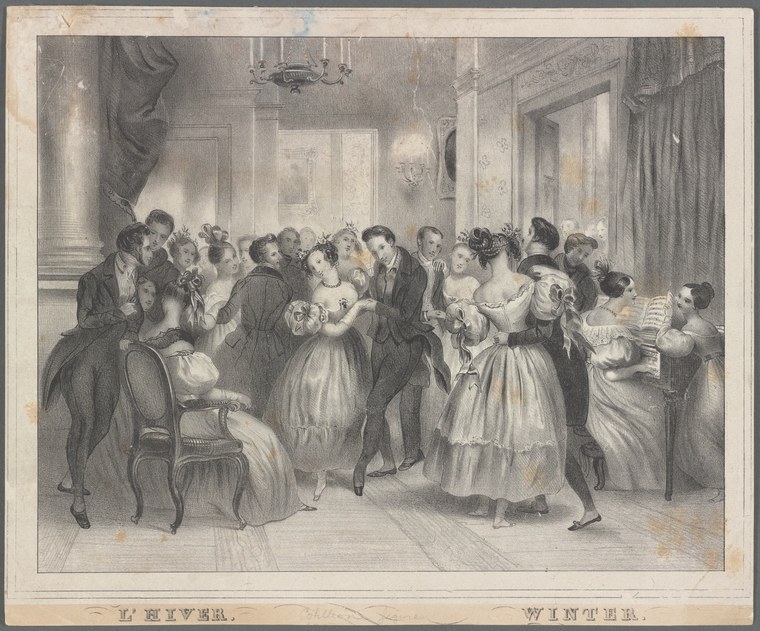
L'hiver
Unknown artist
- Collection:
- Prints depicting dance
- Source:
- New York Public Library
- Rights:
- Public domain — free to use, share and adapt.
- Recorded as:
- Public Domain
This engraving is primary visual evidence of how waltz and quadrille were actually danced and staged in the 19th century, and of how dance functioned as a social ritual and marker of class status. For dance historians and performers, it documents not just posture and hold but the relationship between dancers, musicians, and observers that constituted the ballroom as a social institution.
What you are looking at
A crowded indoor social gathering in an elegant neoclassical interior, the composition divided between observers and dancers. The setting features tall columns, high ceilings with a chandelier, and formal drapery suggesting a ballroom or reception room. On the left, seated figures in dark coats watch the proceedings; on the right, couples dance while musicians (visible at far right with what appears to be a violin) provide accompaniment. The dancers occupy the center and right portions of the space, moving in the formal configurations characteristic of 19th-century ballroom society. The contrast between the static, observant crowd and the graceful movement of the dancers creates a narrative of social performance—the moment when the ball reaches its lively peak. The engraving's title, printed at the base as 'L'HIVER' (Winter), suggests this depicts a winter social season entertainment, likely French or Continental European given the style and language.
The dancing
The dancers are arranged in coupled pairs performing what appears to be a waltz or quadrille. Several couples are visible in motion: the nearest dancers show the characteristic closed-position frame of 19th-century ballroom dance, with partners facing one another in upright posture. The women wear full skirts that splay outward from the turn, creating the visual drama of rotation; the men are in formal tailcoats with the stiff, erect carriage expected of the period. Arms are raised and extended in the formal frame of European court dance. The standing spectators form a loose crowd that frames the dancers, their still bodies and angled attention emphasizing the kinetic energy of those in movement.
The dance depicted
This depicts a ball or formal dance assembly of the mid-to-late 19th century, most likely a waltz or quadrille given the period dress, the closed couples, and the social context. The waltz was the dominant fashionable dance in European ballrooms from the early 1800s onward, and the formal evening wear, the tall columns, and the presence of live musicians all align with the Romantic era ballroom tradition. The image records not just the step but the social ritual—the mingling of dancers and observers, the orchestra's presence, the segregation of gender roles in partnership and dress. No specific stylistic evidence allows us to distinguish between waltz and quadrille with certainty; both were common, though the apparent rotation visible in several figures leans slightly toward waltz.
How it was made
This is an engraving, most likely a steel engraving or wood engraving given the fine line work, high tonal range, and decorative quality typical of mid-19th-century print production. The technique allowed for mass reproduction and distribution, making such images accessible to the middle-class public as both documentary record and aspirational imagery of fashionable society. The delicate parallel line hatching builds form and shadow while preserving clarity of detail—the folds of fabric, the architecture, the individual figures. The printing and distribution by NYPL as a 'Print depicting dance' suggests this was part of the commercial circulation of ballroom imagery, which served both as fashion documentation and as visual instruction or fantasy for a non-elite audience.
About this work
L'Hiver documents a moment in the 19th-century European ballroom—a formal winter social gathering rendered with the precision and aspirational tone characteristic of period engravings. It records the aesthetic and social conventions of Romantic-era dance: the formal dress codes, the coupled partnership, the live music, the architecture of the ballroom as theater, and the mingling of active dancers with an observant public. The work sits at the intersection of social history, fashion documentation, and dance practice, capturing both the steps and the social meaning of formal dance in an era when the waltz was transforming European society.
How to look at it
Attend first to the contrast between stillness and motion: the seated observers form a static frame that makes the dancers' movement legible. Look at the women's skirts—the way they project outward in the turn gives visual evidence of the rotational speed and dynamism of the waltz. Notice the upright, stiff carriage of both partners: the formality of the frame, not relaxation or ease, was the ideal. The positioning of the orchestra at the right margin anchors the image in the social reality of live music—the dancers do not float but are tethered to the tempo set by instruments we can barely see.
The artist
The artist is not recorded in the catalogue. The engraving's style and the NYPL attribution to a series of 'Prints depicting dance' suggest it was produced as commercial print work for a European market, likely French given the French title and the neoclassical architectural idiom. The precision and narrative completeness suggest a professional print-making workshop rather than an amateur or fine-art context.
The period
The 19th century saw the waltz's triumph as the dominant European social dance, a shift that scandalized conservative observers and fascinated the public. By the 1830s–1860s, the waltz and quadrille were the obligatory dances of fashionable society, and illustrated prints like this one circulated widely as both documentary records and as aspirational images for readers who might not attend such balls. The engraving's formal architectural setting and the prominence given to costume and decorum reflect the era's investment in dance as a marker of civilization and refinement.
Where it lives
The work is held in the NYPL's Prints depicting dance collection, a specialized series that documents dance imagery across media and periods. This attribution indicates the work was catalogued for its dance content rather than its artistic or technical merit, and suggests it was acquired as part of a thematic rather than monographic collecting practice.
Dance in this work
Questions about this work
What dance are they doing?
Most likely a waltz or quadrille, the two dominant ballroom dances of the 19th century. The closed couples and the rotational energy visible in the women's skirts suggest waltz, though the image alone cannot rule out quadrille, which was also performed in couples and often waltz-like in motion.
Why is it called L'Hiver?
Winter was the height of the social season in 19th-century European cities. Formal balls and assemblies were quintessentially winter entertainments, so the title signals both the season and the social prestige of the event.
How do I know this is an engraving?
The fine parallel lines (hatching) that build tone and shadow, the uniformity of the printed line, and the high clarity of detail across the composition are all characteristic of engraving. The monochromatic rendering and the paper support also indicate print rather than painting.
Who are all the people standing around?
They are observers and attendees waiting their turn to dance, conversing, or watching the entertainment. The ball was a social event as much as a dance event; not everyone was dancing at every moment, and the mingling of dancers and observers was part of the ritual.
More dance artwork





