49 works in this view — arrow keys or swipe to move between them.
Dance in Art
The Duc de Joyeuse's ball
Unknown artist
- Collection:
- Prints depicting dance
- Source:
- New York Public Library
- Rights:
- Public domain — free to use, share and adapt.
- Recorded as:
- Public Domain
This is a primary visual document of Renaissance court dance as it was actually performed and witnessed—showing costume, architecture, spatial arrangement, and social hierarchy that are invisible in written sources. It demonstrates that court dancing was a formal, rule-bound, hierarchical activity, not the free-form social dancing of later periods. For historians of dance, costume, and court culture, it is an essential record of how the body, dress, and power intersected in Renaissance courtly life.
What you are looking at
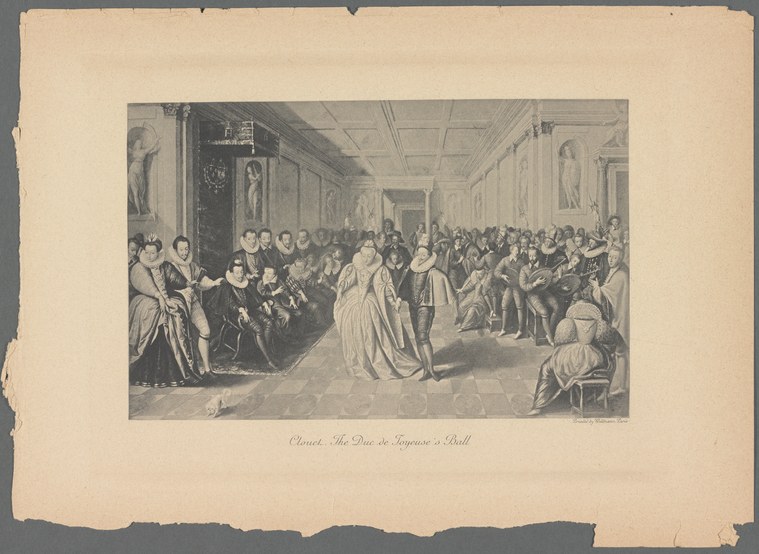
A formal court ball in a grand interior, depicted in a historical engraving. The scene shows a crowded assembly of elegantly dressed figures in Renaissance or early modern court dress—the men in doublets and hose, the women in elaborate gowns with full skirts and high necklines. The architectural setting features a coffered ceiling, classical columns, and wall panels with standing figures or statues. The composition is deep and crowded: in the foreground, several couples are arranged in formation on the polished floor; further back, the space fills with standing courtiers arranged in loose groups along the walls and in the middle distance. The lighting is even and formal, typical of period engraving technique. The overall impression is of a formal, ritualised gathering rather than spontaneous social dancing—the figures are posed and arranged with ceremonial precision.
The dancing
The dancers in the foreground stand in upright, formal postures with composed bearing. The nearest figures show men and women in separate or lightly connected positions, standing rather than in dynamic motion; the hold, where present, appears loose and respectful. The women's full, heavy skirts dominate the silhouette and would severely restrict leg movement. The general deportment is dignified and controlled, with little evidence of the dynamic weight transfer or extended frame that characterises later ballroom styles. The crowd composition suggests hierarchy and formality: elite figures occupy the foreground and are rendered with greater detail, while the background is filled with smaller, more uniformly posed attendants.
The dance depicted
This depicts a formal court ball of the Renaissance or early modern period, most likely a French royal occasion given the title reference to the Duc de Joyeuse. The dance shown is likely a processional or stately court dance such as a pavane or basse danse—forms that prioritised dignity, measured steps, and social order over virtuosic movement. The women's massive skirts and the upright carriage of all figures are consistent with Renaissance dance practice, which valued restrained elegance. The arrangement in lines and the formal spacing suggest a group or set dance rather than freestyle social dancing. No footwork or dynamic movement is legible in the engraving; the emphasis is on the formal assembly itself as a display of court power and ritual.
How it was made
This is an engraving on paper, executed in the linear, tonal style typical of 16th or 17th-century reproductive prints. The technique employs parallel lines and crosshatching to build tone and volume, allowing fine detail in costume and architecture while maintaining the overall formal clarity characteristic of the medium. Engravings of this type were made for circulation among the educated elite and were often bound into books or sold as individual sheets; they served as records of important state occasions and as models of courtly behaviour. The high finish and careful composition indicate this was a significant commemorative print, not a casual sketch.
About this work
This engraving documents a formal court ball, most likely the famous ball given by the Duc de Joyeuse in the French royal court. It is a record of Renaissance court dance as spectacle and ritual—showing not the technical details of individual steps but the social order and ceremonial function of the ball as an instrument of courtly display. The work sits at the intersection of dance history, court portraiture, and political imagery: it records how Renaissance elites danced, how they dressed, and how they organised themselves in formal space.
For dancers and historians, the image is valuable precisely because it captures the formal and social dimensions of Renaissance court dancing that written descriptions alone cannot convey. The massive skirts, the upright carriage, the measured spacing, and the hierarchy of the arrangement all testify to a dance culture fundamentally different from later ballroom practice—one in which movement was constrained by costume, space was organised by rank, and the dance itself was a form of ordered display rather than personal expression.
How to look at it
Observe the formal arrangement of the figures: the way they are distributed in lines and groups, the distance maintained between them, the upright posture of all the dancers. Note the dominance of the women's full skirts in the composition—these enormous garments would have required the dancers to move slowly and deliberately, with steps rather than leaps. Look at the architectural setting and how it frames and contains the dancers: the columns, the ceiling, the wall panels all create a formal, ordered space. The print captures a moment of stillness or measured movement within the ball—not a climactic leap or turn, but the composed, ritualistic stepping and procession that characterised Renaissance court dance.
The period
This engraving dates to the Renaissance or early modern period (likely 16th or early 17th century). Court dancing of this era was dominated by processional and stately forms—the pavane, basse danse, and galliard—which were codified in dance manuals and taught by professional masters. The ball was a central institution of court life and served multiple functions: social, political, and ceremonial. Engravings and descriptions of court balls were published as records of royal power and as models of courtly behaviour for a literate audience. The formal, hierarchical arrangement of figures in this print reflects the real social order of the court, where proximity to the monarch and one's position in the dance were marks of status.
Where it lives
This engraving is held in the New York Public Library's collection of prints depicting dance. The collection includes documentary and commemorative engravings of court occasions, theatrical performances, and social dances from the 16th century onwards, and serves as a visual record of how dance was practised, represented, and valued across several centuries.
Dance in this work
Questions about this work
What is the Duc de Joyeuse's ball?
The Duc de Joyeuse was a prominent French courtier at the court of Henry III in the late 16th century. A famous ball held in his honour became a celebrated occasion in court history and was commemorated in prints, descriptions, and literary references. This engraving appears to document that or a similar high-status court ball.
Why are the women's skirts so enormous?
The massive skirts were a defining feature of Renaissance fashion, achieved using structured underpinnings such as farthingales (hooped petticoats). These skirts were expensive, required space to move in, and visually dominated the wearer's body—they were signs of wealth, status, and courtly fashion. They also severely restricted the dancer's leg movement, requiring slow, measured steps.
What dances would have been performed at this ball?
Renaissance court balls typically featured pavanes (slow, stately processional dances), basse danses (low dances with gliding steps), and galliards (more lively jumping dances performed by skilled dancers). These were often performed in sequence, and the order and choice of dances reflected social order and the occasion's formality.
How do we know this is an engraving and not a painting?
The linear technique, the parallel lines and crosshatching used to build tone, the even tonal values, and the paper support are all characteristic of period engraving. Engravings were made by incising an image into a metal plate (usually copper) with a burin, then inking and printing. This technique produced the fine, even lines visible here.
More dance artwork





