49 works in this view — arrow keys or swipe to move between them.
Dance in Art
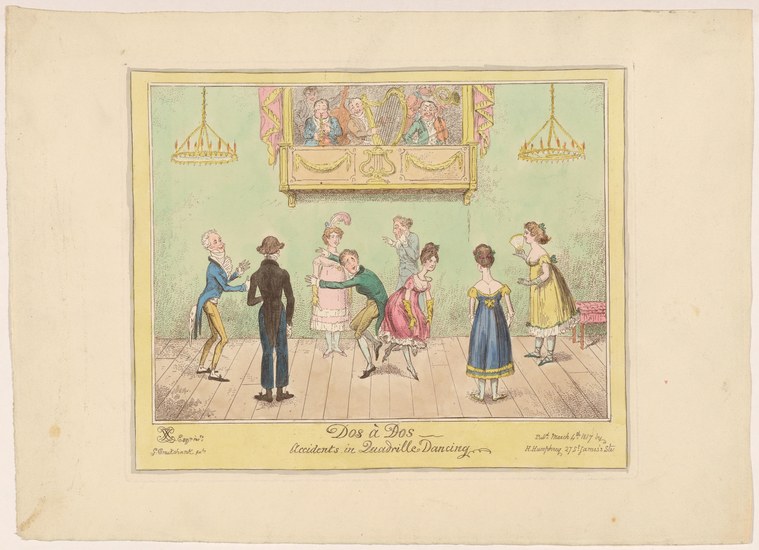
Dos à dos - accidents in quadrille dancing.
Unknown artist
- Collection:
- Prints depicting dance
- Source:
- New York Public Library
- Rights:
- Public domain — free to use, share and adapt.
- Recorded as:
- Public Domain
This print is evidence of how the early 19th-century ballroom was a site of comedy and anxiety, not merely sedate order. It shows that quadrille etiquette was demanding enough that failure was visible and memorable — worth capturing and circulating in print form. For dance historians, the image preserves a rare moment of bodily breakdown in formal dance, revealing what instructors feared and what actually happened when dancers lost control.
What you are looking at
A hand-colored engraving depicts a comic mishap during a quadrille in a ballroom. Eight figures occupy a wooden-floored room beneath hanging chandeliers and an ornate gallery where musicians or observers watch from above. The dancers wear early 19th-century dress: the women in high-waisted gowns of pink, yellow, and blue with long sleeves; the men in dark coats and breeches. The central action captures the moment of a "dos à dos" — a figure in which partners turn back-to-back — but the execution has gone awry. A woman in the center leans sharply backward into an exaggerated arch, her spine nearly horizontal, while a man in dark clothing steadies or propels her from behind. Around them, other dancers maintain their positions: some stand ready to resume, others gesture with apparent alarm or amusement. The composition is crowded and theatrical, with gestures amplified for comic effect. The print's caption identifies this as an accident occurring during the quadrille dance.
The dancing
The central couple dominates the composition through extreme posture: the woman's torso is bent backward at an alarming angle, her arms extended, weight entirely dependent on the man's support. This is not the controlled back-to-back turn that quadrille etiquette required, but a loss of control rendered visually comic. The surrounding dancers stand in upright positions typical of quadrille formation — facing one another or arranged in a set — their hands gesturing expressively toward the accident. The framing suggests a moment of disruption in an otherwise orderly sequence; bodies are tensed, not flowing through movement.
The dance depicted
This is unambiguously a quadrille, the dominant social dance of the early 19th-century European ballroom. The title explicitly names the "dos à dos" — a fundamental figure in which dancers of the same gender or couples turn back-to-back while maintaining upright posture. The print satirizes the difficulty of executing this move correctly, especially for an unskilled dancer, by freezing the moment at which control fails and the woman's back arches beyond propriety. The quadrille was danced in sets of four couples, and the formal arrangement visible here matches that structure. The comic intent suggests this is a print made for social circulation, perhaps to gently mock ballroom mishaps or to instruct through humor.
How it was made
This is a hand-colored engraving, a print technique that allowed multiple copies to be produced and distributed widely. The engraver has used fine parallel lines and cross-hatching to define form, particularly visible in the floor planking, the clothing folds, and the architectural details. Hand-coloring was applied afterward, unevenly in places, giving the figures their distinct gown colors and the room its pale greenish tone. The technique was ideal for social satire and instructional prints: cheap enough to circulate among the middle classes, detailed enough to convey narrative, and reproducible. The style and execution suggest a European print shop, likely French or German given the context of quadrille dance.
About this work
This is a satirical engraving of an accident during a quadrille, the most fashionable social dance of the Regency and post-Regency era. It captures the moment at which the "dos à dos" — a standard ballroom figure requiring both partners to turn back-to-back while upright — fails catastrophically when a woman loses her balance and arches backward, supported only by her partner's grip. The print belongs to a genre of social comedy aimed at ballroom society: it mocks the difficulty of executing correct form and the physical perils of fashionable dancing. Quadrilles were taught, written about, and illustrated extensively in this period, and satirical prints like this one reveal how seriously people took ballroom propriety while acknowledging how easily it could be violated. The image documents not only the dance itself but the social anxiety around bodily control and public embarrassment in the ballroom.
How to look at it
Attend first to the central figure's extreme posture: the woman's arched back is the image's visual pivot and the source of its comedy. The engraver has frozen the moment at maximum disruption, where balance is clearly lost but disaster not yet complete. The surrounding dancers' gestures — their raised hands, their fixed attention — frame this central body as the spectacle. Notice too the setting: the ballroom is orderly and respectable, with chandeliers and a gallery, making the loss of control all the more striking. The print's humor depends on recognizing that this is not how the figure was supposed to proceed.
The artist
The artist is not recorded in the catalogue. The style and subject suggest a European print workshop of the early 19th century, likely French or German, producing satirical and social commentary engravings for a middle-class market. The hand-coloring, composition, and caption inscription are consistent with prints made for popular consumption rather than fine-art collectors.
The period
The quadrille emerged in France in the late 18th century and became the dominant social dance across Europe by the 1810s and 1820s. It required formal instruction, published guides, and careful choreography of figures — making it a dance of aspiration for the growing middle class. Satirical prints and caricatures of ballroom life flourished in the same period, particularly in England and France, documenting both the allure and the perils of fashionable society. The "dos à dos" was a standard figure taught in all quadrille manuals, making its failure a recognizable and laugh-worthy subject for any reader familiar with ballroom dancing.
Where it lives
This engraving is held in the New York Public Library's collection of prints depicting dance. It is a hand-colored engraving, likely printed in the early 19th century and hand-colored afterward, consistent with the production methods of European satirical print shops.
Dance in this work
Questions about this work
What is a dos à dos?
A dos à dos is a quadrille figure in which two dancers or two couples turn back-to-back while maintaining an upright posture. Both dancers or couples rotate around a central axis, pass each other closely without touching, and end facing the opposite direction. It required balance, coordination, and precise timing. This print shows what happened when someone got it wrong.
Why would this be funny to people watching?
Quadrille dancing was a serious business requiring instruction and correct form. A loss of balance that bent the woman's back to such an extreme angle violated every rule of ballroom propriety and physical control. The accident was both frightening and ridiculous, especially in a formal social setting where composure mattered. Satirical prints capitalized on this anxiety by showing what people feared might happen.
Is this engraving signed or dated?
The print carries a caption in text identifying it as depicting the dos à dos and accidents in quadrille dancing, but the artist's name and the date of publication are not recorded in the catalogue, and are not clearly legible in the visible inscription.
What does hand-coloring tell us about this print?
Hand-coloring indicates this was a mass-produced engraving (the black-and-white print was made from a copper plate and printed multiple times) to which color was added by hand afterward, often by workers paid per print. This made it affordable and popular with middle-class buyers. The uneven application of color visible here is typical of the process.
More dance artwork





