49 works in this view — arrow keys or swipe to move between them.
Dance in Art
Foyer de la danse
Unknown artist
- Collection:
- Prints depicting dance
- Source:
- New York Public Library
- Rights:
- Public domain — free to use, share and adapt.
- Recorded as:
- Public Domain
The image documents the social world of ballroom dance at a moment when it was the principal leisure activity of the European and American gentry and middle classes. It shows us what ballroom dancers wore, how they held themselves in formal space, and how the architectural setting reinforced the formality and importance of the event. For historians of dance, fashion, and manners, the work is a primary source on the codes and contexts of Victorian social dancing.
What you are looking at
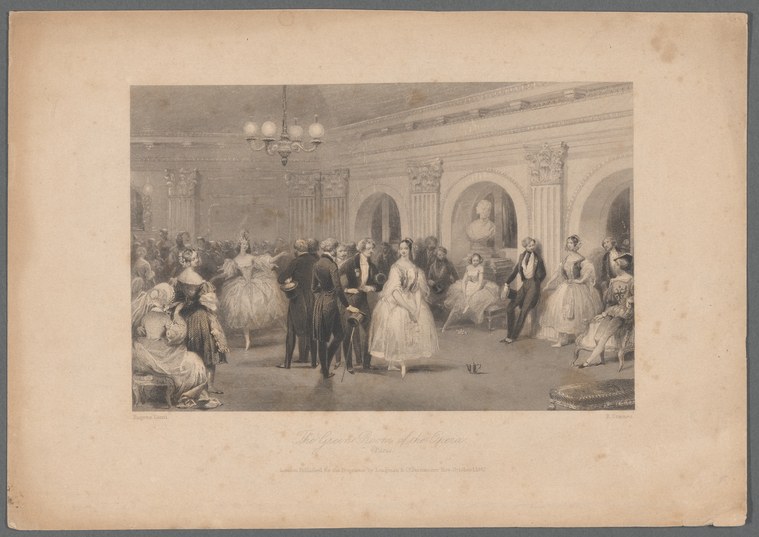
A grand foyer or ballroom filled with fashionably dressed figures in what appears to be the mid-19th century. The space is defined by monumental Corinthian columns and arched doorways, with a chandelier suspended from a coffered ceiling. The composition is crowded but ordered, with women in full-skirted white and pale gowns dominating the foreground and center, while men in dark coats and tails are distributed throughout. Some figures are standing in informal clusters, others appear to be moving or about to move into formation. The lighting is even and formal, befitting an official event. The print captures the moment of gathering rather than active dancing—a scene of anticipation or interval, with the architectural grandeur framing the human figures as a secondary element.
The dancing
The women's bodies are upright and composed, their voluminous skirts occupying considerable visual space; several display the characteristic posture of mid-century formal dress, with shoulders back and arms held at the sides or gesturing gracefully. The men stand in rigid posture, many with hands at their sides or clasped before them. There is no visible closed-hold partnering or active footwork; instead, the figures are arranged in a social formation typical of a reception or promenade rather than in the middle of a dance phrase. The spacing between bodies suggests movement is about to occur, or has paused.
The dance depicted
This is a social dance scene, almost certainly a ball set in the 1840s–1860s based on dress and architectural style. The title *Foyer de la danse* (Dance Foyer) indicates this is the entrance hall or gathering space where dancers assembled and prepared, rather than the ballroom proper. The image documents the social ritual and formality of ballroom culture—the waiting, the dressing, the positioning—rather than the execution of a specific dance step. The genre is almost certainly ballroom dance (likely quadrilles, cotillions, or waltzes of the Regency/Victorian period), but the work captures the social choreography of arrival and arrangement rather than the technical choreography of the dance itself.
How it was made
This is a steel or copper engraving, identifiable by the fine hatching lines used to model form and shadow, the precise linear detail, and the even tone characteristic of the intaglio process. The technique allowed for wide circulation as prints in the mid-19th century, and the quality of execution suggests this was a professional, possibly published work aimed at an educated middle-class audience interested in fashionable society scenes. Engravings of this type were often bound into albums or periodicals documenting contemporary manners and leisure.
About this work
This engraving documents a moment of social formality in the ballroom culture of the mid-19th century. Rather than depicting active dance, it captures the foyer or gathering space where dancers assembled before entering the ballroom—a scene of waiting, dressing, and social positioning. The image is valuable as a historical record of ballroom etiquette, dress, and the architectural settings in which formal dance took place. The work belongs in a dance gallery not because it shows technique, but because it shows the social context, costume, and ceremonial framing that made ballroom dance central to genteel society. The architectural grandeur and the careful arrangement of figures emphasize that this was not casual movement but a highly formalized social ritual.
How to look at it
Attend to the arrangement of the figures: notice how the women's skirts dominate the composition, and how their pale gowns draw the eye. Observe the posture and spacing—this is not a moment of movement but of waiting and arrangement. The architectural framing is crucial: the columns and arches impose order and grandeur on the human figures, suggesting that ballroom dance was understood as a formal, almost ceremonial activity. The print technique creates fine gradations of tone that suggest the three-dimensionality of the space and the texture of fabric. The lack of narrative action is the point—the image is about the social ritual and display rather than the dance itself.
The period
This work dates to the era of Romantic and Victorian ballroom culture, when the waltz, quadrille, and cotillion were the dominant social dances. The architectural style—neoclassical columns and arches—reflects the taste of the 1840s–1860s, when ballrooms in Europe and America were designed as temples to genteel leisure. This was the period when dance instruction was a central part of education for young people of means, and when the ballroom was a primary site of courtship and social display. The mid-19th century also saw the rise of illustrated journalism and print culture documenting fashionable society, which made scenes like this marketable to an aspirational audience.
Where it lives
The work is held in the New York Public Library's Prints collection, a repository of visual documents on social history and culture. The catalogue identifies it as a historical print depicting dance, likely from a series or periodical on fashionable society.
Dance in this work
Questions about this work
Why is this called a 'foyer' and not a ballroom scene?
The foyer (French for entrance hall or vestibule) was the space where dancers gathered, greeted one another, and waited before entering the ballroom proper. The architectural style—entrance arches and an entrance foyer rather than an open ballroom floor—suggests this is the gathering space rather than the dancing space. The image documents the social choreography of arrival and assembly.
What dances would have been performed in a ballroom of this period?
In the 1840s–1860s, the dominant ballroom dances were the waltz (a couple dance), the quadrille and cotillion (group dances), and various other figures and contredanses. The print does not show these dances in action, but the formal dress and setting suggest that all of these would have been performed in such a space.
How does dress indicate the date and social context?
The women wear full-skirted gowns with tight bodices and bare or short sleeves—the silhouette of the 1840s–1860s. The men wear dark coats and tails, the standard dress for formal evening events. This was the costume of ballroom dancing for the upper and professional middle classes. The formality and uniformity of dress emphasize that ballroom dance was a highly codified social ritual.
What was the function of the foyer in ballroom culture?
The foyer was a social space where dancers arrived, removed wraps, greeted acquaintances, and prepared themselves. It was a space of display and anticipation—a moment to be seen before entering the ballroom proper. In some cases, informal dancing or promenading might occur in the foyer before the formal ball began.
More dance artwork





