49 works in this view — arrow keys or swipe to move between them.
Dance in Art
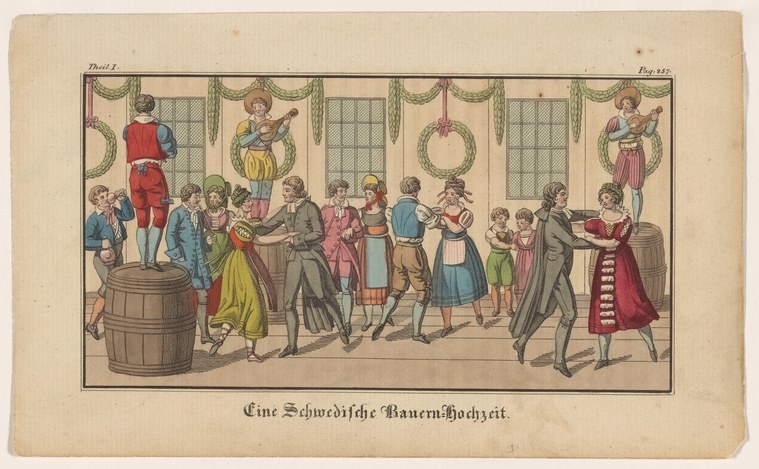
Eine Schwedische Bauern-Hochzeit
Unknown artist
- Collection:
- Prints depicting dance
- Source:
- New York Public Library
- Rights:
- Public domain — free to use, share and adapt.
- Recorded as:
- Public Domain
This engraving is one of the few surviving visual documents of early modern Northern European peasant wedding dance, showing how couples danced socially in community settings rather than in the formal styles recorded in court dance manuals. For historians of folk dance and for dancers interested in regional traditions beyond the better-documented Mediterranean and court contexts, this image provides rare concrete evidence of posture, partnership, dress, and the role of dance in ritual celebration.
What you are looking at
A Swedish peasant wedding celebration unfolds in an interior hall decorated with swags of greenery hanging from the ceiling. The scene is crowded and lively, with figures scattered throughout in clusters of social interaction. At left, a man in red stands elevated on or near a large wooden barrel, presiding over the gathering; below him, children and adults cluster in conversation. The center of the composition is occupied by dancing couples and bystanders: a woman in yellow skirts dances with a man in brown, while nearby other couples stand in pairs, some appearing to clasp hands or prepare to dance. At right, more couples stand together, one woman notably in deep red with ornate trim. The figures are dressed in early modern peasant costume—women in long skirts of yellow, blue, red, and green with white aprons and headdresses; men in hose, doublets, and caps. The mood is festive and informal, with multiple simultaneous conversations and interactions occurring. The setting reads as a communal space, possibly a barn or hall, defined by the architectural framework of windows visible in the background and the decorative garlands overhead.
The dancing
The dancers are shown in a relatively open, social configuration rather than in a tight ballroom hold. Couples stand at conversational distance or with loose hand-holds appropriate to a folk celebration. The woman in yellow at center appears to be stepping or moving in relation to her partner, though the engraving's conventions make fine footwork difficult to discern. Bodies are upright and relaxed rather than formally postured. The composition includes many non-dancing figures—standing, talking, watching—which emphasizes this as a social gathering where dance is one activity among several rather than a formal performance.
The dance depicted
This depicts a Swedish peasant wedding dance (Bauernhochzeit), a folk social dance of the early modern period. The title itself identifies the tradition. The loose hand-holds, upright posture, and the mixing of dancers with onlookers all accord with early modern Northern European folk dance practice, where couples danced within a community context rather than as formal performers. The scale and informality suggest a participatory celebration open to multiple simultaneous partnerships and conversations. The specific Swedish identification in the title suggests this records or stylizes a regional folk tradition, though without a dated signature the engraving cannot be pinned to a particular decade or region within Sweden.
How it was made
This is a hand-colored engraving, as evidenced by the fine line work defining figures and architecture, the hatching technique used for shading, and the distinct colored washes applied to clothing and decorative elements. The printing method allowed wide circulation as a print, likely produced for a German-speaking market given the German title and label. The coloring appears to have been applied by hand after printing, a common practice for popular prints of this era. Engravings of this type—showing regional or ethnic costume and custom—were popular in sixteenth- and seventeenth-century Europe as documents of difference and as curiosities for collectors interested in the customs of other lands.
About this work
This is a hand-colored engraving titled *Eine Schwedische Bauern-Hochzeit* (A Swedish Peasant Wedding), depicting a folk celebration that combines social dancing, courtship, and community gathering. The work documents an early modern Northern European folk tradition through the formal technique of engraving, capturing a moment of collective celebration where dance functions as one thread in a larger social fabric. It belongs in a dance gallery both as a record of peasant wedding customs and as evidence of how elite printmakers of the German-speaking lands understood and represented the dance practices of other regions and classes.
The work offers insight into early modern folk dance as a social rather than theatrical practice. Unlike formal court dances documented in dancing masters' manuals, this scene shows dance embedded in festivity, conversation, and communal ritual. The absence of a named artist or precise date is typical for popular prints of this kind, which were often produced by workshops and circulated widely, suggesting this image had a market among people interested in documenting the customs—and perhaps the picturesque otherness—of Nordic peoples.
How to look at it
Observe the distribution of figures across the composition: dancers and non-dancers are intermixed, suggesting this is a participatory event rather than a performance for an audience. Note the woman in yellow at center, whose posture and position relative to her partner define the primary dancing moment—this is likely the compositional focus. Compare her clothing and the men's hose and doublets to the architectural frame and hanging greenery, which ground the scene in a specific time and place. The engraving technique allows fine detail in costume and facial expression, inviting close looking at how individuals are characterized—their age, status, and role in the celebration. The hand-coloring, applied after printing, may vary between impressions, so the palette you see here is one of potentially many versions.
The period
This engraving was made in an era when printmakers and print publishers in German-speaking territories were producing a growing body of images documenting the costumes and customs of neighboring peoples and regions. Such *Trachtenstiche* (costume prints) and ethnographic images reflected both antiquarian curiosity and an emerging sense of regional and national difference. The sixteenth and seventeenth centuries saw an expansion of printed imagery of dance, from formal court dance manuals and courtship allegories to scenes of peasant celebration that positioned folk customs as both amusing and authentic. Swedish culture in particular held a certain fascination for German publishers as a Nordic alternative to Mediterranean or Italianate court sophistication.
The wedding itself as a folk ritual was a standard subject in Northern European art and prints. Pieter Bruegel the Elder's paintings of peasant weddings established a compositional model—crowded, detailed, mixing dance with eating, drinking, and socializing—that influenced popular prints across the sixteenth and seventeenth centuries. This engraving follows that tradition, presenting the wedding not as a formal ceremony but as a communal celebration in which multiple social activities occur simultaneously.
Where it lives
The work is held in the New York Public Library's collection of prints depicting dance. The absence of a recorded artist, date, or publication information is consistent with popular prints of the early modern period, which often circulated without formal attribution and under shifting titles across different editions and workshops.
Dance in this work
Questions about this work
What is a Bauernhochzeit and why would it have been depicted in a German engraving?
A Bauernhochzeit (peasant wedding) was a folk celebration that combined ritual, feasting, and social dance. German publishers produced images of regional and foreign customs as a form of curiosity and documentation. A Swedish peasant wedding would have seemed both exotic and picturesque to a German-speaking audience, offering a contrast to courtly life while asserting the authenticity and vitality of folk tradition.
How do peasant dances differ from the formal dances documented in dance manuals of this period?
Formal dances recorded in manuals like those of Arbeau or Caroso were choreographed, often performed by nobility, and required training in specific steps and figures. Peasant dances, as shown here, were participatory, improvised within conventions, and embedded in social events like weddings. Couples danced side-by-side or facing, with looser holds and more variable footwork, rather than in the highly codified sequences of court dances.
Can you identify the specific Swedish regional tradition this represents?
Without a date, artist attribution, or detailed inscription, it is difficult to assign this to a specific Swedish region or dance. The engraving presents a generic or stylized version of Swedish peasant wedding custom filtered through a German printmaker's understanding. It should be read as an early modern European conception of Nordic folk practice rather than as an ethnographic record of a particular tradition.
What does the hand-coloring tell us about this print?
The hand-coloring was applied after the engraving was printed, a labor-intensive process that made colored prints more expensive than plain impressions. The presence of careful coloring suggests this print was valued and circulated among a market that could afford hand-finished versions, likely collectors and merchants in prosperous German or Low Countries cities.
More dance artwork





