49 works in this view — arrow keys or swipe to move between them.
Dance in Art
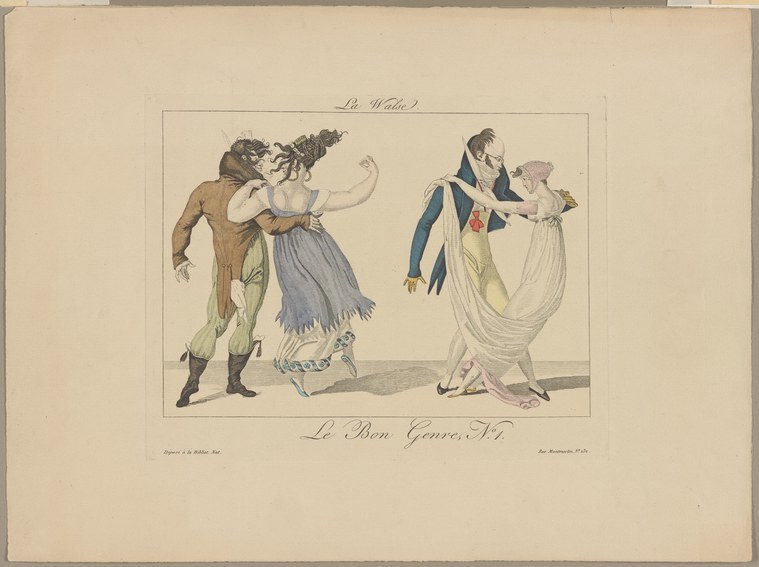
La Walse
Unknown artist
- Collection:
- Prints depicting dance
- Source:
- New York Public Library
- Rights:
- Public domain — free to use, share and adapt.
- Recorded as:
- Public Domain
The image is a primary document of how the waltz was moralized and debated in the early 19th century—not simply as a dance step but as a statement about propriety, gender, and bodily control. It shows that the waltz's closed hold and close contact were experienced as transgressive enough to warrant satirical treatment and moral instruction. For dance historians and curators, it reveals the social panic around the waltz alongside its visual and choreographic details.
What you are looking at
A hand-colored engraving depicting a Waltz scene with four figures in Regency or early 19th-century dress. On the left, a man with dark hair and swarthy complexion, dressed in a brown coat with light breeches and black boots, gestures toward a woman in a high-waisted white dress with blue drapery and feathered headdress; she leans back in an exaggerated pose. On the right, a tall man in dark blue coat with decorative insignia stands close to a woman in a pale green and white dress, his arm around her waist in a closed waltz hold. The woman's elaborately gathered white shawl or train sweeps dramatically across the ground. The composition contrasts two moments or interpretations of the waltz: the theatrical, flirtatious gesture on the left against the formal, constrained partnership on the right. The setting is minimal—a plain floor and neutral background—focusing attention entirely on the figures and their deportment.
The dancing
The right pair demonstrates the waltz hold: the man's arm is placed at the woman's waist, their bodies close but upright, his other arm extended to hold her hand, her free arm raised. The woman's posture is tense, her body leaning away slightly in the characteristic sway of the period waltz. On the left, the man reaches toward the woman with both hands, while she arches backward dramatically, her arms up and her body in an exaggerated curve that conveys flirtation or distress rather than the controlled frame of the right pair. The contrast suggests two registers of waltz behavior: the illicit or improper on the left, the sanctioned on the right.
The dance depicted
This is a waltz, the dominant couple dance of the early 19th century, here presented with satirical intent through its title *La Bon Genre, No. 1* (The Proper Way/Good Taste, Part 1). The image likely contrasts correct and incorrect ways of dancing the waltz at a time when the closed-hold waltz was still considered daring or improper by conservative society. The right pair embodies the new ballroom waltz in its constrained, formal version; the left pair exaggerates the sensuality or disorder that critics feared. The print may be one of a series offering social commentary on manners and dancing.
How it was made
This is a hand-colored engraving, a reproductive print technique that allowed wide circulation and made satirical commentary on contemporary social life accessible to a broad audience. The line-work is fine and precise, defining the figures with classical clarity; the color is applied by hand in flat washes—ochre and brown for the man's coat on the left, blue and white for the women's dresses, with careful attention to the textures of fabric and feathers. The technique allowed the artist to capture nuance of gesture and expression while maintaining the satirical distance that engraving afforded. The hand-coloring and the serial numbering (*No. 1*) indicate this was a published print, likely issued in a series for collectors interested in fashion, manners, and social satire.
About this work
This hand-colored engraving satirizes the waltz and the social anxieties it provoked in early 19th-century Europe. The paired figures—one demonstrating improper sensuality, the other rigid formality—present two extremes of waltz behavior and suggest that the dance occupied contested social territory even as it became the dominant couple dance of the ballroom. The print belongs to a tradition of *bon genre* satire, a French publishing genre that commented on contemporary manners and dress through prints collected by educated urban audiences. For dance historians, it documents how the waltz was understood not as a single technique but as a site of competing social meanings: desire and restraint, modernity and propriety, individual pleasure and social order.
How to look at it
Attend first to the contrast between the two pairs: the right pair's closed, upright frame and formal distance versus the left pair's theatrical reach and exaggerated sway. The right pair is frozen in the regulated moment of the waltz proper; the left pair is caught in an expression of abandon or transgression. The artist has chosen a moment of maximum contrast to make the satire legible—not a neutral snapshot of the dance, but a moral proposition about how the waltz could be danced well or badly, properly or improperly. Notice the woman on the left's elaborate headdress and the theatrical gesture of her body, set against the restraint of the right woman's simpler styling and controlled posture.
The period
The waltz emerged in Vienna and spread to London and Paris in the 1810s, becoming the defining dance of the Romantic era despite fierce criticism from moralists who objected to the closed hold, the speed, and the physical proximity of the partners. The engraving dates to the period of the waltz's rapid social rise and moral controversy. *Bon genre* prints flourished in France during the 1820s–1840s as a vehicle for satirizing contemporary fashion, manners, and social types; they were collected by bourgeois audiences as affordable, witty commentary on urban life. This print reflects both the waltz's cultural ascendancy and the anxiety it provoked.
Where it lives
The print is held in the New York Public Library's collection of prints depicting dance. It is numbered as part of a series and carries publication information at the base (not fully legible in this image). The object type is a hand-colored engraving, a reproductive print produced for circulation among a collecting public rather than a unique artwork.
Dance in this work
Questions about this work
Why does one couple dance properly while the other is ridiculous?
This is a satirical print offering moral instruction on how to waltz correctly. The right pair demonstrates the formal, restrained ballroom waltz approved by dancing masters and polite society; the left pair exaggerates the sensual abandon and physical chaos that critics feared the waltz might encourage. The contrast was meant to be funny and instructive at once—entertainment that taught manners.
Was the waltz really controversial?
Yes. The waltz's closed hold and fast rotation were shocking to many early 19th-century observers. Parents, clergy, and social conservatives objected to the proximity of the dancers and worried that the speed and intimacy would corrupt morals. Satirical prints like this one both reflected and fueled that anxiety, making the debate part of the waltz's cultural appeal.
What is 'bon genre'?
Bon genre refers to a style of satirical French prints from the 1820s–1840s that commented on contemporary fashion, manners, and social types. These hand-colored engravings were affordable, witty, and widely collected by bourgeois audiences interested in urban social commentary. Dance was a frequent subject because it was a visible marker of class, propriety, and modernity.
More dance artwork





