49 works in this view — arrow keys or swipe to move between them.
Dance in Art
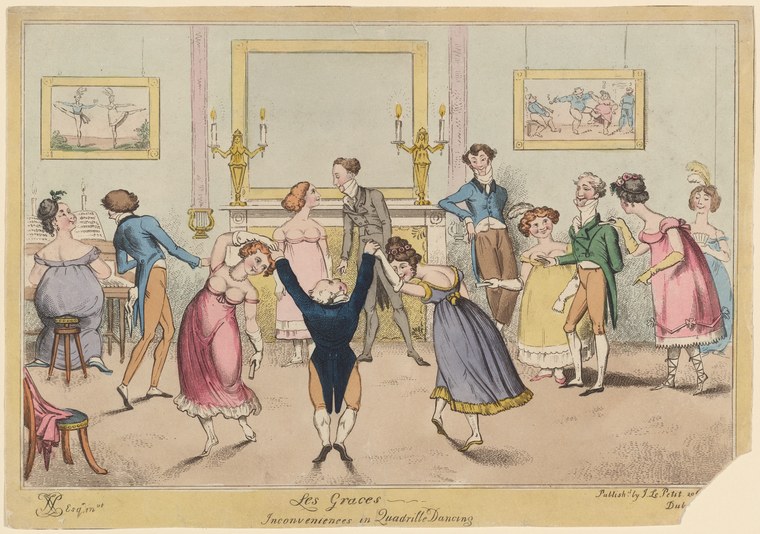
Les Graces: inconveniences in quadrille dancing
Unknown artist
- Collection:
- Prints depicting dance
- Source:
- New York Public Library
- Rights:
- Public domain — free to use, share and adapt.
- Recorded as:
- Public Domain
This print is a primary source for understanding how the quadrille was actually experienced in fashionable society: not as an abstract choreographic ideal but as a live event full of possibility for embarrassment, humor, and human mistake. It also demonstrates how dance was a subject of popular satirical art, used to critique class manners and social pretension. For dance historians and social historians alike, such images reveal the gap between prescribed form and lived experience.
What you are looking at
A crowded ballroom scene rendered in hand-colored engraving, with approximately twelve figures arranged throughout an elegant interior. The room features a classical chimney-piece with gilded candelabra and two framed paintings on the walls above. The floor is bare wood. In the center, a man in dark coat and breeches performs an exaggerated backbend or arch, his body nearly horizontal, while a woman in pink stands nearby with apparent alarm or astonishment. Around this central incident, other dancers and observers in fashionable dress—men in blue coats, women in high-waisted gowns of pink, yellow, green, and grey—stand in various poses of reaction: some laughing, some gesturing with raised arms, some conversing. The overall composition suggests a moment of comic disruption: the title *Les Graces* paired with the subtitle about "inconveniences in quadrille dancing" indicates this is satirical, capturing the chaos or impropriety that can erupt during what should be an orderly, graceful dance.
The dancing
The central male figure is the focal point, his body inverted in an extreme backbend that defies the vertical posture expected of ballroom dance. His legs remain relatively straight while his torso arches dramatically backward—a position that is both acrobatic and ridiculous. The female figure nearest him appears to recoil or gesture in surprise. The other figures around the room maintain upright, standing postures typical of spectators or participants between figures in a set dance, though several have their arms raised in expressive gestures. No couples are shown in the closed hold characteristic of later ballroom styles; instead, the dancers appear to be in the formation and spacing of a quadrille, where dancers rotate through partnerships and positions.
The dance depicted
This is explicitly a quadrille, the most fashionable social dance of the nineteenth century. The quadrille was a four-couple square dance performed to French music, with a set of five figures that demanded precision, timing, and grace. The satire here targets the frequent mishaps and social embarrassments that could occur: a dancer losing balance, falling, or—as here—performing an inadvertent or deliberate backbend that breaks the form entirely. The scene captures the tension between the dance's rigid geometric demands and the very human possibility of failure. The hand-colored engraving technique allowed the artist to emphasize the fashionable dress and the ballroom setting with some sophistication, making the comedy of disruption sharper by contrast with the refined setting.
How it was made
This is a hand-colored engraving, characteristic of early-nineteenth-century popular print culture. The line-work is fine and detailed, rendered in the neoclassical style; the coloring is applied by hand in thin, translucent washes. The technique allowed rapid reproduction and wide circulation among the literate and fashionable classes—this type of satirical ballroom scene was highly popular in France and England during the 1820s-1840s. The engraving's format and style suggest it was published as a single sheet or as part of a series, meant for display in parlors or for collection by those interested in social commentary and fashionable life. The inscription at the bottom indicates a publisher and date, though these are not legible in this reproduction.
About this work
This is a satirical hand-colored engraving depicting a moment of comic disruption during a quadrille, the quintessential social dance of the early nineteenth century. The central figure's exaggerated backbend—labeled as an "inconvenience" in the dance's execution—mocks the pretension and rigidity of fashionable ballroom culture while capturing the vivid visual spectacle of a ballroom scene. The work belongs to a rich tradition of social satire in print that used dance as a subject to comment on manners, fashion, and the human folly that intrudes upon polished social ritual. As a visual document, it records not only how the quadrille was performed and dressed but how it was perceived—as a dance prone to mishap, comedy, and social theater.
How to look at it
Attend first to the central backbend: note how the artist has rendered it with exaggerated distortion, the body arching nearly horizontal while the legs remain straight—an impossible position that reads immediately as comedy. Then scan the surrounding figures and their reactions: raised arms, open mouths, turned heads. The composition uses the central disruption to organize the entire scene, drawing all eyes and gestures toward the moment of failure. Notice too the formal setting—the elegant chimney-piece, the mirrors, the refined dress—which makes the physical disorder more absurd by contrast. The artist understood the quadrille's visual language: the geometric spacing of couples, the relative stillness of spectators, the alternation of movement and waiting that structured the dance.
The period
The quadrille emerged in France around 1800 and became the dominant social dance across Europe and America by the 1820s-1840s. Its strict geometry—four couples in a square, executing five figures in a predetermined sequence—made it both a mark of social competence and a source of anxiety for dancers who might forget steps, collide, or lose timing. The early nineteenth century saw a flood of satirical prints depicting fashionable life, and dance was a favorite target. The print likely dates to the 1820s-1840s, when quadrille mania was at its height and when such humorous scenes of ballroom mishaps were commercially viable. The refined neoclassical interior and high-waisted gowns are consistent with Regency and early Victorian fashion.
Where it lives
The work is held in the New York Public Library's collection of prints depicting dance, catalogued as a single-sheet engraving. It is characteristic of the type of popular satirical print that circulated widely in the early nineteenth century, likely sold individually or as part of a series by a Parisian or London publisher.
Dance in this work
Questions about this work
What is a quadrille?
A quadrille is a social dance for four couples arranged in a square, performed to French music in five predetermined figures or sections. It was the most fashionable ballroom dance of the nineteenth century, requiring precision, timing, and knowledge of the sequence. The dance demanded that dancers maintain correct posture, spacing, and timing, making it both a mark of refinement and a frequent source of social anxiety.
Why is this print called 'Les Graces' if it shows chaos?
The title is ironic. "Les Graces" (The Graces) refers to the classical ideal of graceful, refined movement—precisely what the quadrille was supposed to embody. By showing an ungraceful backbend and social disorder, the artist inverts the title: this is what happens when grace fails, when the rigid form of the dance breaks down and the human body asserts its comic reality.
How do we know this is a quadrille?
The subtitle explicitly states "Inconveniences in Quadrille Dancing." Additionally, the composition shows the characteristic spacing and formation of a quadrille: four couples distributed in and around a square formation, with some dancers engaged while others stand waiting. The interior setting, the formal dress, and the era of the print all support this identification.
Who made this print?
The artist's name is not recorded in the catalogue. The inscription at the bottom of the print likely names the engraver and publisher, but these are not legible in this reproduction. Such satirical prints were often published anonymously or under the publisher's name rather than the artist's.
More dance artwork





