49 works in this view — arrow keys or swipe to move between them.
Dance in Art
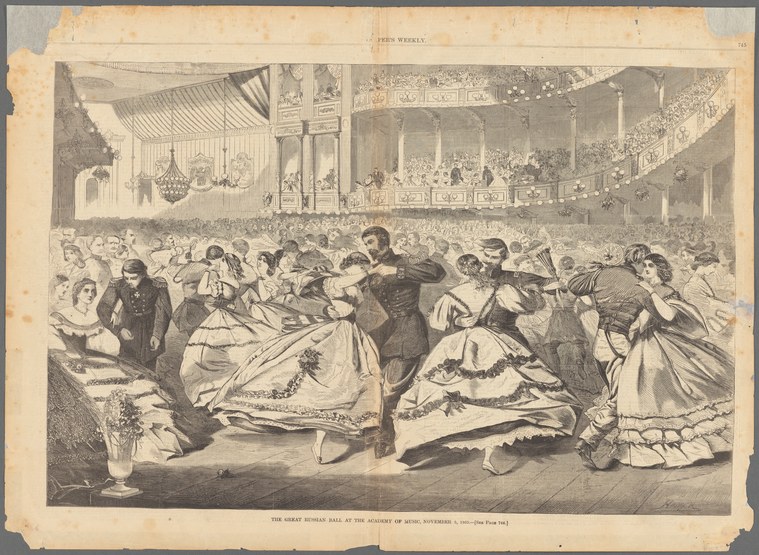
The great Russian ball at the Academy of Music, November 5, 1863
Unknown artist
- Collection:
- Prints depicting dance
- Source:
- New York Public Library
- Rights:
- Public domain — free to use, share and adapt.
- Recorded as:
- Public Domain
This is one of the most detailed and energetic visual records of American ballroom dancing in the 1860s, showing not a posed moment but an actual event and the dancers' real technique and energy in the waltz and related forms. The specificity of the event—a named venue, date, and political context (a Russian ball during the Civil War)—makes this image historically anchored in a way that generic ballroom scenes are not. For anyone studying the social history of dance, American Gilded Age culture, or the visual documentation of dance in the 19th century, this engraving is irreplaceable evidence.
What you are looking at
A grand ballroom fills the composition: an orchestra occupies a raised platform at left with hanging decorative elements above, while tiered galleries crowd with spectators framing the space. The ballroom floor itself hosts dozens of dancers in pairs and groups, their voluminous skirts and formal dress creating a sea of movement. The scene captures an animated moment—some couples pivot in tight formation, others progress across the floor, while seated guests and standing observers line the periphery. The perspective is from floor level, making the scale and energy of the event unmistakable. The architecture suggests a major civic or institutional venue; the sheer number of participants and the formal staging indicate a public ball of significant social importance rather than a private assembly.
The dancing
Dancers move in pairs and small formations across the floor, the majority in what appears to be closed or semi-closed ballroom positions. Men wear dark formal coats and trousers; women wear elaborate full-skirted gowns with tight bodices, many with white or pale silk skirts and dark velvet or satin bodices. The skirts are caught mid-motion in multiple places, showing the vigorous rotation and travel characteristic of turning or traveling dances of the period. Some figures lean into their movement with bent knees; others show the upright carriage and extension expected in formal ballroom technique. The density of dancers and the energy of their poses suggest rapid, energetic movement rather than stately procession.
The dance depicted
This depicts a formal ballroom event—most likely a waltz, quadrille, or polka given the period dress, the paired formations, and the energetic pivoting and traveling visible in multiple figures. The 1863 date places this squarely in the gilded-age ballroom era when waltzes and polkas dominated public and private balls in urban America. The scale and formality suggest this was a major social event, likely drawing elite or fashionable society. The Russian national ball context suggests this may have been a diplomatic or celebratory gathering, though the dance styles themselves appear to follow contemporary Anglo-American ballroom convention rather than explicitly Russian forms.
How it was made
This is a wood engraving or steel engraving, identifiable by the fine cross-hatching and line work that creates tonal gradation, the precision of the parallel lines defining form and shadow, and the evident plate marks. The technique allows both architectural detail and the capture of animated human figures in a single scene of considerable complexity. The fineness of the line work suggests skilled execution and a printing plate capable of many impressions, implying this was published in a periodical or as a separate print for wide circulation. The composition—with its elevated viewpoint and emphasis on crowd and spectacle—is characteristic of wood-engraved reporting images in illustrated newspapers of the 1860s, particularly the style of The Illustrated London News or Harper's Weekly.
About this work
This engraving documents a grand ball held at the Academy of Music in New York on 5 November 1863, capturing the scale and choreography of formal ballroom dancing at the height of the Civil War era. The work functions both as visual reporting—recording an actual social event of note—and as a window into ballroom practice and fashion of the moment. The density of dancers and the precision with which their motion is rendered offer valuable evidence of how these dances were actually performed: the dynamics of the waltz and quadrille, the posture and dress of male and female dancers, and the social choreography of a major public assembly. For historians of dance, fashion, and American social life, this image is a primary document of mid-19th-century urban ballroom culture at its most formal and elaborate.
How to look at it
Look first at the variety of moments frozen in a single frame: some couples are caught mid-turn with skirts flying, others mid-progress across the floor, and some are in a moment of direction or formation change. The artist has not chosen a single climactic moment but rather a representative slice of the ball's energy and complexity. Notice the architectural framing—the elevated platform, the galleries, the formal space—which emphasizes the public and ceremonial nature of the event. Examine the posture and arm positions of the dancers: the upright carriage, the closed or semi-closed hold, and the downward angle of the frame all tell us this is not a romantic or theatrical representation but a social documentary. The sheer number of figures also matters: this is a crowd scene as much as a dance scene, reflecting the ballroom as a place of social performance and display.
The period
The 1860s were the height of the waltz's social dominance in America and Europe. The waltz had displaced the quadrille and cotillion as the primary turning dance, though these older forms remained part of the repertory at formal balls. The Civil War (1861–65) was ongoing, yet public ballrooms and formal social life in northern cities like New York continued, sometimes as a form of patriotic or morale-building spectacle. The Russian ball in November 1863 likely had diplomatic significance—Russia's support for the Union was important during the war—making this not simply a dance event but a political and social one. The scale and public nature of the event, and its documentation in the illustrated press, reflect the 19th-century practice of reporting major social events as news and as visual spectacle for a mass audience.
Where it lives
The work is held in the New York Public Library's Prints collection, which specializes in visual documentation of New York history and culture. It is catalogued as a print depicting dance, indicating its value as both a dance historical document and a record of a specific social event.
Dance in this work
Questions about this work
Was this a real event or a fictionalized scene?
The catalogue identifies this as documenting an actual event: a ball held at the Academy of Music on 5 November 1863. The specificity of the venue and date, and the style of documentation, suggest this was a news engraving reporting on a real, notable social gathering, likely published in an illustrated newspaper shortly after the event.
What dances are being performed?
The formations and dynamics suggest primarily waltzes and possibly polkas or quadrilles. The paired pivoting and traveling, the upright posture, and the period dress all point to the standard ballroom dances of the 1860s. Without musical notation or explicit labels in the image, we cannot identify every dance in the room, but the waltz was dominant at formal balls of this era.
Why was there a Russian ball during the American Civil War?
Russia's government was sympathetic to the Union cause during the Civil War, and Russian diplomatic presence in America was significant. A Russian ball in New York would have been a major social and diplomatic event, combining celebration, entertainment, and political expression.
How do historians know how 19th-century ballroom dancing looked?
Images like this engraving are among our best sources: they show posture, hold, dress, and the dynamics of movement frozen in a moment. Combined with written dance manuals, music, and descriptions from the period, such images allow us to reconstruct and understand ballroom practice and technique of the era.
More dance artwork





