49 works in this view — arrow keys or swipe to move between them.
Dance in Art
La dance de Laloÿeau
Unknown artist
- Collection:
- Prints depicting dance
- Source:
- New York Public Library
- Rights:
- Public domain — free to use, share and adapt.
- Recorded as:
- Public Domain
The print preserves a specific named entertainment that is otherwise poorly documented in dance history, and it shows how comedic or burlesque dance was performed and staged when most surviving dance documents focus on court ballet or social dances. The composition—a male performer on an elevated stage watched by a formally arranged female audience—reveals period attitudes toward spectatorship, gender roles in performance, and the professional theater.
What you are looking at
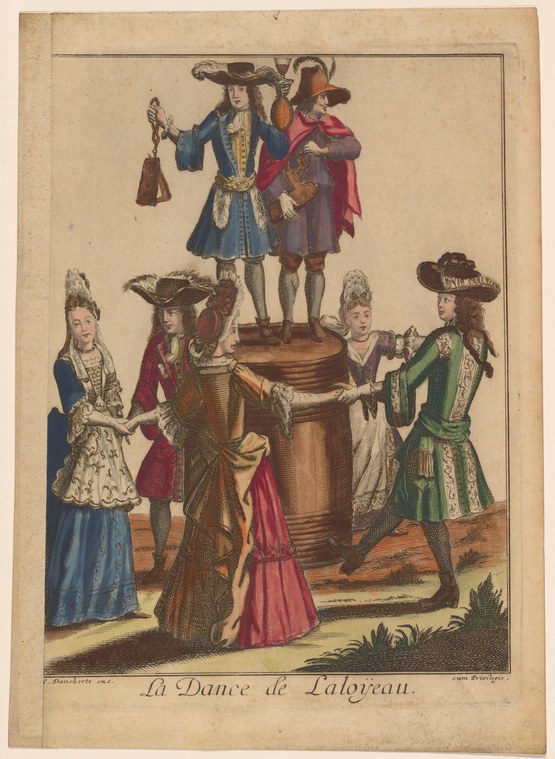
A hand-colored engraving depicts a theatrical dance scene centered on an elevated wooden platform. Three male figures in elaborate 18th-century dress—blue coats with gold trim, breeches, and wide-brimmed hats—occupy the platform in animated poses, their bodies leaning and gesturing dramatically. Below and around them stand four female onlookers in rich silk gowns (deep blue, crimson, gold, and green), their skirts voluminous and their postures formal. The women wear fashionable caps or bonnets. The male figures on the platform gesture outward and downward toward the women, their raised arms and twisted torsos suggesting theatrical narrative or courtship. A single leafy plant detail in the lower right grounds the scene. The composition creates a clear spatial hierarchy: the dancing men elevated and active, the women stationary and receptive below.
The dancing
The three male dancers adopt exaggerated, asymmetrical poses—one leans forward with an arm extended downward, another twists his torso while holding an object (possibly a small bag or purse), the third stands with arms spread. Their legs are visible beneath the coat skirts, planted in wide stances rather than closed positions. The female figures maintain upright, dignified postures with hands folded or at their sides; they form a semicircle watching rather than participating. The composition suggests a solo male performance for a female audience rather than partnered dancing.
The dance depicted
This engraving almost certainly depicts *La Danse de Laloÿeau* (The Dance of Laloÿeau), a famous comedic or satirical dance or pantomime of the late 17th or early 18th century, likely performed as theatrical entertainment. Laloÿeau was a known performer or character type of that era. The elevated platform and dramatic gestures suggest a professional or semi-professional entertainment rather than social dancing—the men perform *for* the women rather than *with* them. The style and energy suggest a comic or burlesque piece, with exaggerated postures and props (the small item held by one dancer). Without further documentation, the specific steps and musical accompaniment cannot be determined from the image alone.
How it was made
This is a hand-colored engraving, identifiable by the fine line-work, the formal composition, and the carefully applied watercolor or gouache tints over the printed image. The artist's name appears at lower left but is partially legible in reproduction. The medium—engraving rather than etching—indicates professional production and fairly wide circulation, likely as a print for collectors or as an illustration in a publication. The careful hand-coloring suggests this was a more expensive or deluxe version, intended for a wealthy audience. The technique allowed fine detail in the figures' dress and expressions, which was essential for depicting the theatrical costume and comedic energy.
About this work
This engraving documents a theatrical dance or pantomime entertainment from the late 17th or early 18th century, centered on a performer or character named Laloÿeau. The print preserves not only the choreography (insofar as it is frozen in a single moment) but the social and theatrical context—the relationship between performer and audience, the costume, the elevation of the male performer, and the formal attention of the female spectators. Such prints were important documents of stage entertainment before photography; they served as souvenirs, advertisements, and records of successful productions. The work sits at the intersection of theatrical practice, social history, and printmaking, offering evidence of how professional dance entertainment was marketed and remembered in the early modern period.
How to look at it
Observe the moment the artist chose: not a geometric symmetrical pose, but a chaotic, energetic instant in which three male bodies twist and gesture in different directions. This is not a precise, repeatable step but a peak moment of comedic action—appropriate for a burlesque or pantomime entertainment. Notice too the careful attention to the fabric and texture of the costumes, especially the voluminous skirts and the gold trim, which signal the theatrical and professional nature of the performance. The print is designed to convey narrative and character as much as movement.
The artist
The artist is not clearly identified in the available record. The signature at the lower left of the print may read as a family name, but it is not reliably deciphered from this image. The print appears to be a professional product, suggesting the maker was a working printmaker or engraver of the late 17th or early 18th century, likely based in France (given the French title and language conventions).
The period
This print dates to a period when theatrical dancing was undergoing significant change. Court ballet was declining in importance, and professional stage entertainment—including comedy, pantomime, and popular dances—was expanding, especially in Paris. The exaggerated, comic style suggests this is not an academic dance (not a minuet or other courtly form) but rather a popular or burlesque entertainment. The prominence of elaborate costume and comic gesture points to the importance of visual spectacle and character in theatrical dance of the era.
Where it lives
This print is held by the New York Public Library as part of their collection of prints depicting dance. It is a historical document of theatrical practice and likely circulated as a popular print in the 17th or 18th century.
Dance in this work
Questions about this work
Who was Laloÿeau?
Laloÿeau is not well documented in surviving records. The print suggests this was a known performer or character type in late 17th- or early 18th-century theatrical entertainment, possibly a comic dancer or pantomime artist. More specific biographical information would require access to contemporary theater records or other prints and documents that name this performer.
Is this a social dance or a theatrical performance?
This is clearly a theatrical performance. The elevated platform, the costumes, the dramatic exaggeration of pose, and the formal arrangement of the audience all signal professional or semi-professional entertainment. The male performers are dancing for the benefit of a watching audience, not with them.
What dance form is this?
The specific dance form is not identifiable from the image alone. It is likely a comedic, burlesque, or pantomime dance of the era—not a formal court dance or a defined social dance form. The exaggerated poses and theatrical props suggest improvisation or a loose narrative structure.
More dance artwork





