49 works in this view — arrow keys or swipe to move between them.
Dance in Art
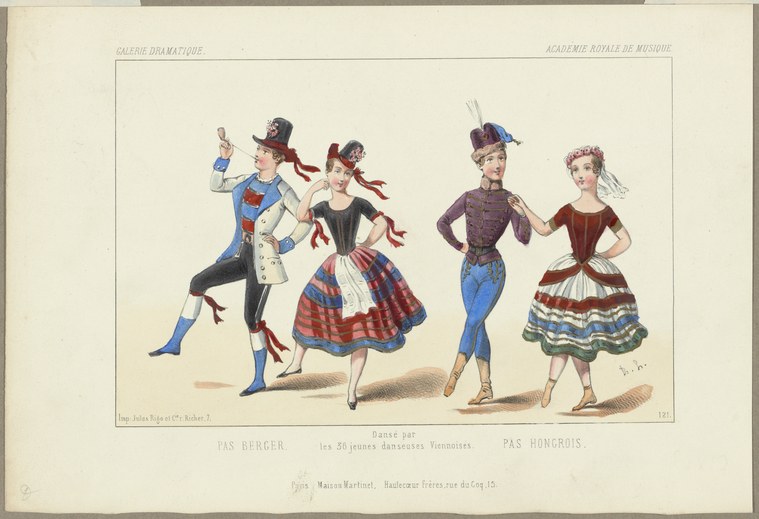
Pas berger, Pas hongrois, dansé par les 36 jeunes danseuses viennoises
Unknown artist
- Collection:
- Prints depicting dance
- Source:
- New York Public Library
- Rights:
- Public domain — free to use, share and adapt.
- Recorded as:
- Public Domain
This print documents the theatrical presentation of character dances drawn from European folk tradition at a moment when national and regional identities were shaping dance repertory. The specificity of the costumes and the emphasis on ensemble spectacle reveal how mid-19th-century theater used dance to represent place and culture.
What you are looking at
A theatrical print depicts five young dancers in a lively ensemble arrangement, arranged across the composition to showcase individual costumes and poses. The leftmost figure wears a blue tunic with white accents and a brown hat, striking an animated pose with raised arm. To his right, a figure in a brown/red hat and black bodice with a striped skirt in red and white performs with characteristic attitude. Center-right stands a dancer in purple velvet with blue leggings, arms akimbo. On the far right, a figure in a wine-red dress with a tiered, ruffled skirt in white and multicolored stripes wears an ornamental headdress. All five figures are arranged as if in performance, with varied leg positions suggesting rapid movement. The composition is set against a plain background with minimal detail, focusing attention entirely on the dancers' bodies and costumes.
The dancing
The dancers display varied leg positions and arm carriage suggesting folk or character dance style rather than academic ballet. Several figures show lifted legs or turned-out positions, with dynamic arm gestures rather than the controlled frame of ballroom dance. The poses are playful and asymmetrical—one figure raises a hand exuberantly, another stands with arms at the waist in defiant attitude. The bodies appear light and energetic, captured mid-movement rather than in repose. This is ensemble work presented as a parade of individual characters rather than unified partner dancing.
The dance depicted
The title identifies this as a 'Pas berger' (shepherd's dance) and 'Pas hongrois' (Hungarian dance) performed by 'les 36 jeunes danseuses viennoises' (36 young Viennese dancers). The print likely commemorates a specific theatrical performance. The costumes shown—particularly the Hungarian-inspired dress of the rightmost figure, with its characteristic tiered skirt and ornamental headdress—and the rustic shepherd theme suggest these are character dances drawn from European folk tradition, theatricalized for concert performance. The mixed dance styles (Pas berger and Pas hongrois in a single work) and the ensemble number indicate this is a suite or divertissement typical of mid-to-late 19th-century theatrical productions.
How it was made
This is a hand-colored lithographic print, evident from the careful chromatic separation of blue, red, purple, and ochre tones and the slight overlapping at edges characteristic of stone lithography. The technique allowed rapid, economical reproduction for theatrical publicity and sale to dance enthusiasts. The print bears a publication mark at the foot indicating French production. Lithography was the dominant medium for theatrical dance imagery of this period, enabling wide distribution of images of celebrated performances and dancers to a growing middle-class audience.
About this work
This is a theatrical publicity print documenting a 19th-century ensemble dance performance in Vienna. It combines two character dances—a Pas berger and Pas hongrois—performed by a large company of young women, presented here through five representative costumed figures. The work exemplifies the taste for folk-inflected character dances and national dance types that dominated European theatrical dance in the era between Romantic ballet's height and the emergence of modern dance. The print preserves evidence of a now-vanished performance tradition and the visual language through which dance was marketed and consumed.
How to look at it
Observe how each figure is treated as a distinct character type through costume, rather than as part of a unified formation. The print freezes the dancers mid-pose rather than at a moment of obvious technical display; notice how the attitudes and gestures emphasize theatrical personality and national type over balletic line. The plain background and neutral stance lines push focus entirely to the body and dress, the conventional presentation of theatrical dance prints of the period. Each costume detail—the striped skirt, the ornamental headdress, the tunic—carries information about regional identity and dance style.
The artist
The artist is not recorded on the print. The publication details at the foot indicate a Parisian firm, likely Maison Martial, suggesting this was a commercial theatrical print produced for immediate sale following a performance in Vienna, probably touring through or sponsored in Paris.
The period
This work dates to the mid-to-late 19th century, when European dance was divided between the classical ballet tradition (centered on ethereal, pointe-dancing heroines) and the character or national dances that provided color and comedy to mixed programs. Vienna was a major dance capital; this print likely documents a performance by a local company, possibly a school or resident ensemble. The emphasis on named national types (Hungarian, shepherd) reflects the Romantic era's fascination with folk culture and national identity. Theatrical lithographic prints of this kind were a primary means by which urban audiences encountered dance imagery outside the theater.
Where it lives
This hand-colored lithographic print is held in the New York Public Library's collection of prints depicting dance. The collection contains theatrical and social dance imagery from the 18th through early 20th centuries, primarily European in origin.
Dance in this work
Questions about this work
What is a pas berger and a pas hongrois?
Both are character dances popular in 19th-century European ballet and theater. A pas berger is a shepherdess dance, part of the tradition of rustic or pastoral character dances used for variety and color in ballets and mixed programs. A pas hongrois draws on Hungarian folk style and music. These dances were typically performed by women and required bright personality and clear technique but not the extreme extension or pointe work demanded by classical ballet.
Why does the print show only five dancers when the title mentions 36?
This is a selective representation showing five costumed characters as examples of the ensemble. The full company of 36 dancers would have performed as an ensemble or in variation, but the print captures a sample of the distinctive costume types and characters to advertise the spectacle of the complete performance.
Where and when was this performance?
The title states it was performed by the 'jeunes danseuses viennoises' (young Viennese dancers), indicating a Vienna-based company. The French text and publication in Paris suggest either that the ensemble toured to Paris or that a Paris theater produced this print to commemorate or advertise the work. The exact date is unknown, but the style and printing technique suggest the 1850s–1880s.
How do character dances like these relate to ballet?
Character dances were a formal category in 19th-century theater, typically appearing in mixed bills alongside classical ballet. They drew on folk or national styles and were meant to entertain and display regional identity, often providing comic relief or spectacle. Dancers trained in ballet technique performed them, but they required different qualities—a lighter touch, vivid personality, clear but less extreme line—than the ethereal, romantic aesthetic of classical ballet.
More dance artwork





