49 works in this view — arrow keys or swipe to move between them.
Dance in Art
Landscape with dancing figures
Unknown artist
- Collection:
- Prints depicting dance
- Source:
- New York Public Library
- Rights:
- Public domain — free to use, share and adapt.
- Recorded as:
- Public Domain
This work shows how dance operated in the context of 18th-century aristocratic leisure and landscape aesthetics. It documents the informal, social modes of dancing that coexisted with the formal ballet and court dances recorded in other sources, and reveals how dancing bodies were used by landscape painters to animate and humanize idealized natural settings.
What you are looking at
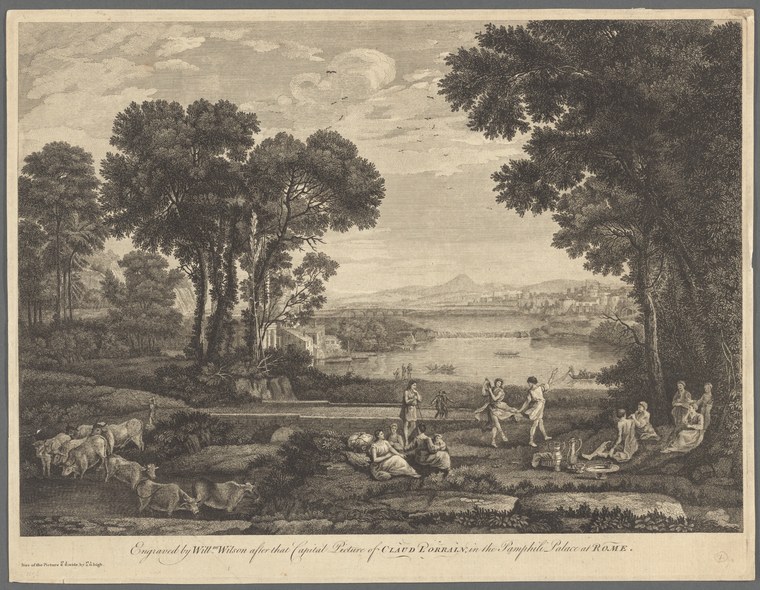
A landscape engraving depicting a pastoral idyll with dancing figures distributed across a gently sloping foreground. The composition opens onto a distant valley with a river, bridge, and town visible in soft atmospheric perspective. The immediate scene is framed by tall trees—slender pines on the left and dense foliage on the right—which create a theatrical proscenium. In the middle distance, figures in light dress move in small groups and couples across the grass. Some appear to be dancing; others recline, stand in conversation, or sit in clusters. The lighting is even and bright, with white clouds in a pale sky suggesting afternoon. The engraving technique allows fine detail in the foliage and a sophisticated tonal range from deep blacks in the trees to delicate greys in the distant landscape. The overall mood is one of leisured pleasure—this is not a village gathering or celebration, but an aristocratic or genteel retreat into nature.
The dancing
The dancers occupy the middle ground in loose, informal arrangements rather than the tight formations of court dance. Several pairs appear to be moving together—some with arms raised or extended, suggesting social dancing rather than a choreographed set. Individual figures stand with relaxed posture, and some recline on the grass. The bodies are rendered in neoclassical proportion and delicate line work. At least twenty figures populate the scene, ranging from solitary observers to pairs and small groups. The spacing is open and naturalistic; there is no visible corps de ballet or rigid geometric arrangement. Arms and legs suggest gentle, continuous motion rather than sharp positions.
The dance depicted
This appears to document a European aristocratic or polite-society leisure activity of the 17th or 18th century—a pastoral dance gathering or fête champêtre. The informal, distributed arrangement of dancers suggests social dancing in a garden setting rather than a theatrical or ceremonial performance. The engraving's caption (legible as "Engraved by Will[iam] Woollett after [a] Painting of [Claude] Lorrain or the Paysage [Idéal] of Rome") attributes it to a protean source, but the dance activity itself is secondary to the landscape. Couples and small groups appear to be performing minuets, country dances, or other social dances of the period appropriate to outdoor aristocratic gatherings. The style is informal and recreational, not virtuosic or formal.
How it was made
This is an engraving, a technique evident from the fine parallel lines (hatching and cross-hatching) that build tone and shadow throughout the composition. The inscription at the base credits the engraver (Woollett) and indicates a painting source (attributed to the Claude Lorrain school or Paysage Idéal tradition). Engraving allowed wide circulation and was the dominant reproductive medium of the 18th century, suggesting this image was intended for print collectors, connoisseurs, and amateurs of landscape and polite society. The meticulous technique and refined scale indicate it was made for an educated, leisured audience familiar with both landscape painting and social dance. The combination of pastoral tradition and contemporary figures positions it between fine art and documentation of manners.
About this work
This engraving depicts an imagined or idealized scene of 18th-century aristocratic leisure—a gathering of gently dressed figures dancing and socializing in a landscape framed by majestic trees and opening onto a distant view of civilization. The work sits in the tradition of European pastoral engraving and the "landscape with figures" genre, in which dance and social pleasure are subordinate to the representation of ideal nature and the leisure of the privileged classes. It documents not a specific event but a type of pleasure and a mode of social bonding—the outdoor dance gathering—that was both real in aristocratic life and a conventional subject in landscape art. For dance history, it is valuable as evidence of how social dancing was integrated into genteel leisure and how it appeared to educated artists and audiences of the period.
How to look at it
Attend first to the composition: the dancers are distributed across the foreground in a loose, seemingly unstaged arrangement, quite unlike the formal court ballets or theatrical dances that dominate other visual sources from the period. Notice how the artist has used them to animate the middle distance and draw the eye into the landscape beyond—they are part of the scenery, not the subject. Look at the poses and hand positions: they suggest gentle, continuous motion, not the sharp positions and lifted bodies of classical technique. The engraving technique—fine, parallel lines—allows the artist to suggest drapery, grass, and distant atmosphere with equal refinement, treating the dancers as one element in a unified vision of cultured leisure.
The artist
The engraving credits William Woollett as engraver, one of the most accomplished reproductive engravers of the 18th century. Woollett (1735–1785) was renowned for engraving landscapes after old masters and contemporary paintings, particularly works in the Claude Lorrain tradition. The painting source is ascribed to the Paysage Idéal school or Claude's manner, suggesting the composition derives from an earlier work in the classical landscape tradition, adapted with contemporary dancing figures.
The period
This engraving belongs to the 18th-century vogue for pastoral landscape, both in painting and in the applied arts and print market. It reflects the Enlightenment's idealization of nature, leisure, and social pleasure among the educated classes. At the same time, the informal social dances depicted—likely minuets, cotillions, and country dances—were the daily performance of polite society. This was the age of the dance master and the dancing assembly, when social dancing was a necessary accomplishment and a primary form of entertainment and courtship among the gentry and nobility. The engraving conflates landscape idealism with contemporary social practice, suggesting that such gatherings represented a return to natural, virtuous pleasure.
Where it lives
The New York Public Library holds this print as part of its collection of prints depicting dance. It is a reproductive engraving, intended for circulation as a print commodity among collectors of landscape, art, and social documentation.
Dance in this work
Questions about this work
Is this a real event or an imaginary scene?
This is an idealized composition in the pastoral tradition—not a documentary record of a specific gathering. However, it depicts the real practice of aristocratic outdoor dancing that did occur in the 18th century. The scene combines actual social customs (outdoor dancing, polite dress, leisure in nature) with artistic convention (Claudean landscape, distributed figures, theatrical framing through trees).
What dances are these people doing?
The informal spacing and arm positions suggest social dances of the 18th century—likely minuets, cotillions, or country dances—rather than a specific choreographed sequence. The artist has prioritized the overall mood of pleasure and leisure over anatomical precision or recognizable dance forms.
Why is this in a collection of dance imagery if the dance is so secondary?
It is valuable precisely because it shows dance as an integrated part of aristocratic life and leisure—not isolated in the theater or ballroom. It reveals how dancing bodies and social dancing were understood and depicted by educated artists, and what role dance played in the self-image of the leisured classes.
More dance artwork





