49 works in this view — arrow keys or swipe to move between them.
Dance in Art
Ballabende: Modernes Tanz-Album für Pianoforte
Unknown artist
- Collection:
- Prints depicting dance
- Source:
- New York Public Library
- Rights:
- Public domain — free to use, share and adapt.
- Recorded as:
- Public Domain
This image shows how ballroom dance was taught and imagined in the early 20th century: through the idealized body, the formal frame, and the aspirational imagery of sheet music covers. For historians of social dance and its codification into technique, it is a direct record of what a "correct" waltz looked like in the Edwardian period and how it was marketed to amateurs. For fashion and design historians, it documents the silhouette, hairstyle, and interior aesthetics of the 1900s–1910s.
What you are looking at
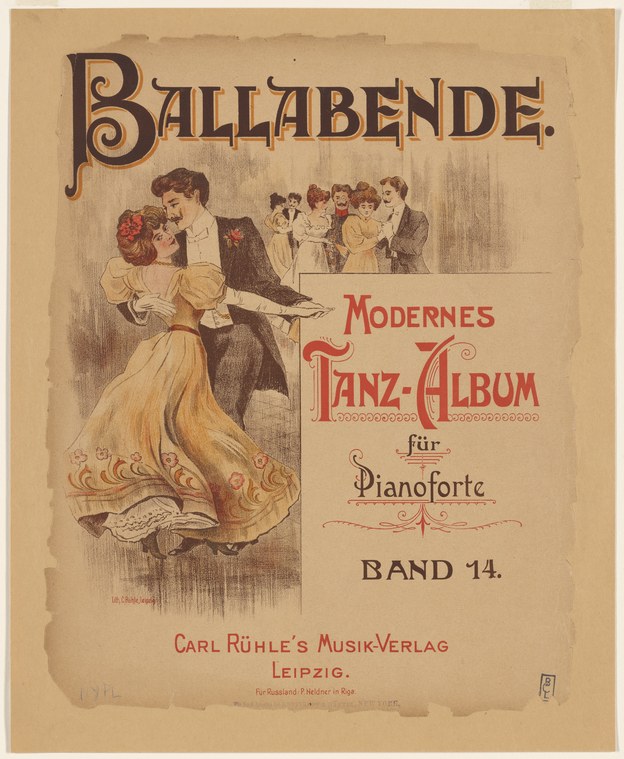
This is the cover of a German dance music album for piano, showing a ballroom scene in fin-de-siècle style. A couple dominates the foreground in an elegant closed dance frame: the woman wears a flowing gown in golden-yellow silk with a full skirt caught mid-swirl, her red-auburn hair piled high in the Gibson Girl fashion of the 1900s–1910s. The man in dark formal dress (tailcoat, white shirt) leans attentively toward her, his posture formal and controlled. Behind them, slightly out of focus, a group of well-dressed spectators—men in evening wear and women in lighter gowns—watches from what appears to be a ballroom interior with neutral background washes suggesting interior architecture. The lighting is soft and atmospheric, typical of early 20th-century chromolithographic printing, with warm tones emphasizing the luxury and refinement of the scene. The title *Ballabende* (literally "Ball Evenings") frames the image as a document of fashionable social dance in Edwardian high society.
The dancing
The lead couple holds a classical closed ballroom frame: the woman's left hand rests on the man's right shoulder, his right hand at her waist; their outer arms are extended but not fully straight, giving a relaxed but controlled line. Both bodies lean slightly forward into the frame, and the woman's weight appears to be transferring as her skirt swells in the momentum of a turn—the right leg would be weighted or recovering, suggesting mid-rotation. The man's posture is upright and guiding, his gaze directed at his partner. The background figures are in conversation posture, standing and observing rather than dancing, establishing this as a moment of performance or display within the social event.
The dance depicted
The image depicts the ballroom waltz or a similar closed-hold partner dance of the Edwardian era, most likely a Viennese or slow waltz given the formal setting and fashionable dress. The composition emphasizes the turn—the woman's billowing skirt is the artist's primary tool for conveying the rotational momentum and grace of the dance. *Ballabende* was marketed as sheet music for amateur pianists playing at dance events, so this cover image advertises the social waltz as the primary dance content, with secondary dances (polka, galop, etc.) likely included in the collection. The setting is upper-class: this is the ballroom waltz of the middle and upper bourgeoisie, danced at formal dances and soirées, not a folk or street variant.
How it was made
This is a chromolithographic cover for a bound or loose-leaf sheet music collection, printed in Germany by Carl Rühle's Musik-Verlag in Leipzig. Chromolithography allowed the publisher to use multiple color stones to achieve the soft gradations, warm flesh tones, and fabric textures visible here—the silk of the woman's gown and the subtle modeling of the ballroom interior. The process was well-suited to commercial music covers aimed at a middle-class domestic market, as it was economical for moderate print runs and conveyed elegance without the cost of fine art printing. The decorative typography and ornamental flourishes around the title are typical of Art Nouveau design applied to commercial objects.
About this work
This is a commercial sheet music cover from the early 1900s advertising a collection of dance music for the waltz and other ballroom dances. The image is a blueprint for Edwardian ballroom practice: it shows the ideal closed-hold frame, the formal dress code, and the social context (an evening ball) in which amateur musicians and dancers encountered each other. Sheet music covers of this period served as both practical objects and aspirational imagery—they taught dance posture and decorum to those learning at home while advertising the pleasures of ballroom society to those who purchased them.
As a primary source for the history of ballroom dance, Edwardian fashion, and the circulation of music for social dancing, the cover is invaluable. It captures the moment when the waltz had become fully domesticated into middle-class European life, and when published dance music was a major industry supplying pianos in living rooms across the German-speaking world.
How to look at it
Attend first to the woman's skirt: the artist has frozen the moment of a turn, using the swirl of fabric to convey rotation and momentum without depicting the legs. This was a common convention in ballroom dance imagery of the period, as propriety limited how much of the leg could be shown. Notice the closed frame and how the man's hand guides at the waist—this is the core technical instruction the image conveys. The background spectators establish this as a public performance within a private event, which was the nature of the ballroom: dancing was social display, not anonymous movement. The soft lighting and warm colors were also a sales technique, making the sheet music appealing as a domestic object.
The period
The waltz had dominated European ballroom dancing since the early 19th century, but the period of 1880–1920 saw it at its cultural peak and greatest professionalization. Dance teachers published books on technique, orchestras specialized in waltz repertory, and publishers like Rühle mass-produced dance music for home use. The figure shown here—the woman's S-bend silhouette, the man's upright posture—reflects the physical ideal of the Edwardian era, when dance deportment and bodily control were linked to class status and propriety. The Gibson Girl hairstyle and the luxury of the gown signal that this is aspirational imagery, aimed at the affluent middle class.
Where it lives
This is a cover from a music collection held in the New York Public Library's Prints collection, part of a larger holding of dance-related pictorial materials. Such covers survive in quantity because they were printed in the hundreds or thousands and bound into sheet music books that were stored in music libraries and private collections.
Dance in this work
Questions about this work
What dance is shown here?
The image depicts the waltz, almost certainly a Viennese or slow waltz given the formal dress and closed-hold frame. The billowing skirt conveys the rotational momentum that is the heart of waltz technique. The title *Ballabende* (Ball Evenings) confirms this is meant to represent the fashionable ballroom waltz of the Edwardian era.
Who danced to music from albums like this?
Amateur pianists and their guests in middle- and upper-class households across the German-speaking world. These collections were purchased by families with pianos and used for home dances, lessons, and musical evenings. The cover image was aspirational—it showed buyers the elegant setting and proper form they could imitate.
What does the woman's skirt tell us about the dance?
The swirl of the skirt is the artist's primary way of showing the turning motion central to the waltz. Because propriety prevented artists from showing the legs directly, the fabric's movement became a coded way of depicting rotation and speed. The fuller, more elaborate the skirt, the more energetic the turn.
When was this published?
The catalogue record does not specify a date, but the Edwardian fashion—the Gibson Girl hairstyle, the S-bend silhouette, the gown style—places it between approximately 1900 and 1915. Carl Rühle's Leipzig publishing house was active in this period, producing dance music collections for the European market.
More dance artwork





