49 works in this view — arrow keys or swipe to move between them.
Dance in Art
Harlequin and Mother Goose: or The golden egg
Unknown artist
- Collection:
- Prints depicting dance
- Source:
- New York Public Library
- Rights:
- Public domain — free to use, share and adapt.
- Recorded as:
- Public Domain
Pantomime was a genuinely popular dance and theatrical form, but it is dramatically underrepresented in art historical discourse, which privileges ballet and social dance. This print is evidence of how the majority of people encountered dance—as part of comedic, physical theater rather than as refined spectacle. The image also documents the visual conventions of commedia dell'arte and the continued vitality of that tradition in British popular theater.
What you are looking at
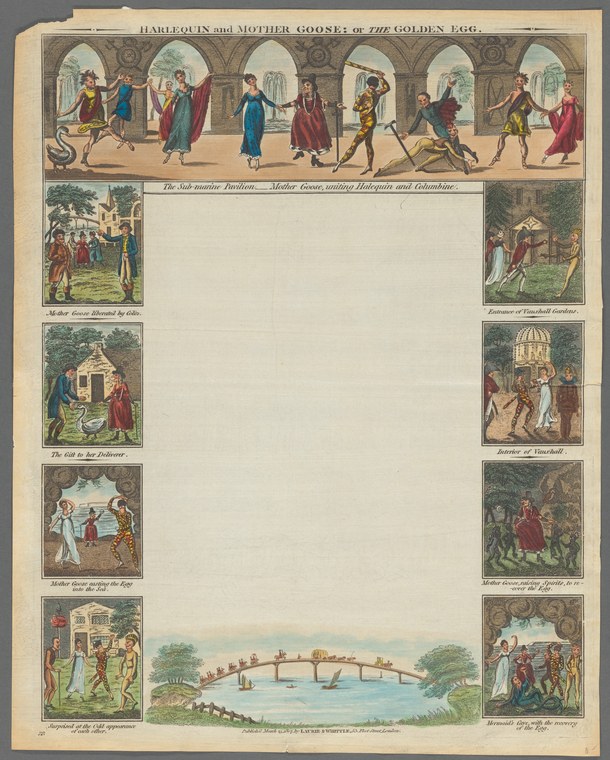
This is a broadside or chapbook illustration for a pantomime narrative, with a frieze of six scenes across the top showing the action of *Harlequin and Mother Goose*, and a border of eight smaller scenes framing a large central landscape. The top register depicts interior scenes under arched colonnades, with figures in commedia dell'arte dress—Harlequin recognizable by his diamond-patterned costume and mask—interacting with other stock characters. The surrounding vignettes show outdoor and domestic moments: characters gathering around a cottage, a figure striking a pose in a garden, encounters at a bridge. The color palette is muted—ochres, greens, and reds—typical of hand-tinted woodcuts or engravings. At the bottom, a pastoral landscape shows a simple arched bridge over water, flanked by trees. The composition is densely packed with narrative incident, designed to advertise or recap the plot of a theatrical entertainment rather than to capture a single moment of dance.
The dancing
The figures throughout are small and stocky, rendered in the flattened style of popular theatrical prints. In the top frieze, dancers and actors are shown in profile or three-quarter view, their bodies often twisted to display costume detail or gesture expressively—arms raised, legs in exaggerated strides, torsos angled for maximum visual interest. Several figures appear to be mid-leap or in unstable postures, suggesting vigorous movement rather than formal technique. The Harlequin figure is unmistakable by his costume; other figures wear flowing drapery, doublets, and caps. There is no formal ballroom hold visible; the interactions are comedic and physical, with bodies close together but not in the controlled frames of social dance.
The dance depicted
This depicts moments from a pantomime or comic theatrical entertainment, not a codified dance style. Pantomime was a popular British theatrical form combining dance, acrobatics, slapstick, and spectacular scenery, typically performed at Christmas and Epiphany. The narrative frame—*Harlequin and Mother Goose; or The Golden Egg*—suggests a plot involving magical transformation or pursuit, conventional to the harlequinade. The figures are shown dancing, leaping, and fleeing in the context of dramatic action rather than as an autonomous aesthetic practice. The movement is vivid and unbounded, aligned with the physical vocabulary of commedia dell'arte and British pantomime rather than with contemporary social or theatrical ballet. No specific dance steps are legible.
How it was made
This is a hand-colored engraving or woodcut, typical of popular theatrical broadsides and chapbooks of the late 18th or early 19th century. The technique allowed for rapid reproduction and distribution; this was inexpensive ephemera, meant to be sold at theaters or in the street. The composition is busy and crowded, designed to tell a story in miniature and to be read sequentially like a comic strip. The hand coloring was applied after printing, accounting for the sometimes crude overlay of color. This format was the primary way theatrical narratives reached a mass audience before photography; the image served as advertisement, souvenir, and plot summary simultaneously.
About this work
This is a popular print documenting a pantomime performance, a form of British musical theater that flourished from the 17th century onward and combined dance, acrobatics, spectacle, and slapstick comedy. The broadside format—with multiple scenes crowded into a single sheet—was the standard way such entertainments were advertised and recalled by audiences. The print captures not a refinement of dancing technique but the exuberant, physical energy of theatrical performance: bodies in motion, characters in pursuit, the promise of magical transformation and surprise. For historians of dance and theater, such prints are invaluable records of what non-elite performance looked like and how it was consumed.
How to look at it
The viewer should read this like a narrative sequence, following the action from left to right across the top and then moving through the surrounding vignettes. Notice how the artist uses costume and mask to distinguish characters instantly—Harlequin's diamond pattern is the anchor of recognition. Observe the exaggerated postures and asymmetrical compositions; the figures are not balanced or graceful but precarious, caught in mid-stumble or mid-leap. This captures the visual logic of pantomime: comedy comes from the body pushed into awkward or impossible positions. The crowding and density of the composition also conveys the sensory overload of a theatrical performance, loud and chaotic and full of surprise.
The period
Pantomime emerged as a distinct form in early-18th-century England, influenced by commedia dell'arte and incorporating acrobatic dance, transformations, and topical humor. By the late 18th and early 19th centuries, it had become a fixture of winter entertainment, performed by major theatrical companies and beloved by all social classes. The form coexisted with the rise of Romantic ballet (which emphasized ethereal, otherworldly movement) and with the consolidation of ballroom dance as a marker of respectability. Pantomime occupied a different register entirely: vulgar, physical, unrefined, and all the more popular for it. Broadside and chapbook illustrations were the mass medium of the era, preceding illustrated newspapers and magazines.
Where it lives
This work is held in the New York Public Library's collection of prints depicting dance, indicating it was collected as documentary evidence of how dance was performed and understood in the period. Such broadsides survive in large numbers but are often treated as historical documents rather than as art objects; this cataloguing marks a shift toward recognizing their visual and cultural significance.
Dance in this work
Questions about this work
What is pantomime and how does it differ from ballet?
Pantomime is a form of comic theatrical entertainment combining dance, acrobatics, and slapstick, emphasizing physical comedy and magical transformation. Ballet emphasizes refined technique, narrative expressed through ethereal movement, and formal training. Both were performed in theaters in the 18th and 19th centuries, but to different audiences and for different purposes: ballet aspired to beauty and refinement, pantomime to laughter and surprise. This print shows pantomime in action—exuberant, unrefined, and popular.
Who was Harlequin and why is he so recognizable?
Harlequin is a stock character from commedia dell'arte, a form of Italian popular theater that influenced performance throughout Europe. He is recognizable by his distinctive diamond-patterned costume (shown in this print), his mask, and his role as a witty, acrobatic servant figure. The character was adapted into British pantomime and became central to the harlequinade, a short comedic afterpiece. His costume made him instantly recognizable to audiences even in crowded theaters.
What does this image tell us about how dance was performed in the 18th–19th centuries?
This image shows that much of what people experienced as dance was embedded in theatrical narrative and physical comedy rather than presented as an autonomous art form. The movement is vigorous, unballetic, and designed to be funny or surprising. It reveals a parallel history of dance practice outside the elite world of ballet—one that was more democratic, more varied, and more rooted in the body's capacity for surprise than in technical refinement.
More dance artwork





