49 works in this view — arrow keys or swipe to move between them.
Dance in Art
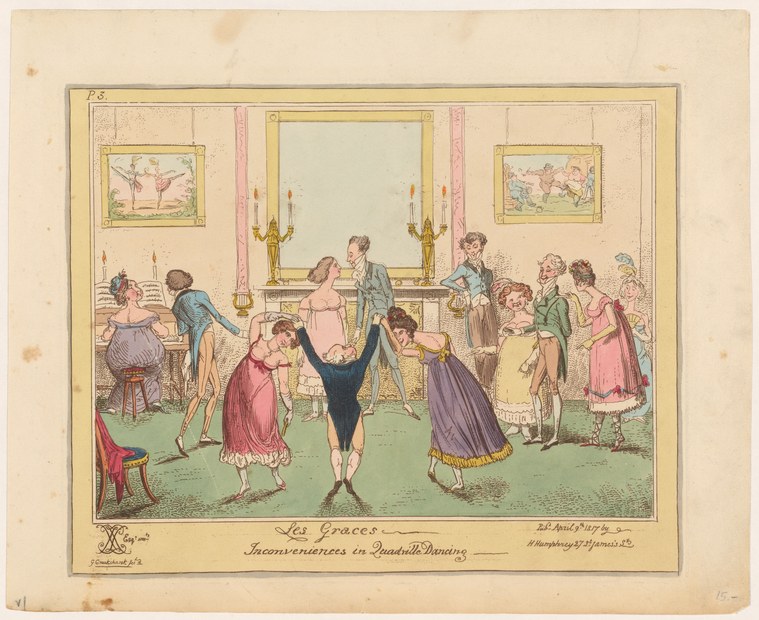
Les Graces: Inconveniences in quadrille dancing
Unknown artist
- Collection:
- Prints depicting dance
- Source:
- New York Public Library
- Rights:
- Public domain — free to use, share and adapt.
- Recorded as:
- Public Domain
The print is valuable historical evidence of how the quadrille was taught, practiced, and perceived in early 19th-century England. It reveals that dancing was a frequent subject for satire precisely because social dancing was a high-stakes social skill, and the print's humor depends entirely on its audience's familiarity with proper quadrille form. The work also documents the interior world of Regency dancing—the crowded drawing room, the presence of candles and mirrors, and the mixed-gender participation—in a way that straightforward instructional prints do not.
What you are looking at
A satirical colored engraving depicts the chaos of a quadrille dancing lesson in an elegant drawing room. The scene is crowded with fashionably dressed figures in Regency-era costume—women in high-waisted muslin gowns and men in tailored coats and breeches—arranged in fractured formation across a green floor. At the center, a woman in a black dress and a man in bright pink have collided or tangled mid-movement, their limbs akimbo in an ungainly pose that forms the comic focal point. Around them, other dancers are variously confused: some mid-stumble, others gesturing in exasperation or bewilderment. The walls are hung with pink damask and hung with classical prints (showing crucifixion scenes); a fireplace and mirror are visible, and tall candelabra flank the scene. The overall impression is one of social disorder masked by fine furnishings—a drawing-room comedy of errors.
The dancing
The dancers lack the coordinated frame and alignment that quadrille etiquette demanded. The pair at center are locked together without the proper closed hold, their bodies twisted and off-balance. Surrounding figures have lost formation entirely: some lean backward at precarious angles, others have abandoned their partners or stand frozen in confusion. Feet are planted awkwardly or tangled. No dancer shows the upright carriage and controlled positioning that would characterize a competent Regency-era quadrille. The composition deliberately exaggerates bodily dysfunction to satirize incompetent dancing.
The dance depicted
The title explicitly names the quadrille, the most fashionable social dance of the Regency period, and the subtitle "Inconveniences in quadrille dancing" signals that this is a satire on dancing gone wrong. The quadrille was a group dance in square formation, requiring coordination between four couples and precise execution of figures. This print mocks the chaos that could result when dancers were clumsy, inexperienced, or overcrowded. The image captures not an aspirational vision of the dance but a comic calamity—the moment when social pretension collides with physical incompetence. Such satirical prints were a popular genre in Regency and early 19th-century England, aimed at audiences who recognized the dance and its protocols well enough to appreciate the humor.
How it was made
This is a hand-colored engraving, likely aquatint or etching with subsequent watercolor application. The technique is evident in the fine linear detail (the damask wall pattern, the fine tailoring of coats) combined with the soft washes of color that define the figures and space. The hand-coloring suggests a print made for a middle-to-upper-class market—too expensive to be mass-produced for penny prints, but affordable for homes with disposable income for satirical amusement. The inscription at the base indicates a London publisher and date notation; the cartouche in the lower left and the classical print-room presentation suggest it was issued as a print to be mounted and framed.
About this work
This is a comic engraving of a quadrille dancing lesson descended from the British satirical print tradition, likely produced in the early 19th century. The quadrille was the pinnacle of social dance for Regency gentry and aspiring middle classes; mastery of its figures was a marker of social refinement. This print satirizes the gap between the ideal and the reality—between the elegant drawing-room setting and the dancers' inability to execute the dance with grace and coordination. The work belongs in a history of dance imagery because it documents not the virtuosity of the dance but its social stakes and its comic potential when it went awry.
How to look at it
Attend to the moment of collision: the artist has frozen the dance at its most chaotic, with the central couple's bodies twisted in a tangle that violates every principle of Regency deportment. Notice how the surrounding figures are equally confused—some mid-stumble, others frozen in dismay. The contrast between the elegant setting (the fine furnishings, the classical prints on the walls) and the physical chaos is the point: no amount of refined décor can rescue incompetent dancing. The hand-coloring emphasizes the grotesque: the bright pink of the man's coat and breeches make him a figure of ridicule, while the black dress of his partner suggests she is bearing the brunt of his clumsiness.
The period
The quadrille emerged in France in the late 18th century and became the dominant ballroom dance across Europe and Britain in the Regency and early Victorian periods (c. 1810–1850). It was more complex and formally structured than the country dances and cotillions it partly replaced, requiring knowledge of figures and precise coordination. In Britain, the quadrille was taught in specialized dancing schools and was a required skill for anyone entering polite society. Satirical prints on the follies of fashion and social pretension were a thriving genre during this period, and dancing was a frequent target because it combined bodily exposure, social anxiety, and the risk of public failure. Other contemporary prints mocked waltz dancing, corsets, and fashionable exaggeration.
Where it lives
The work is held in the New York Public Library's Prints collection. It is a hand-colored engraving from the early 19th century, issued as a single print for the London market.
Dance in this work
Questions about this work
What is a quadrille?
The quadrille was a group ballroom dance in square formation, popular from the 1800s through the 19th century. Four couples danced in a square, moving through a series of prescribed figures that required coordination and knowledge of the steps. It was more formal and complex than country dances, and skill at the quadrille was a social asset.
Why was dancing satirized in prints?
Dancing in Regency society was a high-stakes social performance. Incompetence at the quadrille or waltz could damage one's reputation, and satirical prints mocked the anxiety and pretension surrounding dancing. These prints were enjoyed by the same audiences who danced—they poked fun at social climbing and bodily weakness.
Is this print really about the dance, or just about making fun of people?
Both. The satire works only if the viewer understands quadrille form and expects dancers to move with grace and coordination. The humor depends entirely on knowledge of the dance and its social importance. The print documents how people actually danced when they were clumsy or overcrowded, which contrasts with the idealized vision in instructional manuals.
More dance artwork





