49 works in this view — arrow keys or swipe to move between them.
Dance in Art
Island of jewels: quadrilles by J.H. Tully
Unknown artist
- Collection:
- Prints depicting dance
- Source:
- New York Public Library
- Rights:
- Public domain — free to use, share and adapt.
- Recorded as:
- Public Domain
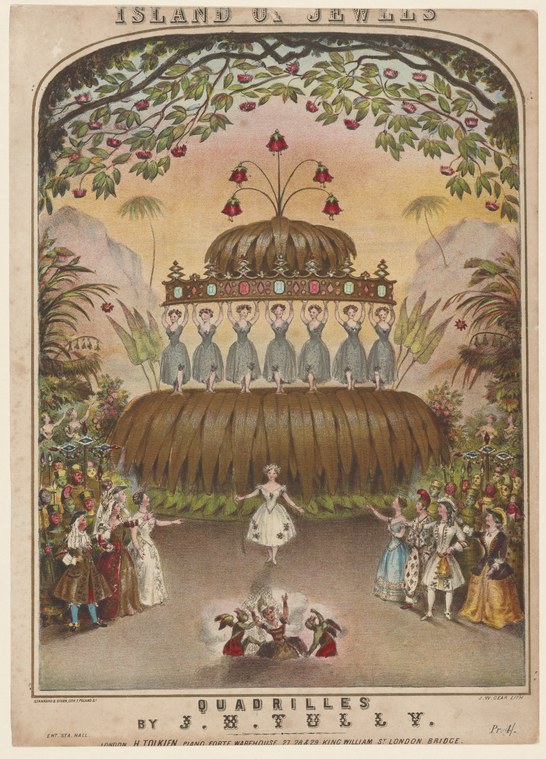
The quadrille was the defining social dance of the 19th century, and prints like this one—combining fantasy setting, theatrical staging, and named choreography—reveal how the dance was marketed, performed, and imagined beyond the ballroom. The image documents not just a dance form but the theatrical and romantic fantasies attached to it, showing how commercial print culture shaped public understanding of fashionable movement.
What you are looking at
A fantastical theatrical scene set within a giant shell or pod-like structure dominating the composition. Seven figures in formal dress stand atop this shell, arranged in a line and wearing what appear to be uniform jackets with decorative details. Below them, suspended above the ground, is an ornate pavilion or throne topped with a crown and supporting red jeweled ornaments. The foreground shows a dancing figure in a white dress, posed in mid-movement, surrounded by an assembly of spectators in period costume lining both sides of the scene. The setting is richly decorated with hanging vines and foliage at the top, exotic plants and flowers in the background, and an overall dreamlike quality enhanced by subtle color gradations. The composition reads as a procession or theatrical performance within an enchanted garden or exotic locale.
The dancing
The central dancing figure in white occupies a prominent position with weight shifted to one leg, the other extended in a balletic line; the pose suggests trained, formal movement rather than folk dance. The seven figures atop the shell stand rigidly upright in a formal line, suggesting either authority, ceremony, or a corps de ballet. Spectators at ground level—men, women, and children in mixed dress ranging from simple to elaborate—form an audience boundary. The spacing and framing suggest a choreographed moment rather than spontaneous movement.
The dance depicted
The title and inscription 'Quadrilles by J.H. Tully' identify this as a quadrille, the most popular formal dance of the 19th-century ballroom. The solitary female dancer in white performing before a formal audience and the structured line of figures above suggest a theatrical or demonstration context rather than social dancing. The quadrille was danced by sets of couples in a square formation, progressing through five figures; this image appears to capture a solo or featured dancer within that structure, or possibly a theatrical interpretation of the form. The exotic, fantastical setting—the shell pavilion and jeweled crown—suggests this is not a straightforward ballroom scene but rather a theatrical or narrative adaptation, possibly from a stage production or elaborate print series illustrating romantic or adventure narratives.
How it was made
This is a hand-colored engraving or lithograph, characteristic of popular theatrical and dance prints of the mid-19th century. The fine linear detail, the distinct color separation (particularly visible in the vegetation, costumes, and architectural elements), and the framing convention are consistent with commercial print production for mass audiences. The technique allowed the artist to create theatrical effects through layered color and imaginative detail; the hand-coloring suggests a print produced for a market willing to pay for finished rather than outline copies. Such prints circulated widely among theatrical enthusiasts and ballroom dancers seeking to follow fashionable dances and stage innovations.
About this work
This is a colored engraving depicting a scene titled 'Island of Jewels,' illustrating a quadrille—the dominant ballroom dance of 19th-century European and American society. Rather than documenting an actual ballroom, the print presents the quadrille within a theatrical fantasy, complete with an exotic architectural frame, an audience of onlookers, and a solo female dancer in formal white dress at the center. The presence of an inscription crediting the quadrille to 'J.H. Tully' suggests this may illustrate a specific choreographic composition or variation, or advertise a performance. The work belongs to a rich tradition of dance prints that merged social dance documentation with theatrical spectacle, circulating knowledge of fashionable dances through imaginative visual narratives rather than instructional clarity.
How to look at it
Observe the formal pose of the central dancer—the extended leg, the upright carriage, the white formal dress—which conveys balletic training within a social dance context. Note the architectural fantasy of the shell and crown, which frames the dance as spectacle rather than social practice. The audience arrangement encircling the dancer suggests this is a demonstration or performance moment, not a snapshot of private ballroom behavior. The named choreographer in the title signals that viewers of this print would have sought to learn or replicate this specific version of the quadrille.
The artist
The artist is not recorded in the catalogue. The work is credited to choreographer J.H. Tully for the quadrille composition itself. The engraving style and hand-coloring technique are consistent with mid-19th-century commercial print production, likely London or a major European theatrical center. Such prints were often created as collaborative ventures between choreographers, artists, and print publishers, with the choreographer's name featured prominently to advertise both the dance and the print.
The period
The quadrille dominated ballroom culture from approximately 1820 through the 1890s, with peak popularity in the mid-19th century. It originated in Paris and spread rapidly through Europe and America, becoming the essential formal dance for any respectable social occasion. The period saw intense commercial activity around dance prints, instruction manuals, and theatrical choreography; prints like this one advertised specific named quadrilles (often titled after exotic locales, romantic narratives, or current events) and encouraged ballroom dancers to learn variations. The fantastical setting reflects Romantic-era aesthetics in visual culture, where dancers and dances were often depicted in dreamlike or exotic rather than realistic contexts.
Where it lives
The work is held as part of the New York Public Library's collection of prints depicting dance. No accession number or acquisition date is recorded in the catalogue. The source attribution 'NYPL' indicates this is an institutional copy.
Dance in this work
Questions about this work
What is a quadrille?
A quadrille is a formal ballroom dance danced by four couples arranged in a square. It was the most fashionable social dance of the 19th century. The dance progressed through five linked figures, each with specific steps, and was performed to lively orchestral music. Quadrilles were central to respectable social life from 1820 onward.
Why is the setting so fantastical if this is a social dance?
The exotic setting is characteristic of commercial dance prints of this era. Rather than document actual ballroom scenes, these prints positioned social dances within theatrical or narrative frames—serving as both artistic works and advertisements for specific choreographic compositions. The fantasy setting made the print more desirable as a collectible while still conveying the essential information about how the dance was performed.
Who was J.H. Tully?
J.H. Tully is credited as the choreographer of this quadrille composition. Beyond this attribution, the catalogue does not record biographical information. Many quadrilles were created and named by ballroom masters and choreographers of the period; Tully's name appearing on the print indicates his work was popular enough to merit commercial publication and circulation.
More dance artwork





