49 works in this view — arrow keys or swipe to move between them.
Dance in Art
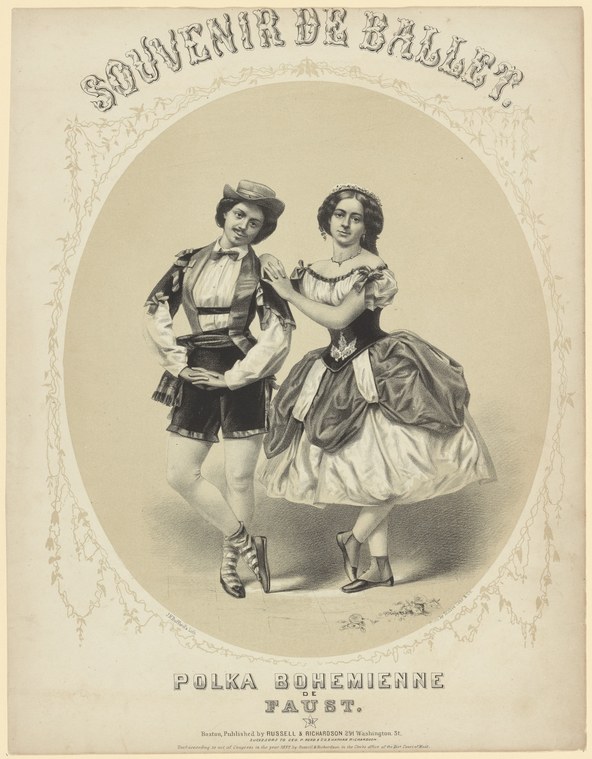
Souvenir de ballet. Polka bohemienne de Faust
Unknown artist
- Collection:
- Prints depicting dance
- Source:
- New York Public Library
- Rights:
- Public domain — free to use, share and adapt.
- Recorded as:
- Public Domain
Polka was ubiquitous in 19th-century entertainment, but images of it being danced are far rarer than images of ballet. This print preserves how polka was costumed, partnered, and promoted in professional theatre, and shows the gender conventions and theatrical tricks (travesty costume, exotic theming) that made it entertaining. It is direct evidence of mid-Victorian stage dance practice.
What you are looking at
Two young women in mid-19th-century dress are captured mid-performance against a plain background, framed within an ornamental oval border with floral wreath decoration. The figure on the left wears a dark velvet jacket with white puffy sleeves, a short dark skirt with decorative trim, white stockings, and dark shoes—the costume of a male dancer or travesty role. She stands in a dynamic pose with weight shifted, one leg extended. The figure on the right wears a pale satin ball gown with full skirt, short puffed sleeves, and a floral wreath in her hair, posed as a classical female dancer. Both figures are animated and engaged with one another, their bodies angled toward each other in the social proximity of a partnered dance. The composition emphasizes the contrast between their costumes and roles, a staged moment of theatrical interaction rather than a literal ballroom scene.
The dancing
The two dancers occupy the frame with clear spatial relationship and mutual engagement. The left figure (in male costume) leans slightly forward, with arms positioned to support or lead, weight grounded and athletic. The right figure stands with the upright carriage expected of a female dancer of the period, her posture open and receptive. Both have their gaze directed toward one another or slightly away in the conventional modest reserve of mid-19th-century theatrical portraiture. The bodies show understanding of paired work—there is a clear lead-and-follow dynamic even in this static moment.
The dance depicted
The title identifies this as 'Polka bohémienne de Faust'—a theatrical polka number from Faust, most likely Charles Gounod's opera (1859) or one of its many stage adaptations and derivatives popular in the 1860s–70s. The polka was a essential ballroom and theatrical dance of this period, a sprightly couple dance in 2/4 time. The 'Bohemian' designation suggests exotic or disreputable character association, fitting the Faust narrative. The travesty costume on the left—a woman dancing the male role—was an established theatrical convention of the era, and the apparent youth of both dancers suggests this was a specialty number, possibly from a music hall or opera-house production aimed at entertainment rather than narrative integrity.
How it was made
This is a lithographic print, evidenced by the soft tonal gradations, the ornamental lettering, and the characteristic grey and black line work. The oval framing and decorative border are typical of commercial theatrical souvenir prints of the 1860s–1870s, a format that served as marketing material and collectible memorabilia. Lithography allowed for rapid, relatively inexpensive reproduction, making these prints widely available to audiences who had seen the performance or wished to own a record of celebrated dancers or roles. The technique supports fine detail in costume and expression, and the subtle modeling of bodies shows the artist's competence.
About this work
This is a theatrical souvenir print documenting a stage dance number from the mid-19th-century operatic or music-hall repertory. It captures a polka, one of the era's most popular couple dances, as performed in a staged version tied to Gounod's Faust. The image is valuable precisely because it shows how polka appeared in professional theatre—the costumes, the physical relationship between dancers, the emphasis on spectacle and novelty (here, the travesty costume). Polka prints like this circulated widely and remain among the best visual records of how this dance was actually performed and marketed to audiences. The work belongs in a dance history collection because it documents both choreographic content and the commercial apparatus through which dance reached the public.
How to look at it
Observe the costume contrast: the left figure's athletic male dress and the right figure's classical female ball gown encode their social roles and theatrical types. The spatial relation between them—close, engaged, balanced—shows the polka as an intimate couple dance, not a formation or soloist spectacle. The restraint of their poses relative to the energy implied by the title ('bohemian,' 'Faust') is key to reading mid-19th-century theatrical convention: dance was shown as poised and controlled even when the narrative promised wildness. The printer chose to capture them mid-motion but not mid-leap, suggesting the polka's character as a brisk, grounded, social dance rather than an acrobatic display.
The artist
The print is published by Russell and Richardson of Washington Street, Boston, suggesting American production or distribution in the 1860s–70s. The artist is unrecorded, which is typical for theatrical souvenir prints of this period—they were often produced by commercial lithography houses working from photographs or drawings of performers, with authorship subsumed into the publishing enterprise. The unsigned image reflects the industrial, anonymous production of popular entertainment ephemera.
The period
The polka entered European ballrooms in the 1840s and became a craze by the 1850s, displacing the waltz as the dance of fashionable society. By the 1860s, it had migrated into opera houses, music halls, and theatrical productions as a specialty number. The costume style and printing technique place this work in the 1860s–70s. Gounod's Faust premiered in 1859 and became one of the most frequently performed and adapted operas of the era; operatic and music-hall versions spawned numerous derived productions and balletic interludes. Travesty roles (male characters danced by women) were well established in theatre by this date, offering both comic and romantic possibilities.
Where it lives
This is a theatrical souvenir print from the NYPL's collection of prints depicting dance. It was produced as commercial ephemera—marketed to theatre-goers as a memento of a performance—and has survived as a collectible artifact of 19th-century popular entertainment and dance history.
Dance in this work
Questions about this work
What is a polka bohémienne?
'Bohémienne' refers to a Bohemian or exotic character, a theatrical framing common in 19th-century dance numbers. A polka bohémienne is a polka choreographed as a specialty act with exotic or disreputable character association. In the context of Faust, it likely accompanied or characterized a role associated with Bohemian life or the supernatural.
Why is the left figure dressed as a man?
Travesty roles—male characters played by women in drag—were a standard theatrical convention of the 19th century, offering comic, romantic, or spectacle value. The practice was especially common in music halls and lighter operatic productions. It allowed female dancers to perform 'masculine' roles and movement styles within the constraints of theatrical propriety.
Was polka danced in theatres as well as ballrooms?
Yes. While polka began as a ballroom dance, by the 1860s it was a fixture of theatrical entertainment, performed in opera houses, music halls, and variety shows as specialty numbers. The theatrical version was more elaborate and deliberately choreographed than the social ballroom polka, and was often linked to character, narrative, or exotic themes.
What does this print tell us about how polka was actually danced?
The image shows the polka as a close, upright couple dance with clear lead-and-follow roles, performed with controlled posture and athletic but refined movement. The costumes and framing emphasize spectacle and theatricality rather than pure ballroom simplicity, suggesting that stage polka was a heightened, more elaborate version of social polka.
More dance artwork





