49 works in this view — arrow keys or swipe to move between them.
Dance in Art
Basse danse
Unknown artist
- Collection:
- Prints depicting dance
- Source:
- New York Public Library
- Rights:
- Public domain — free to use, share and adapt.
- Recorded as:
- Public Domain
This is one of the few surviving visual documents of the basse danse from the period when it dominated European court life, and it shows the dance as those who performed it understood it: a formal, heraldic accomplishment inseparable from nobility. The print's composition and technique make it a key source for understanding Renaissance costume, the couple form in early modern dance, and the role of engraving in circulating elite cultural practice.
What you are looking at
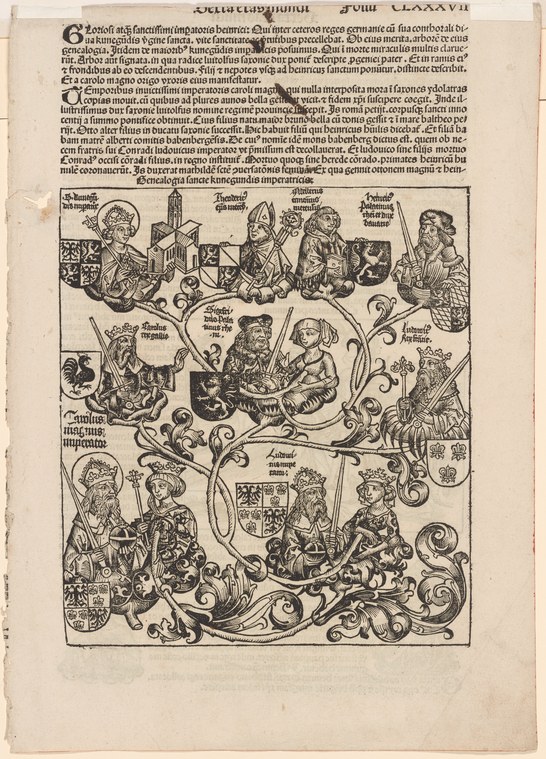
This is a densely populated engraving showing aristocratic dancers and musicians arranged in a symmetrical, heraldic composition centered on a large coat of arms. The central figures—a couple in rich period dress—occupy the heart of the design, surrounded by eight smaller vignettes depicting paired dancers in various formal postures. The dancers wear the characteristic costume of northern European nobility in the late 15th or early 16th century: long gowns with full skirts for the women, close-fitting hose and short doublets for the men, many adorned with feathered headdresses and jeweled ornaments. The composition is framed by scrolling foliate ornament in the Renaissance style, with heraldic shields embedded throughout. The engraving technique creates fine linear detail in the fabrics and accessories, while the overall arrangement—formal, symmetrical, and genealogical rather than narrative—suggests this is a commemorative print documenting a noble family's rank and cultural refinement through the civilized accomplishment of dance.
The dancing
The dancers throughout adopt the upright, restrained posture characteristic of Renaissance court dance: straight spines, arms held at measured angles, heads lifted. Couples maintain a formal spatial relationship—close but not embracing—with hands often joined or held at chest height. The footwork is suggested rather than anatomically explicit, but the weight distribution suggests the deliberate, processional movement of a basse danse rather than athletic leaping. The women's long skirts dominate the visual field, their volume conveying the gliding, shuffling steps of the dance rather than any vigorous elevation.
The dance depicted
This is documentation of the basse danse (or bassadanza), the most prestigious social dance of the Renaissance court, danced by nobility across northern Europe from approximately 1450 to 1550. The basse danse was a low, processional dance performed in couples, with a repertoire of named figures (branle, double, single, reprise) executed to instrumental music. The engraving shows the dance as an emblem of courtly status and dynastic alliance rather than as a performance event; the formal arrangement around heraldry suggests this records a specific noble marriage, betrothal, or family gathering. The presence of musicians (visible in the upper registers) confirms the association: basse danse required live instrumental accompaniment, typically shawms, sackbuts, or fiddles.
How it was made
This is a woodcut or engraving on paper, executed in black ink with fine parallel hatching to create tonal depth in the fabrics and heraldic fields. The technique allows for the precise rendering of costume detail and facial features, and the impressions would have been relatively inexpensive to produce and distribute compared to manuscript illumination. The composition's rigorous symmetry and heraldic framing suggest it was commissioned for a specific occasion—possibly a wedding or noble celebration—and circulated among the court and its wider network as a printed record of dynastic prestige. The presence of extensive Latin text above and below indicates an educated audience and suggests the print carried genealogical or commemorative information.
About this work
This engraving documents the basse danse, the foundational social dance of the Renaissance European court. It presents the dance not as a moment of action but as a formal, heraldic emblem of nobility and courtly refinement: couples arranged symmetrically around a coat of arms, their restrained posture and rich dress signaling social rank and education. The print circulated to record a specific noble occasion—likely a marriage or family gathering—and to celebrate the accomplishment of dance as a marker of civilized status.
For historians of Renaissance dance, this is primary evidence of how the basse danse was understood and performed: the upright frame, the hand positions, the gender dynamics of the couple form, and the integration of music all appear here. The engraving also reveals the social function of dance as a public display of courtly identity, frozen in print for distribution and commemoration.
How to look at it
Attend first to the formal, heraldic composition: this is not a snapshot of a moment but a genealogical and commemorative document arranged around a coat of arms. The couple at the center, larger than the surrounding pairs, are the focus of whatever occasion this records—a marriage, perhaps, or an alliance. Notice the consistency of posture across all the dancers: the upright spine, the measured arm positions, the restraint of gesture. This is not virtuosic display but the performance of order and control. The fine rendering of fabric—the folds of the women's skirts, the jeweled trim of the men's doublets—shows that dress itself was part of the dance's meaning: these are the clothes of rank, and the dance displays them.
The period
The basse danse emerged in Italy in the mid-15th century and became the standard social dance of the Burgundian and northern European courts by 1470. It was danced at all formal noble gatherings—weddings, treaties, state visits—and mastery of it was expected of anyone claiming courtly status. By the time this engraving was made (likely late 15th or early 16th century), the dance had a codified vocabulary and was taught by dancing masters who traveled between courts. The rise of printing in this period allowed for the reproduction and wider circulation of images of court life; engravings like this one served as both celebration and instruction, displaying the prestige of noble families while also documenting the visual and physical practices of courtly dance.
Where it lives
This engraving is held in the Prints collection of the New York Public Library. It is a single-sheet print, likely commissioned for distribution within and beyond the court of a specific noble family, and represents the type of commemorative ephemera through which Renaissance courts documented and disseminated their cultural and dynastic authority.
Dance in this work
Questions about this work
What is a basse danse?
The basse danse (low dance) was the most prestigious social dance of the Renaissance court, performed by nobility in couples. It was a processional, relatively low-impact dance executed to instrumental music, with a repertoire of named figures and steps. It required training from a dancing master and was considered a necessary accomplishment of courtly status, danced at all formal noble occasions.
Why is this engraving arranged around a coat of arms?
The coat of arms and the symmetrical, heraldic composition indicate that this engraving commemorates a specific noble family or occasion—likely a marriage, betrothal, or dynastic celebration. The arrangement of dancers around the heraldry serves to document the family's rank and refinement through their practice of courtly dance, linking genealogy to cultural accomplishment.
How do we know this is a basse danse and not another Renaissance dance?
The upright posture, the restrained arm positions, the close couple form with formal hand-holding, and the absence of any suggestion of elevation or vigorous movement all point to the basse danse. This is the dance most frequently represented in Renaissance prints, and its formal, heraldic presentation matches surviving descriptions of the dance as a symbol of noble status.
What does this print tell us about how Renaissance nobles learned to dance?
The precision of the postures and the consistency across all the couples suggests the dancers had been trained to a standard—almost certainly by a dancing master, who would have taught them the named figures, steps, and deportment of the basse danse. The print's circulation would have served both as a record of mastery and as a kind of instruction for others: this is how it should look.
More dance artwork





