49 works in this view — arrow keys or swipe to move between them.
Dance in Art
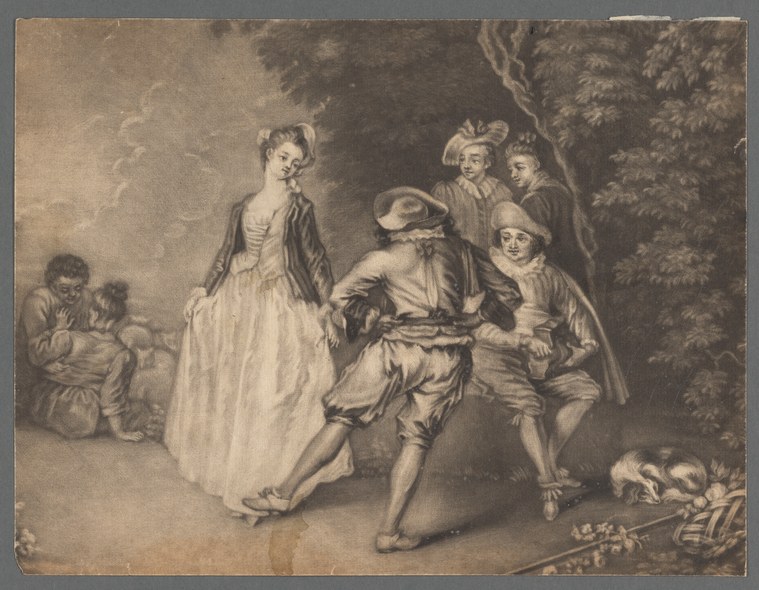
Man and woman dancing outdoors, observed by others
Unknown artist
- Collection:
- Prints depicting dance
- Source:
- New York Public Library
- Rights:
- Public domain — free to use, share and adapt.
- Recorded as:
- Public Domain
This image encapsulates how dance was understood as ritual and theatre in the 18th century—not merely as physical activity but as a coded language of social status, courtship, and aesthetic refinement. For historians of dance, dress, and manners, it reveals the performative dimensions of what might appear in documentation as mere 'minuet' or 'country dance,' and shows how visual culture codified and circulated ideals of propriety and grace.
What you are looking at
A woman in a pale muslin gown stands at center-left, her posture upright and formal, while a man in breeches and a loose tunic bows or leans toward her in a courtly gesture. Behind them, three younger figures—two women and a youth—cluster in the middle distance, observing the interchange. At the far left, two putti or cherubs sit on the ground, one playing a stringed instrument. The setting is a wooded garden or parkland, suggested by heavy foliage rendered in deep shadow at the right edge and overhanging branches above. The composition is ordered but intimate, lit from the left so that the principals stand in soft relief against the hazy background. The overall mood is one of courtly encounter or flirtation, staged outdoors in an arcadian setting.
The dancing
The man's weight is forward and his torso bends in a deep bow or courtly gesture of deference or invitation—his right leg extends behind or bends under him. The woman remains upright and composed, her left arm extended slightly as if in response or acknowledgment. Their spatial relationship suggests a formal dance encounter rather than active dancing: the woman's skirt hangs nearly straight, and her posture does not show the rotational energy or weight shift of actual movement. The three figures behind them form a line of witnesses rather than participants, their poses suggesting rapt observation rather than engagement in the dance.
The dance depicted
The imagery strongly suggests a Regency- or late-Georgian-era social dance encounter, most likely a minuet or a moment from a country dance in which partners take turns in formal salutation. The bow and the woman's composed response are quintessentially minuet-like—a stylised greeting that frames the dance rather than executing steps. The presence of the cherubs and the wooded setting evoke pastoral convention, suggesting this may illustrate a literary or theatrical scene (possibly from a play, novel, or design for a ballroom scheme) rather than documenting an actual dance. The formal dress and arcadian frame point to historic-baroque or historic-regency social dance, though the print's date and exact subject remain unrecorded.
How it was made
This is a hand-colored engraving or possibly a mezzotint, evidenced by the tonal graduation, the fine line work, and the soft-focus handling of the foliage and sky. The technique allowed for wide distribution and reproduction, suggesting this was intended for a fashionable audience—likely as an illustration to a book, a standalone print for purchase, or a design pattern for needlework or interior decoration. The delicate coloring (pale wash over the woman's gown, subtle browns and greens in the landscape) is characteristic of 18th-century decorative prints rather than fine-art engravings, implying a commercial context.
About this work
This is an 18th-century engraving depicting a formal courtship or social dance encounter set in an arcadian landscape. A elegantly dressed man bows to an upright woman while three figures observe and cherubs make music, composing a scene of courtly manners rendered in the pastoral idiom favored by the period. The work belongs to a large tradition of aristocratic leisure imagery: it documents not how dance was actually performed but how the period imagined courtly flirtation and social refinement. The print survives as an artifact of both dance culture (the precise choreography of greeting and approach) and visual culture (the engraver's craft and the commercial circulation of refined taste).
How to look at it
Attend to the precise moment chosen: not active dancing but the moment of greeting or approach that frames the dance. Notice how the woman's stillness and the man's elaborate courtesy create a freeze-frame of social negotiation. The observer figures in the background are key—they remind us that this is a performance watched by others, and that being seen dancing (or courting through dance) was itself part of the point. The cherubs playing music are not marginal decoration but a visual assertion that this encounter is orchestrated, refined, and removed from ordinary life.
The period
The late 18th century saw an explosion of decorative prints depicting aristocratic leisure, courtship, and dance. Engravings of this type were produced for a fashionable middle and upper-class market and often appeared in bound collections, as illustrations to novels and conduct books, or as framed wall decoration in drawing rooms. The arcadian or pastoral setting was a standard frame for dance imagery of this era, allowing artists to elevate social ritual into the realm of timeless elegance. The minuet, which dominated courtly dance throughout the 18th century, was by this period becoming an increasingly formal and theatrical practice, performed as much for display as for social interaction—a shift that prints like this both reflected and reinforced.
Where it lives
The print is held in the New York Public Library's collection of works depicting dance. No artist, date, or accession number is recorded in the catalogue; it is catalogued only as an unknown work from an unknown period showing 'a man and woman dancing outdoors, observed by others.'
Dance in this work
Questions about this work
Is this a painting or a print?
This is an engraving, likely hand-colored after printing. The technique (fine line work, tonal gradation, soft focus) and the delicate wash of color are typical of 18th-century commercial prints, not oil paintings. The image was likely reproduced many times and sold as a standalone sheet or as part of a collection.
What dance is being shown?
The formal bow, the woman's upright posture, and the overall composition suggest a minuet or similar courtly dance, most likely from the late 18th century. However, the image captures the moment of greeting or courtship rather than the execution of steps, so the specific dance cannot be identified with certainty. The pastoral setting and theatrical framing suggest this may be an imagined or idealized scene rather than a documentary record.
Why are there cherubs in a dance scene?
The cherubs playing music are part of the arcadian or pastoral convention used to elevate social scenes into the realm of classical or mythological beauty. They signal that this is not an ordinary social encounter but a refined, aestheticized display of courtship and grace. In 18th-century visual culture, cherubs and putti were used to legitimize and ennoble scenes of leisure and pleasure.
Who danced like this in real life?
The aristocracy and wealthy merchant classes danced minuets and country dances at balls, assemblies, and private gatherings throughout the 18th century. However, this image is more idealized than documentary—it represents how the period wanted dance to appear (refined, theatrical, courtly) rather than how it necessarily was. Many such prints were commissioned for interior decoration or as illustrations to novels and conduct books.
More dance artwork





