49 works in this view — arrow keys or swipe to move between them.
Dance in Art
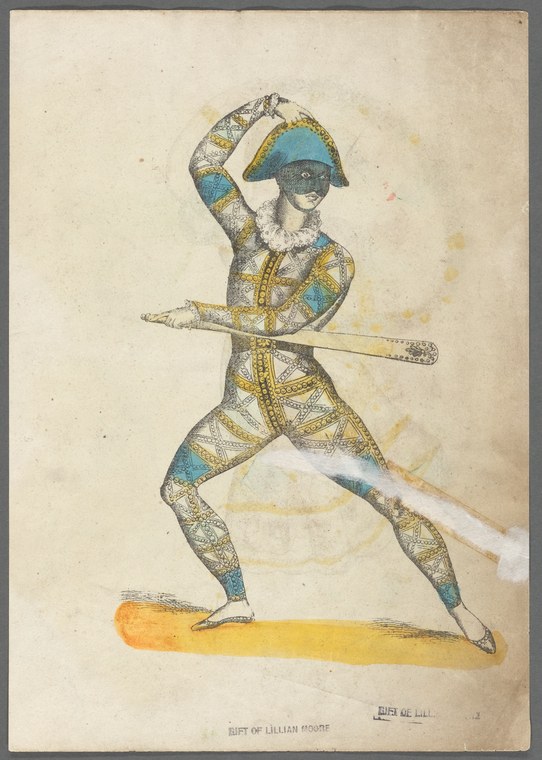
Robert Honner as Harlequin. On the verso is a female figure, possibly Columbine
Unknown artist
- Collection:
- Prints depicting dance
- Source:
- New York Public Library
- Rights:
- Public domain — free to use, share and adapt.
- Recorded as:
- Public Domain
This print documents a performer and character type central to the history of European physical theater and the acrobatic movement vocabulary that influenced later ballet and modern dance. Harlequin's movement language—quick, athletic, improvisational, and deeply connected to comic timing—represents an alternative theatrical tradition to courtly ballet, one in which the body's flexibility and agility were as important as grace. The image preserves evidence of how a celebrated performer embodied this role for his audience.
What you are looking at
A single male figure dominates the composition, caught mid-action in a dynamic, athletic pose. He wears a blue helmet or cap and an ornate tunic decorated with gold geometric patterns and blue panels, the costume fitting closely to his torso and limbs. He stands on a yellow platform or stage floor, one leg extended forward in a lunge while his other leg supports his weight. His right arm is raised high, hand near his helmet in a contemplative or dramatic gesture, while his left arm extends outward holding what appears to be a thin staff or wand. The figure's musculature is clearly articulated, suggesting a trained performer. The background is plain cream paper, allowing the figure to read as a theatrical study rather than a narrative scene. The print shows evidence of hand-coloring in watercolor or gouache, with the blues and golds applied over a black-ink underdrawing. The verso reportedly carries a female figure, possibly Columbine, though only this male figure is visible here.
The dancing
The dancer's weight is balanced dynamically, with the supporting leg slightly bent and the extended leg stretched in an open, attacking posture. The raised arm and extended opposite limb create a diagonal line through the body, emphasizing extension and lift. The torso remains upright and alert despite the wideness of the stance, suggesting trained control rather than casual movement. The figure reads as a solo performer, self-contained and theatrical, with every limb deployed for maximum visual impact.
The dance depicted
This is identified as Robert Honner as Harlequin, placing it within the tradition of commedia dell'arte performance that dominated European theater from the 16th through 18th centuries. Harlequin (or Arlecchino) was the quick-witted, acrobatic servant character, known for his physical virtuosity, witty movements, and the ability to move fluidly between broad comedy and dance-like physicality. The dynamic, open stance and the emphasis on extension and balance suggest the athletic, improvisational movement vocabulary the character required. Honner's pose captures the character in a moment of dramatic action or declaration, with the staff—likely the slapstick or wooden prop associated with Harlequin—held as both weapon and prop. The movement is theatrical rather than ballroom, designed to be read from a distance and to showcase the performer's agility.
How it was made
This is a hand-colored engraving or print, identifiable by the fine black-line underdrawing visible beneath the watercolor or gouache washes of blue and gold. The technique allowed for multiple impressions to be produced and distributed, making Honner's performance accessible to a wide audience beyond those who could attend the theater. The hand-coloring, executed with some care and consistency in the blue and gold palette, suggests this was a marketable theatrical print—a souvenir or publicity image of a well-known performer. The precision of the printed line underneath the color indicates this was a professional theatrical documentation, likely produced for sale or distribution.
About this work
This is a theatrical portrait of an actor-dancer performing the commedia dell'arte character Harlequin, documented through the popular medium of hand-colored engraving. Robert Honner was a notable performer of the character in the 18th century, and this print captures him in a moment of dynamic physical action, dressed in Harlequin's distinctive patterned tunic and armed with his traditional slapstick prop. The work belongs to the substantial tradition of theatrical prints that served as both documentation and marketing for popular performers and characters of the period.
The image sits at the intersection of theater history, dance history, and printmaking practice. It testifies to the physical and comedic demands placed on actors performing commedia dell'arte roles, and to the value placed on theatrical portraiture as a way of preserving and promoting popular performances. The verso's reference to a female figure (possibly Columbine, Harlequin's traditional love interest) suggests this may have been part of a paired or sequential series documenting key characters from a performance.
How to look at it
Look at the moment of extension: the artist has chosen to freeze the dancer mid-action, with limbs stretched wide and the body energized. Notice how every limb reads differently—the raised arm is contemplative or commanding, the extended leg is attacking or escaping, the planted foot is stable. The geometric patterns on the tunic emphasize the planes of the body and make the figure's musculature and line readable from a distance. The yellow platform grounds him in a theatrical space separate from the viewer. This is portraiture of a performer as much as documentation of a character—the image celebrates both Honner's physique and his skill at reading as Harlequin to an audience.
The artist
The artist is not recorded, which was common for theatrical prints of this period. These were often produced by print workshops as commercial ventures, with the image based on descriptions or sketches provided by the theater or performer rather than from an artist's independent study. The quality of the engraving and the care in hand-coloring suggest a professional print establishment, but attribution to a specific artist cannot be made from the image alone.
The period
This print dates from an era when commedia dell'arte remained popular across Europe, despite its origins in Italian popular theater of the 16th century. By the 18th century, when Honner was performing, the tradition had become professionalized and formalized, with actors like Honner developing considerable reputations and celebrity status. At the same time, ballet was developing as a distinct art form at court and in opera houses, creating a parallel but separate theatrical tradition emphasizing noble bearing and geometric line. Commedia dell'arte, by contrast, celebrated quick wit, physical comedy, and improvisation—a tradition that would eventually feed into modern physical theater and character work.
Where it lives
This work is held in the New York Public Library's collection of prints depicting dance. It is a theatrical print, a category of commercial publication used to promote performances and performers to a theater-going public. The verso's notation suggests this may have been part of a series documenting characters from a production or performer's repertory.
Dance in this work
Questions about this work
Who was Robert Honner?
Honner was an 18th-century performer celebrated for his portrayal of Harlequin, the quick-witted, acrobatic servant character from commedia dell'arte tradition. He was prominent enough to be documented in theatrical prints like this one, which circulated as souvenirs and promotional materials. Beyond the evidence of this print, biographical details are sparse, as was typical for performers of the period.
What is Harlequin and why does he matter to dance history?
Harlequin is a stock character from commedia dell'arte, a form of improvisational popular theater originating in 16th-century Italy and spreading across Europe. The character embodies a movement vocabulary emphasizing agility, quick changes of direction, balance, and physical comedy. This athletic, improvisational approach to movement influenced the development of pantomime and later physical theater traditions, and represents an important alternative to the courtly grace of contemporary ballet.
What is that staff or stick the figure is holding?
That is Harlequin's slapstick, a wooden prop used for both comic effect and theatrical communication. It allowed the character to gesture, point, gesture, and create sound effects on stage. The slapstick was particularly important in a tradition based on rapid physical action and pantomime, where the object became an extension of the performer's body.
How were theatrical prints like this one made and used?
Theatrical prints were made using engraving or etching techniques to create a black-line image, which was then hand-colored with watercolor or gouache. These were commercial publications sold to theater-goers as souvenirs, much like playbills or photographs today. They served both to document popular performances and performers and to advertise upcoming shows, making them valuable evidence of what audiences saw and valued in the theater.
More dance artwork





