49 works in this view — arrow keys or swipe to move between them.
Dance in Art
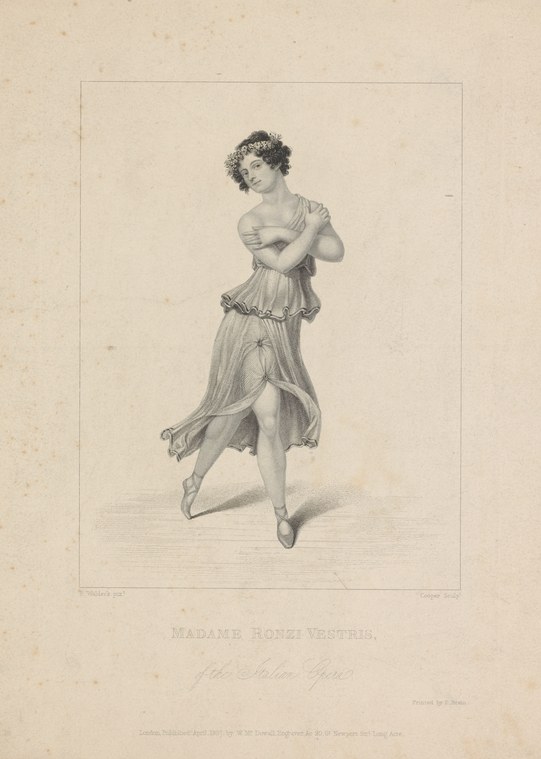
Madame Ronzi Vestris, of the Italian Opera.
Unknown artist
- Collection:
- Prints depicting dance
- Source:
- New York Public Library
- Rights:
- Public domain — free to use, share and adapt.
- Recorded as:
- Public Domain
This print is a primary document of professional theatrical dance practice in the early nineteenth century, recording not just that Madame Ronzi Vestris existed and was celebrated, but how she held her body and what audiences came to see. It demonstrates the neoclassical idiom that preceded romanticism and provides evidence of the gendered aesthetic of the era—the isolated, ornamental female figure on display. For dance historians, it is an artifact of the print culture that sustained celebrity and sustained knowledge of performance across geographically dispersed audiences before photography.
What you are looking at
A single female dancer is depicted in mid-performance against a plain background, captured in a moment of graceful movement. She wears a classical draped tunic in the neoclassical style, with the fabric gathered at the waist and falling asymmetrically to reveal one leg in an extended position. Her upper body is bare-shouldered, and her dark curled hair is arranged in the classical manner of the period. Her arms frame her body with one drawn across her torso and the other extended, creating a sense of controlled elegance. The composition isolates the figure against white paper, drawing all attention to her pose and the fall of her drapery. The engraving technique renders fine detail in the musculature and fabric, with subtle shading that suggests the three-dimensionality of her form and movement.
The dancing
The dancer stands in a balletic pose with her weight supported on one leg while the other extends behind or to the side, the foot pointed. Her torso maintains an upright carriage despite the asymmetrical leg position, and her arms are positioned to frame rather than fully support the movement—a quality characteristic of early nineteenth-century theatrical dancing. Her body demonstrates the controlled, lifted quality expected of professional dancers of this era, with elongated lines from fingertips through the extended leg. The single figure allows the artist to emphasize the isolation and technical precision of the pose.
The dance depicted
This appears to document a solo from early nineteenth-century Italian opera ballet, likely a *ballabile* or similar theatrical interpolation. The neoclassical drapery and pose align with the romantic ballet aesthetic then emerging across European opera houses. Madame Ronzi Vestris was a celebrated performer of the Italian Opera—almost certainly the King's Theatre in London or similar venue—and this print records a signature moment from her performance, the kind of dramatic solo that would have been a vehicle for a principal dancer. The isolated figure and classical references suggest this was aspirational imagery, circulated among audiences who would recognize the dancer and her particular style.
How it was made
This is a steel or copper engraving, a reproductive print technique that allowed wide distribution of theatrical imagery in the early nineteenth century. The fine hatching and delicate modeling suggest a skilled hand working at some scale; the technique was labor-intensive, which indicates this was a commercially valuable image, likely sold as a theatrical souvenir or collected in volumes of opera or dance prints. Engraving allowed for precise capture of costume detail and the dancer's form, though the technique's tonal range was limited compared to later lithography. The survival of the catalogue number at lower left suggests this was part of a numbered series.
About this work
This is a theatrical souvenir—a souvenir print documenting a celebrated performer of the Italian Opera in a signature pose from the early decades of the nineteenth century. Madame Ronzi Vestris was part of the Vestris dynasty of dancers and was known for her work in London and continental opera houses during a period of rapid evolution in ballet technique and aesthetics. The image captures the neoclassical idiom that dominated theatrical dance in the 1820s–1840s, before the full flowering of romantic ballet and the introduction of pointe work as standard technique.
What makes this work matter to dance history is that it is a fixed image of ephemeral performance—a moment chosen by the artist as emblematic of this dancer's skill and celebrity. Unlike a written description, the engraving preserves the actual silhouette, the specific drape of the costume, and the particular quality of the pose that made Vestris recognizable and admired. It is a record of how bodies were shaped by dance training and costume during the transitional moment between neoclassical and romantic ballet.
How to look at it
Attend to the moment chosen: this is not a leap or a violent gesture, but a moment of stillness and balance within movement—the kind of moment a dancer holds to display line and control. Notice how the engraver has rendered the weight of the fabric and the weight of the body as different things; the draped tunic falls with almost sculptural formality while the body itself maintains the tension of an active pose. The artist has chosen to show the dancer at a point of maximum extension and minimum action, the classical pose that demonstrates training rather than the dynamism of a jump. The bare shoulders and classical drapery are deliberate archaisms, evoking ancient sculpture rather than contemporary fashion, a convention that persisted in serious theatrical dance into the romantic era.
The period
This print belongs to the early nineteenth-century explosion of theatrical souvenir and celebrity imagery in London and Europe. The period saw the rise of the professional prima ballerina as a celebrity figure, and the print market supplied engravings and lithographs of celebrated performers in costume to audiences and collectors. The Vestris family dominated European dance during this era—Luigi Vestris was the most celebrated male dancer of the late eighteenth century, and the name carried prestige into the next generation. The neoclassical aesthetic reflected in the costume and pose was already beginning to yield to romantic sensibilities by the 1820s–1830s, though the classical vocabulary remained dominant in opera ballet. The print culture of the theater was essential to building and maintaining the celebrity of dancers who performed in cities across Europe; an engraving like this one would have been purchased by attendees of performances or by collectors of theatrical imagery.
Where it lives
This print is held by the New York Public Library in its collection of theatrical prints and engravings. It is the kind of commercial souvenir or collected image that would have circulated widely in the early nineteenth century, sold individually or bound into volumes of operatic or choreographic imagery.
Dance in this work
Questions about this work
Who was Madame Ronzi Vestris?
Ronzi Vestris was a professional dancer associated with the Italian Opera—most likely the King's Theatre in London—during the early nineteenth century. She was part of the Vestris family, which dominated European dance. The family name carried prestige and she would have been recognized by London theater audiences as a performer of significant skill and status. Little documentation of her specific repertory or career arc survives beyond scattered references and prints like this one.
What is she dancing?
We cannot identify a specific choreography from the image alone. The pose and costume suggest a solo from an opera ballet or *ballabile*—an entertainment inserted into an operatic performance—and the classical idiom suggests it was a serious theatrical piece rather than a comic interlude. The neoclassical aesthetic and the isolated female figure are typical of early nineteenth-century theatrical dance in European opera houses.
Why is she wearing such minimal costume?
The bare shoulders and draped tunic are deliberate archaisms, evoking ancient Greek or Roman sculpture. This was a convention in serious theatrical dance, especially in opera, to elevate the dance and distance it from contemporary fashion. It also displayed the dancer's trained body and allowed visibility of the leg line and footwork—essential in an era when the vocabulary of ballet technique was rapidly expanding.
Is this a pointe work?
No. The pose does not show the turned-out leg and extended line characteristic of pointe work. This image predates or sits at the very threshold of the era when pointe work became standard in ballet. The dance vocabulary visible here is neoclassical—based on turned-out positions and extensions, but without the additional technology of pointe shoes that would come to dominate ballet from the 1830s onward.
More dance artwork





