49 works in this view — arrow keys or swipe to move between them.
Dance in Art
Nouveau menuet de la cour: d'après l'ancient menuet
Unknown artist
- Collection:
- Prints depicting dance
- Source:
- New York Public Library
- Rights:
- Public domain — free to use, share and adapt.
- Recorded as:
- Public Domain
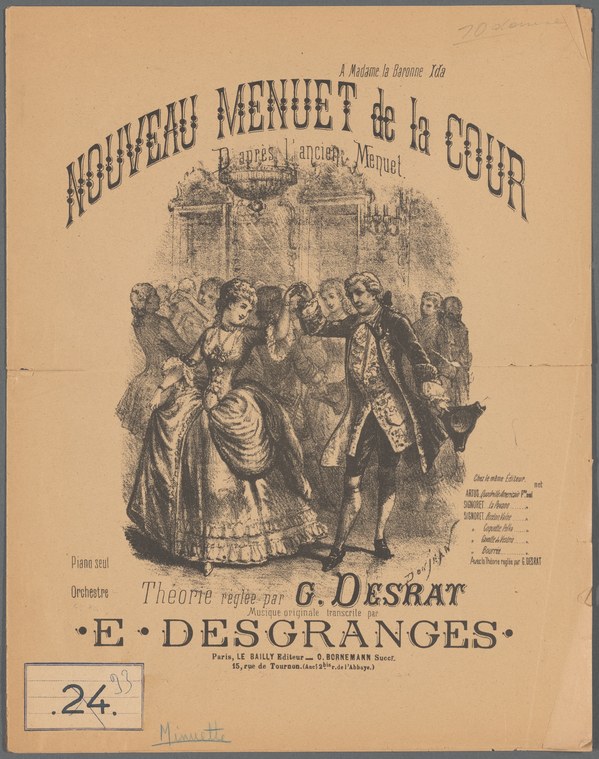
This print documents the 19th-century fascination with reconstructing and performing historical dances as theater, a practice that shaped modern ballet and dance history. It shows us exactly what the minuet looked like to mid-century viewers—how the body was held, how costume functioned, how courtship was choreographed—and reveals how historical knowledge was transmitted through published theatrical imagery before film or photography made such documentation routine.
What you are looking at
This is a theatrical print advertising a minuet performance, rendered in the style of 19th-century French theatrical ephemera. The composition centers on a scene of aristocratic courtship, with a elegantly dressed woman in the foreground wearing a full skirt with gathered drapery, positioned in conversation or flirtation with a man in formal court dress to her right. Additional figures in period costume are visible in the background, suggesting a court setting or ballroom. The engraving employs cross-hatching and fine linework to suggest texture and depth, with particular attention to the elaborate folds and volume of the woman's skirt—the kind of garment that would have been essential to the minuet's visual impact. The title arcs above the scene in bold theatrical lettering, while credits and production information appear below, identifying this as a published score or libretto for performance.
The dancing
The primary couple is positioned in three-quarter view, maintaining the formal distance and erect posture characteristic of courtly dance. The woman's body is angled to present her skirt, while her arms suggest the held, restrained gesture of court dance rather than the fluid, extended arm patterns of Romantic ballet. The man's formal stance—upright, composed—mirrors the woman's formality. Both figures suggest the deliberate, measured carriage of minuet technique rather than the release or dramatic extension of later 19th-century theatrical forms.
The dance depicted
This is the minuet, the dominant court dance of the 17th and 18th centuries, presented here as a historical recreation or entertainment piece in the 19th century. The title explicitly states it is 'after the ancient minuet' (d'après l'ancient minuet), suggesting this is a theatrical revival or pastiche rather than a record of contemporary court practice. The minuet is characterized by its Z-shaped floor pattern, small precise steps, and elaborate use of the skirt in creating visual interest—all of which align with what the engraving shows. The print advertises a theatrical orchestration by G. Desrat and E. Desgranges, indicating this was a published work meant for professional performance or amateur study.
How it was made
This is a wood engraving or steel engraving, a reproductive print technique that allowed mass distribution of theatrical imagery and sheet music covers in 19th-century France. The fine parallel lines (hatching) build tone and texture without color, a technique suited to both mechanical reproduction and the elegant, linear aesthetic valued in theatrical advertising. The level of detail and the precision of the line work suggest a skilled professional engraver, probably working from a drawing or painting provided by the music publisher. Such prints were the primary way theatrical scenes reached the public before photography; they served both as advertisements and as mementos of performances.
About this work
This is a printed advertisement or cover for a theatrical minuet, a 19th-century stage recreation of the aristocratic court dance that dominated European ballrooms in the 17th and 18th centuries. The image is documentary evidence of how the minuet was understood and performed in the mid-to-late 1800s—not as a living social practice, but as a historical entertainment, a display of elegance and courtship ritual for paying audiences. The engraving captures the formal posture, restrained gesture, and elaborate costume (particularly the woman's voluminous skirt) that were understood to be essential to the minuet's identity, even as the dance itself had become a theatrical revival rather than a fashionable social form.
How to look at it
Attend to the woman's posture and the treatment of her skirt: the engraver has carefully rendered the gathered, voluminous fabric in a way that suggests both the technical construction of the garment and its role as a partner in the dance. Notice the formal, upright carriage of both figures and the restrained positioning of their arms—these are the hallmarks of court dance as opposed to the lifted, extended line of theatrical ballet. The composition freezes a moment of courtly interaction, probably the formal greeting or opening phrase of the minuet, which was as much about demonstrating breeding and courtesy as about pure movement.
The artist
The artist is not recorded in the catalogue. The engraver worked from a composition (likely by an uncredited illustrator) and the work was published by G. Desrat and E. Desgranges, Parisian music publishers based on the Rue de Touron. The credit line indicates this was a commercial theatrical enterprise, not an artist's independent project—the engraver was a skilled tradesperson serving the publishing industry's demand for attractive theatrical covers and sheet music.
The period
The minuet had ceased to be a living social dance by the 19th century, having been displaced by the waltz, polka, and other Romantic-era social dances. However, it remained central to ballet training and was frequently performed in theatrical contexts as a symbol of aristocratic grace and historical elegance. The 1800s saw a boom in historical dance revivals and theatrical spectacle, particularly in France. Publishing such illustrated scores and libretti was a major commercial enterprise; they served as both marketing tools and instruction materials for amateur musicians and dancers.
Where it lives
This print is held in the New York Public Library's collection of prints depicting dance, suggesting it was recognized even then as a key document of theatrical and dance history. As a published theatrical score or libretto with integral illustration, it represents the category of ephemeral cultural products that documented and promoted professional and amateur performance in 19th-century Europe.
Dance in this work
Questions about this work
Was the minuet still danced when this print was made?
Not as a fashionable social dance—it had been displaced by the waltz and polka by the early 1800s. However, it remained a staple of ballet training and was frequently performed in theaters as a historical or comedic reference, a display of aristocratic refinement. This print advertises one such theatrical performance, explicitly marketing it as an 'ancient minuet' to audiences who would have known it primarily from paintings, literature, and dance notation.
What does the woman's skirt tell us about minuet technique?
The minuet was designed to display the dancer's costume as much as the movement itself. The voluminous skirt required specific footwork and hip placement to manage gracefully; the small, precise steps of the minuet (as opposed to the larger steps of earlier dances) allowed the skirt to ripple and move expressively. The engraver's detailed rendering of the skirt's folds suggests he understood its importance to the dance's visual effect.
Who were Desrat and Desgranges?
They were Parisian music publishers active in the 19th century, based on the Rue de Touron. This print credits them as the choreographers or arrangers of the orchestration ('Théorbe réglée par G. Desrat'), suggesting they were involved in creating the theatrical version rather than merely publishing it. The level of production quality—a commissioned engraving—indicates they were successful commercial operators in the music publishing trade.
How would this print have been used?
As a cover for published sheet music, as an advertisement for a theatrical production, and as a souvenir or instruction material for amateur musicians and dancers. The combination of attractive illustration, clear title, and performance credits made it both a commercial product and a reference document. Someone learning the minuet from notation could consult the image to understand the proper posture and costume.
More dance artwork





