49 works in this view — arrow keys or swipe to move between them.
Dance in Art
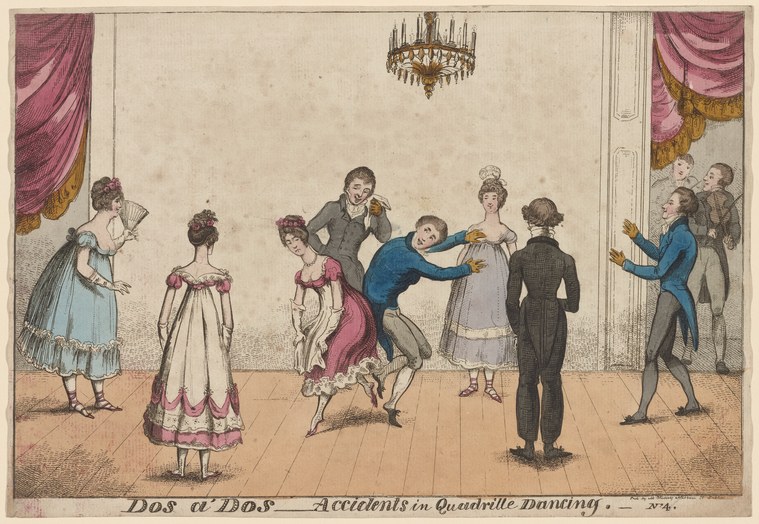
Dos à dos -- accidents in quadrille dancing
Unknown artist
- Collection:
- Prints depicting dance
- Source:
- New York Public Library
- Rights:
- Public domain — free to use, share and adapt.
- Recorded as:
- Public Domain
The quadrille was the dance of the Regency era, and this image is one of the few period sources that shows how the dance looked, how close the dancers stood, and what bodies and dress were involved. The satirical angle reveals what mattered most to Regency society: the public humiliation of a misstep, not the aesthetic or technical merit of the dance itself. For historians and dancers, this is evidence of both the form and the social anxiety that attended it.
What you are looking at
A hand-colored engraving depicting a parlor or ballroom scene of social mishap during a quadrille. The moment captures the aftermath or midst of collision—a central male figure in blue coat and breeches has stumbled or fallen, his body off-balance and arms gesturing outward in distress. Around him stand six or seven figures in Regency-era dress: women in high-waisted muslin gowns with short sleeves, some in pastel shades of pink and white; men in dark tail coats. The figures arrange themselves in informal groupings—some watching the accident with concern or amusement, others still maintaining dance posture. A crystal chandelier hangs from a coffered ceiling above; the walls are hung with plum-colored drapery caught up at the corners. The floor is rendered in warm tan. The composition is deliberately theatrical: the focal figure's distress is the pivot, and the other dancers' varied reactions—some averting, some gesturing, one or two with hands raised—suggest the social embarrassment of a public stumble during a formal dance.
The dancing
The male figure at center is depicted mid-fall or recovery, his body leaning back with one leg extended and both arms up in a gesture of loss of control or appeal. The women around him maintain the upright posture and composed arm carriage of the ballroom, though their expressions and body angles show response to the accident. One woman to the left wears a pale blue shawl. The men in dark coats stand with the contained stance expected of Regency partners. No visible footwork is shown—the interest is in the social moment rather than the mechanics of the dance. The groupings suggest the interrupted formation of a quadrille, with partners separated by the incident.
The dance depicted
This is a quadrille, the most fashionable social dance of the Regency era, typically danced by four couples arranged in a square. The print's title explicitly names it as an 'accident' in quadrille dancing—likely satirizing the comic possibilities of the form, which required precise figures and close proximity to partners and other dancers. The quadrille was danced in formal dress, in ballrooms, by the respectable classes, and involved set patterns of movement: dancers progressed through named figures (such as the 'dos à dos' mentioned in the title, a back-to-back passing maneuver). The image captures not the choreography but the social disruption when a dancer lost control or miscalculated timing—a moment of involuntary comedy in an otherwise rigid and rule-bound dance.
How it was made
This is a hand-colored engraving, identifiable by its fine parallel line work and the application of watercolor or gouache tint over a printed black-line foundation. The technique allowed rapid mass production for the popular print market and satirical broadsides of the period. The hand-coloring, while not uniform, gives the figures individual character and legibility at a distance. Such prints were affordable, portable, and designed for parlor walls and albums; they reached a broad middle-class and aspiring audience. The print's style and subject matter suggest it was issued as part of a series documenting the foibles and fashions of Regency social life.
About this work
This is a satirical engraving of a Regency-era social disaster: a gentleman's loss of balance or collision during a quadrille, watched by his horrified or amused companions. The quadrille was the preeminent ballroom dance of the 1810s–1820s, a geometrically precise form that required all dancers to maintain composure and timing. The humor of the image lies in the contrast between the dance's formal demands and the human body's failure—a gentleman sprawling, his partners' reactions ranging from alarm to barely suppressed hilarity. The work is both a document of how the dance was performed and a social commentary on Regency manners and embarrassment.
The print belongs to a substantial body of satirical and anecdotal imagery of the Regency ballroom, many of which played on the anxieties and mishaps of the social season. Such prints were widely circulated and collected; they were affordable enough for ordinary households yet sophisticated enough for the drawing rooms of the respectable middle class. This example captures not the beauty or skill of the dance but its precarious social stakes.
How to look at it
Look first at the central male figure and trace the moment of loss of control—his body tells the story of the accident. Then read the responses of the other dancers: some have turned to look, some are frozen mid-figure, one or two appear to be suppressing amusement. Notice the symmetry of the composition: despite the chaos, the other dancers still hold to the ballroom's formal geometry. The detail of dress is also key—the high-waisted muslin gowns and the tailcoats are not invented; they are accurate to the Regency ballroom and tell us who these dancers were. Finally, observe the title's reference to 'dos à dos'—a specific quadrille figure in which dancers pass back-to-back; the accident may be the result of a dancer miscalculating this precise maneuver.
The period
The quadrille emerged in France in the 1780s and dominated European and British ballrooms from roughly 1810 to the 1860s. It arrived in Britain during the Napoleonic Wars and became the emblem of fashionable society. Unlike earlier country dances or cotillions, the quadrille's set figures and geometric precision were celebrated as modern and intellectually satisfying. However, popular prints and satire of the era also mocked the dance's rigidity and the social strain of learning its complex patterns. This engraving appears to date to the height of the quadrille's popularity, probably the 1820s. The ballroom interior—with its chandelier, drapery, and polished floor—reflects the aspirations of the middle-class public who attended assembly rooms and hired teachers to learn fashionable dancing.
Where it lives
The work is held in the New York Public Library's collection of prints depicting dance. It is catalogued as 'Dos à Dos—Accidents in Quadrille Dancing' with no recorded artist, date, or medium information in the catalogue record. The print appears to be part of a larger series on Regency ballroom life, possibly associated with the prolific satirical print industry of early 19th-century London.
Dance in this work
Questions about this work
What is a 'dos à dos' and what does it have to do with the accident?
'Dos à dos' (back-to-back) is a figure in the quadrille in which two dancers pass back-to-back, often while turning. The maneuver required precise timing and coordination. The print's title suggests the accident occurred during or was caused by this figure—perhaps a dancer misjudged the distance or tempo. The humor lies in the clash between the figure's geometric precision and the messy reality of human bodies in motion.
Why was the quadrille so popular and why is it satirized here?
The quadrille was modern, French, prestigious, and required instruction to learn properly. It was the ultimate marker of gentility in Regency society. Exactly because it was so revered, it was ripe for satire. Prints like this one gently mocked the anxiety and effort involved in mastering the form and the social disaster that could result from a single misstep. The humor is warm rather than cruel—the gentleman is silly, but not contemptible.
How do we know this is a Regency-era image?
The dress is diagnostic: the women's high-waisted muslin gowns with short sleeves and the men's tailcoats and breeches are characteristic of the 1800s–1820s. The interior—the crystal chandelier, wall drapery, and polished wood floor—reflects the aspiring middle-class ballroom. The print's style, hand-coloring technique, and satirical subject matter are all consistent with the Regency popular-print market. The work has not been attributed to a specific artist or dated in the record, but its visual language places it confidently in this period.
Who danced the quadrille and where?
The quadrille was danced by the respectable middle and upper classes in formal ballrooms, assembly rooms, and at private balls. It required four couples (eight dancers) arranged in a square, and partners were typically matched by social rank or family connection. Teaching quadrille was a profession; dance masters advertised their expertise in the newspapers. The dance was public, rule-bound, and required careful attention to etiquette. An accident like this one would have been genuinely embarrassing.
More dance artwork





