49 works in this view — arrow keys or swipe to move between them.
Dance in Art
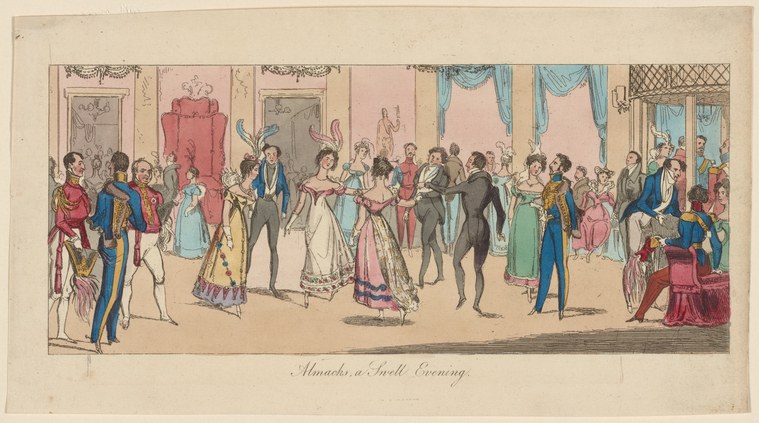
Almacks, a swell Evening
Unknown artist
- Collection:
- Prints depicting dance
- Source:
- New York Public Library
- Rights:
- Public domain — free to use, share and adapt.
- Recorded as:
- Public Domain
The print is a rare visual record of how ballroom dancing was actually performed and staged in the most elite context in Regency England—not from a dance manual or choreographic description, but from a contemporary observer rendering the bodies, costumes, and spatial arrangements as they were seen. Almack's was the institution that defined respectability in dance for the era, and this image documents both the dances performed there and the social machinery surrounding them.
What you are looking at
A crowded ballroom scene of fashionable society in full evening dress, rendered in colored hand-tinted engraving. The composition stretches across the width of the print in a continuous frieze, with dozens of figures distributed throughout an elegant interior hung with blue silk curtains and decorated with neoclassical details. Couples stand and converse in small clusters, some clearly engaged in or preparing for dance; at the far right, a seated figure in red receives guests. The women wear high-waisted muslin gowns with colored silk trim and ribbons, their hair arranged in the close curls of the Regency period; the men stand in dark tailcoats, breeches, and stockings. The scene captures the moment of social dancing—some couples hold the closed ballroom position while others stand at the periphery, creating the fractured, sequential tableau typical of Regency ballroom prints. The color printing is delicate and uneven, suggesting hand coloring after engraving.
The dancing
The dancers visible in the composition adopt the upright, formal posture of early 19th-century ballroom dance. Several couples are shown in a closed hold with the man's right hand at the woman's waist and her left hand on his shoulder—the standard frame for the waltz and country dances of the period. The figures are slender and elongated in the fashion-plate style, with arms held at controlled angles rather than fully extended. The women's postures emphasize the high-waisted silhouette of Regency dress, with the torso held erect and the body weight distributed over straightened legs. No footwork detail is visible, but the overall carriage is that of trained social dancers moving through formal patterns.
The dance depicted
This is a representation of Regency-era ballroom dancing, most likely depicting either the cotillion or the quadrille—the two dominant partner and set dances of British high society between 1810 and 1830. The title 'Almacks, a Swell Evening' references Almack's Assembly Rooms on King Street in London, the most exclusive and fashionable venue for ballroom dancing in this period, where admission was strictly controlled and the dances were performed by the aristocracy and upper gentry. The waltz is also visible in the composition, marking the period of its social acceptance in England (it had been controversial in the 1810s but was established by the 1820s). The image documents not the dance itself but the social ritual surrounding it—the negotiation of partners, the spectacle of fashionable dress, the hierarchies of inclusion and exclusion that governed Almack's. The artist has chosen to show the dance as a backdrop to social performance rather than as a technical accomplishment.
How it was made
This is a hand-colored etching or engraving, with the outlines incised or etched and the color applied by hand in successive layers. The technique allowed for mass circulation—multiple impressions could be taken from the plate and then colored by workshop assistants, making it an economical way to produce fashionable prints for the middle-class market. The style of color—pale washes with selective darker accents—is typical of Regency-period hand tinting, where the engraver's line remains visible beneath the color and carries much of the compositional weight. This was a commercial popular print, intended for framing in drawing rooms or sale as a satirical or topical image, not a fine art object; the subject matter (high society, fashionable dress, recognizable venues) confirms this audience and purpose.
About this work
This is a social document of Regency ballroom culture rendered as a composite scene: a single evening at Almack's Assembly Rooms, the arbiter of fashionable dancing in Regency London. The print captures the formal, ritualized nature of early 19th-century ballroom dance and the centrality of dress, deportment, and social rank to the practice. The engraving was made for a middle-class audience interested in high-society spectacle and fashion, functioning simultaneously as a record of dance practice, a fashion plate, and a social satire. It preserves the specific look and etiquette of Almack's during its heyday, when the institution controlled access to ballroom dancing and social legitimacy itself. The work belongs to the extensive tradition of Regency social prints that documented contemporary dance, costume, and manners for a consumer market that did not attend such venues but was fascinated by them.
How to look at it
The viewer should attend to the variety of moments frozen in the composition: some couples are actively dancing in closed hold, while others are negotiating position, talking, or waiting on the margin. The artist has used the frieze format to show the dance as a social sequence rather than a single moment, capturing the full social ritual of the ballroom. Notice the careful differentiation of dress between the plain dark coats of the men (which follow strict regulation) and the colorful, varied ornament of the women's gowns—the print is partly a fashion document. The spatial arrangement, with figures at the periphery looking inward at the dancing couples, reflects the actual social structure of the ballroom, where not everyone danced and not every moment was spent in motion.
The period
This print was made during the height of Almack's cultural influence, when the venue (founded 1765) was at its most exclusive and fashionable under the management of a powerful committee of aristocratic women. The Regency period (1811–1820) and the years immediately after saw the waltz's triumph in British ballroom culture, despite initial moral objections to its closeness of hold; the quadrille and cotillion remained equally popular. Regency fashion was moving toward the neoclassical silhouette visible in the print—high waists, narrow skirts, minimal ornamentation—which had implications for how the body moved in dance. The print is part of a substantial commercial genre of satirical and observational prints of London life that flourished in this period, exploiting the public's appetite for images of fashionable society and high-society scandal.
Where it lives
The print is held in the New York Public Library's collection of prints depicting dance. It is a hand-colored engraving or etching of the type widely distributed in early 19th-century London and designed for middle-class consumption and collecting.
Dance in this work
Questions about this work
What was Almack's Assembly Rooms?
Almack's was the most exclusive ballroom in Regency London, located on King Street in the West End. Admission required a voucher from one of the club's patronesses (powerful aristocratic women), making it the gatekeeper to fashionable society. The venue was famous for strict rules governing dress, behavior, and dancing, and absence from Almack's was a serious social liability for unmarried women and ambitious men.
What dances are shown in this print?
The print shows multiple couples in the closed ballroom hold typical of both the waltz and the quadrille, the two dominant partner dances of the Regency period. The quadrille was a set dance performed in groups of four couples in a square formation; the waltz was a turning dance in closed hold that had recently become acceptable in British society despite earlier moral disapproval.
Why is everyone dressed so formally?
Almack's enforced strict rules of dress. Men were required to wear dark tailcoats, breeches, and stockings; women wore full-length gowns in the neoclassical style. These rules were part of the venue's function as an arbiter of respectability and taste, and violation of dress code could result in exclusion. The formal dress was also a marker of the social status of those admitted.
How do we know this is Almack's and not just a generic ballroom?
The inscription on the print reads 'Almacks, a Swell Evening.' The recognizable interior details (the classical architectural ornament, the arrangement of curtains and lighting) were distinctive features of the Almack's Assembly Rooms. The print was made for an audience that knew the venue by sight and was interested in topical images of fashionable society.
More dance artwork





