49 works in this view — arrow keys or swipe to move between them.
Dance in Art
The hunt ball
Unknown artist
- Collection:
- Prints depicting dance
- Source:
- New York Public Library
- Rights:
- Public domain — free to use, share and adapt.
- Recorded as:
- Public Domain
For historians of ballroom dance and courtship, this engraving documents the aesthetics and social function of the waltz in its mature Victorian form—the posture, the frame, the ballroom architecture, and the mixing of couples and observers that created the social event. For art historians, it is evidence of how the dance was visualized and circulated in print culture, and what the educated viewer was meant to understand from such a scene.
What you are looking at
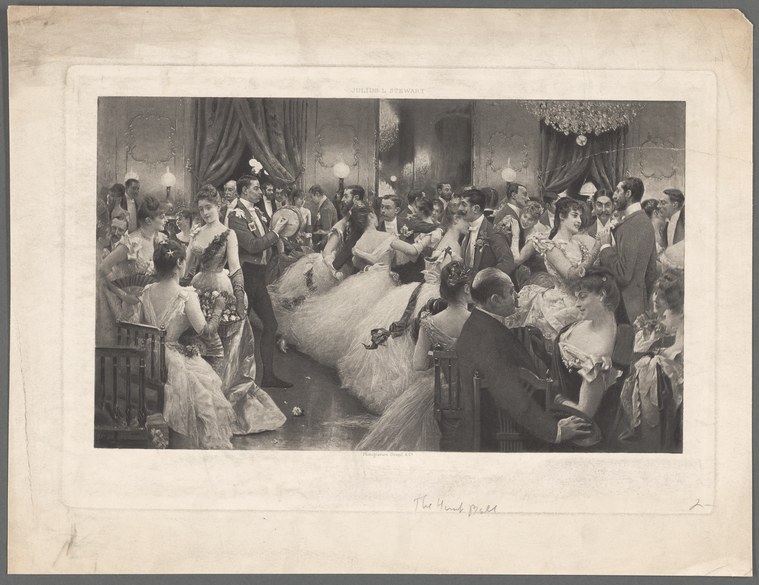
A grand ballroom scene depicts a formal social dance at what appears to be an aristocratic gathering, probably a hunt ball given the title. The composition is crowded and animated, with couples and groups distributed throughout an ornate interior lit by a large chandelier. The women wear white or pale evening gowns with low necklines and full skirts; the men are in dark formal dress—tailcoats and white shirt fronts. In the foreground, a woman's voluminous skirt billows outward, caught mid-movement, suggesting active dancing. The background shows additional figures in conversation and observation, the crowd creating a sense of social performance and spectacle. Tall curtains frame the scene, and the perspective draws the viewer into the crush of the event. The engraving technique renders fabrics with careful attention to the fall of silk and lace, and light falls across the figures to suggest the brilliance of the chandelier above.
The dancing
The dancers move in closed pairs across the floor, the women's arms positioned in the partner hold typical of European ballroom dance of the period. Their posture is upright and formal; the man in the immediate foreground supports his partner as her skirt swings, suggesting a turning figure or waltz step. Most couples maintain an even frame and face one another, though some figures at the edges stand in conversation. The density of the crowd means bodies overlap and interlock, creating a sense of the social press of the ballroom rather than isolated dancing couples. Arm lines are restrained and the overall movement appears controlled and measured rather than exuberant.
The dance depicted
This depicts the waltz or quadrille, the dominant couple dances of the Gilded Age ballroom. The closed hold, the turning motion visible in the woman's skirt, the formal evening dress, and the setting of a grand ball all point to European ballroom dance of the mid-to-late 19th century. The 'hunt ball' was a real social institution in upper-class British and American life—a formal dance held in connection with hunting season. The image captures the waltz as a primarily social performance, executed in the presence of spectators and in competition for floor space and attention, rather than as a display of technical skill. The dance here is a marker of class and courtship.
How it was made
This is an engraving or etching, likely a wood engraving given the fine parallel hatching used to model fabric, shadow, and the figures' faces. The technique required skilled hand-work to render the tonal gradations and the intricate play of light across silk skirts and the chandelier. Engraving of this quality and scale was expensive and required a large, educated audience to justify the cost—this was a print for middle and upper-class viewers who recognized the ballroom as their own world or aspired to it. The medium's ability to reproduce fine detail made it ideal for capturing the social markers of dress and setting that made the hunt ball legible to contemporary viewers.
About this work
This is a social document as much as a dance image: a record of how the waltz and quadrille were danced in the ballroom of the Gilded Age, and of the ritual and spectacle surrounding them. The print captures a specific moment in dance history—the waltz's integration into formal European ballroom life, when it had moved from scandal to respectability—and frames it as a display of social order, fashion, and courtship. The image belongs in a dance gallery because it shows us not just the step or the hold, but the entire social apparatus of ballroom dance: the dress code, the architecture that housed it, the gender relations it enacted, and the role of the spectator in making the dance meaningful.
How to look at it
Look first at the woman's skirt in the foreground: the engraver has caught the moment of a turn or spin, when the skirt swings outward in a bell shape. That detail—the fabric's response to the body's motion—is the signature of the waltz. Then trace the couples across the floor and notice how many are in closed hold, facing one another, moving in the same direction around the room. Finally, observe the social composition: the density of the crowd, the presence of observers at the margins, the way some figures watch the dancers. The artist is showing you the waltz not as an isolated technical feat but as a social performance, witnessed and judged.
The period
The hunt ball was a fixture of upper-class British and American social life from the mid-19th century through the early 20th. The waltz, imported from Austria and initially condemned as improper by conservatives, had become the supreme expression of respectable courtship and social rank by the Gilded Age. Engravings like this one were produced in large numbers for periodicals, gift books, and parlor display, serving as visual instruction in manners and fashion. The hunt ball itself was not primarily a dance event but a social gathering in which dancing was a central activity; the print's crowding and social mixture reflect that reality. Contemporary photographs and sketches of ballrooms show similar scenes—the crush of the crowd, the mix of dancers and observers, the formal dress—but engravings allowed for a more composed and polished rendering of the scene.
Where it lives
This engraving is housed in the New York Public Library's prints collection, where it forms part of a larger group of dance-related prints. The collection includes similar scenes of 19th-century ballroom life and serves as a visual record of popular dance and social custom.
Dance in this work
Questions about this work
How do we know this is a hunt ball and not just any ball?
The title, recorded in the print or its catalogue entry, identifies it as such. Hunt balls were distinctive social events in the British and American upper class, held during the hunting season, and they were popular subjects for prints aimed at viewers interested in fashion and society life. The formal dress and elaborate ballroom setting are consistent with a major social event rather than a private or smaller gathering.
What is the difference between a waltz and a quadrille in this image?
The waltz is a couples' dance in closed hold with continuous turning motion; the quadrille is a figure dance for four couples in a square formation. In a crowded ballroom print like this one, both dances would have been happening simultaneously in different areas of the floor. The woman's billowing skirt in the foreground suggests a waltz turn, but some of the other couples may be in quadrille figures. The engraver has not distinguished them clearly, as the social effect—the crush, the spectacle—was more important than the technical detail.
Why are women's skirts so big?
The full skirt was the height of fashion in the mid-to-late 19th century, achieved with layered crinolines and petticoats. Large skirts were impractical for dancing but were a powerful marker of status—they consumed fabric and labor, and required a woman to move carefully and formally. The engraver has emphasized the skirts as one of the print's main subjects, as they were for the contemporary viewer: the movement and fall of expensive fabric was one of the pleasures of watching the waltz.
More dance artwork





