49 works in this view — arrow keys or swipe to move between them.
Dance in Art
Les petites folles: trois quadrilles pour le piano, dédiés aux jeunes demoiselles
Unknown artist
- Collection:
- Prints depicting dance
- Source:
- New York Public Library
- Rights:
- Public domain — free to use, share and adapt.
- Recorded as:
- Public Domain
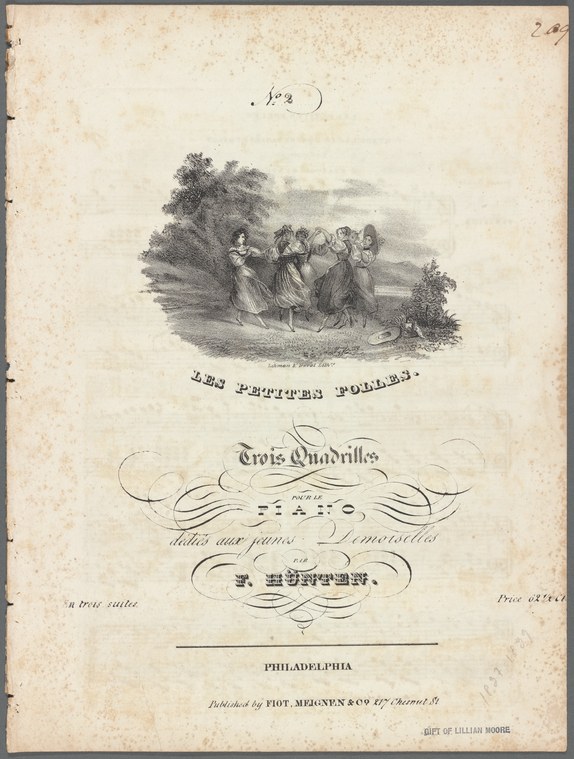
This object reveals the entanglement of dance, music, gender, and domestic life in nineteenth-century America. The quadrille's presence in amateur piano repertories, and its marketing specifically to young women, shows how ballroom dance saturated middle-class life not through professional performance but through sheet music and home practice. The disjuncture between the title (which names a dance) and the image (which shows no dancing) is itself instructive: it documents what the publisher believed would sell the music, and what audiences believed a dance-music cover should depict.
What you are looking at
This is a lithographic title page for a piano piece, printed in Philadelphia in the 1840s–1850s. At the top, within an ornamental oval border, a scene shows five young women in mid-nineteenth-century dress arranged in a loose group on a lawn, with trees visible behind them. The women wear full skirts typical of the 1840s–1850s, with fitted bodices and long sleeves. Their poses suggest animated conversation or preparation rather than formal dancing—one figure gestures expressively. The setting is informal and domestic, executed in the soft tonal gradations characteristic of lithography, with atmospheric shading suggesting daylight and outdoor air. Below this vignette, decorative flourishes frame the title and attribution.
The dancing
The five figures are distributed informally across the composition without the rigid geometry of formal dance instruction. Their bodies are at various angles: some turn toward each other, one extends an arm in gesture. None display the upright, symmetrical frame of ballroom dancers or the trained posture of staged performers. The grouping suggests social gathering or courtship rather than choreographed movement, and the loose spacing—sometimes overlapping, sometimes apart—implies spontaneous arrangement rather than set positions. The artist has rendered the women as conversational and engaging rather than as bodies executing a specific step.
The dance depicted
The title identifies this as *Trois Quadrilles pour le piano, dédiés aux jeunes demoiselles* (Three Quadrilles for piano, dedicated to young ladies). Quadrilles were among the most popular social dances of the nineteenth century, especially among the middle class, and were central to ballroom life and domestic musical performance. Yet the imagery here does not depict an actual quadrille in progress—no couples, no formation, no hold. Instead, it presents an idealized domestic scene of young women, likely meant to appeal to the purchasers and performers of the sheet music: young ladies of genteel households. The vignette illustrates not the dance itself but the genteel social world in which such music was consumed and performed, marking this as sheet music marketed to a female amateur audience rather than a dance instruction document.
How it was made
This is a lithograph, identifiable by the soft tonal modeling, the way forms emerge from subtle gradations of tone rather than line, and the characteristic uneven inking visible across the surface. The process allowed rapid, affordable production of illustrated sheet-music covers for popular sale. The vignette and decorative typography were drawn directly onto the lithographic stone, enabling the printer to produce multiple copies for commercial distribution. This technology democratized illustrated music publishing: unlike hand-colored engravings or paintings, lithographs could be mass-produced affordably, making illustrated sheet music accessible to middle-class households. The presence of the printer's name (Fiot. Meigon & Co., Philadelphia) and the legible title indicate this was a commercial product intended for retail sale.
About this work
This is the decorative title page of a published piano score, printed in Philadelphia in the mid-nineteenth century, containing three quadrilles for amateur home performance. Rather than depicting dancers executing the quadrille, it presents an idealized scene of genteel young women in a domestic landscape, framing the music as a fashionable pursuit suited to unmarried ladies of respectable families. The lithographic technique allowed the publisher to create an appealing, affordable cover that would attract buyers from the growing middle class. The work is a document of how dance was marketed, consumed, and imagined in the American domestic sphere of the 1840s–1850s: not primarily as a performed art to be watched, but as a participatory social practice mediated through domestic music-making.
How to look at it
Note the absence of what you might expect to find: the five figures are not arranged in the closed couples or the geometric sets that an actual quadrille would require. No one is shown dancing; instead, they are shown socializing, gesturing, turning toward one another in conversational mode. This is the image the publisher chose to frame a dance-music product, and it tells us what the audience valued: not technical instruction or performance documentation, but the idealization of young women's genteel social world. The soft, luminous lithographic rendering—pastoral and intimate—associates the music with leisure, propriety, and feminine accomplishment rather than with spectacle or virtuosity.
The period
The quadrille dominated social dancing in Europe and America from the 1820s through the 1880s. It was considered more orderly and democratic than older court dances: any four couples could perform it from written instructions, without need for a dancing master's constant oversight. By the 1840s, quadrilles had become standard in amateur piano repertoires alongside waltzes and other dances, published in countless arrangement for home performance. Young women's musical education routinely included dance music, and the ability to play quadrilles and cotillion sets at the piano was a mark of gentility. This sheet music belongs to that vast, mostly anonymous output of commercial music publishing directed at female amateurs, a publishing sector that grew dramatically as the middle class expanded.
Where it lives
The work is held in the NYPL's collection of prints depicting dance, catalogued without accession number or date of acquisition. It bears the imprint of Fiot, Meigon & Co., Philadelphia, a music publisher active in the mid-nineteenth century.
Dance in this work
Questions about this work
Why doesn't the picture show people actually dancing a quadrille?
This is a sheet-music cover, not a dance instruction manual. The publisher used an idealized domestic scene to market the music to its target buyers—middle-class families purchasing amateur piano pieces for home performance. The vignette sold the music as a fashionable, genteel pursuit, not as a guide to how the dance was executed. The image appeals to the consumer's sense of social aspiration and refinement.
What is a quadrille?
A quadrille is a ballroom dance for four couples arranged in a square. It consists of five sections, each with a defined pattern of movements and figures. It became one of the most popular social dances of the nineteenth century and was a staple at balls and assemblies. Its popularity was partly due to its democratic structure—it required no aristocratic privilege or professional instruction, only a copy of the figures and some musical accompaniment.
Who would have bought this music?
Middle-class families, particularly those with daughters old enough to learn piano. Quadrille arrangements for piano were among the most affordable and widely available dance music in the nineteenth century. The dedication 'aux jeunes demoiselles' (to young ladies) makes clear the publisher's target: girls and unmarried women whose musical literacy and access to a piano were marks of their families' gentility and prosperity.
What can we learn from this image about nineteenth-century dance culture?
It reveals that ballroom dance in the nineteenth century was not primarily a spectator art but a participatory amateur practice mediated through home music-making. Dance culture was gendered feminine insofar as women's musical and social education was concerned; dance music functioned as both leisure and a marker of respectability. The absence of actual dancers in the imagery suggests that the imagined user of the music valued the social and genteel associations of dance more than technical mastery or performance.
More dance artwork





