49 works in this view — arrow keys or swipe to move between them.
Dance in Art
Men dancers and choreographers in prints
Unknown artist
- Collection:
- Prints depicting dance
- Source:
- New York Public Library
- Rights:
- Public domain — free to use, share and adapt.
- Recorded as:
- Public Domain
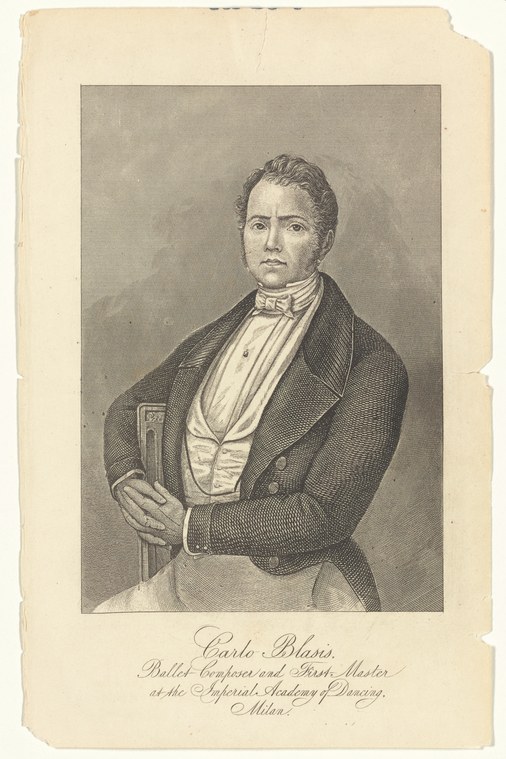
Blasis was one of the first to systematize ballet technique in written form, and his theories influenced a generation of dancers and choreographers. This portrait, produced for circulation during his lifetime or shortly after, shows how ballet masters were presented to the public—not as performers but as intellectual authorities. Understanding how dance professionals were visualized and celebrated in this period is essential to reading the institutional history of ballet.
What you are looking at
This is a portrait engraving of a male dancer in early 19th-century formal dress. He stands in a three-quarter pose against a neutral background, wearing a dark jacket with white shirt front and bow tie, light-colored breeches, and what appear to be formal dancing shoes. His left arm hangs naturally at his side while his right arm is bent, the hand positioned near his chest in a gesture of presentation or address. His expression is serious and composed, his gaze directed toward the viewer with the formal dignity expected of a theatrical professional of his era. The engraving technique renders the figure with fine hatching and tonal gradation, creating volume and a sense of refinement appropriate to the subject's status.
The dancing
The figure is presented in a standing position with an upright, formal carriage typical of early 19th-century ballet and theatrical dance. His posture suggests trained deportment—shoulders back, neck elongated, weight evenly distributed. The positioning of his right hand near the torso, combined with the alert but composed expression, suggests the formal address or salutation pose common in ballet and theatrical performance of the period. There is a single figure only, rendered in isolation rather than in movement or partnering.
The dance depicted
The inscription identifies this as Carlo Blasis, the renowned ballet master and choreographer. Blasis was a dominant figure in early 19th-century ballet, known for his theoretical writings on dance technique and his work as a teacher and choreographer across Europe. The formal portrait style and the absence of active movement suggests this is a professional likeness documenting a celebrated figure rather than depicting a specific choreography or moment of performance. The dignified pose and formal dress are consistent with how ballet masters of the era were portrayed—as intellectual authorities rather than performers in motion.
How it was made
This is an engraving, rendered with fine cross-hatching and careful tonal modulation to suggest form and fabric. The technique allows for the precise delineation of detail—the texture of the jacket, the crisp white of the shirt, the fall of light across the face—and was the standard method for producing reproducible theatrical portraits for circulation among audiences and within the profession. The quality of the engraving suggests this was a work of some expense, intended for a educated audience familiar with Blasis's reputation.
About this work
This is a formal engraved portrait of Carlo Blasis, one of the most influential ballet theorists and teachers of the early 19th century. The image documents not a dance itself but the professional identity of a man who shaped how ballet was taught and understood in his time. As the inscription records, Blasis held the position of ballet master at the Royal Academy of Dancing in Milan, one of the principal institutional centers of ballet pedagogy in Europe. The work belongs in a gallery of dance imagery because it documents the career and cultural standing of a figure whose writings and teaching methods—collected in works like *Traité élémentaire, théorique et pratique de l'art de la danse* (1820)—codified the technique and aesthetic principles that defined 19th-century ballet.
How to look at it
The viewer should attend to the pose as a deliberate statement of professional authority: Blasis is not shown dancing, but rather presenting himself as a master of the art. The formal dress—indistinguishable from the everyday formal wear of a gentleman of his era—was what a ballet master would have worn while teaching or appearing in administrative roles at the academy. The hand gesture and the direct gaze establish a relationship with the viewer as a person of cultivation and knowledge. The engraving technique, with its careful modeling of form, reflects the period's investment in rendering professional identity with precision and dignity.
The artist
The engraver is not recorded, but the quality of execution and the formal nature of the commission suggest a professional of standing, likely working in Italy or a major European dance center in the early 19th century. Such portraits were typically created by engravers specializing in theatrical and professional portraiture, and were often issued as separate prints for sale to audiences or within the profession itself.
The period
This portrait dates to the era when ballet was establishing itself as a legitimate theatrical art form with systematic pedagogy. The early 19th century saw the publication of the first comprehensive written treatises on dance technique, of which Blasis's work was the most influential. At the same time, theatrical portraiture—particularly engraved portraits of celebrated dancers and masters—became an important market, circulating the likenesses of stars and celebrated teachers to a growing middle-class audience. This was also the period of Romantic ballet, though Blasis himself was more closely aligned with the late Classical aesthetic and the codification of technique that would support Romantic choreography.
Where it lives
This engraving is held in the New York Public Library's collection of prints depicting dance, suggesting it entered an institution dedicated to preserving visual records of dance history. Such institutional collecting often focused on portraits of celebrated dancers and teachers, understanding them as documents of the profession's development.
Dance in this work
Questions about this work
Who was Carlo Blasis and why is he important?
Blasis (1795–1878) was an Italian ballet master and theorist whose written works, particularly his *Traité élémentaire* (1820), were the first systematic codification of ballet technique. He taught at major academies including La Scala in Milan and was instrumental in establishing ballet as a discipline with standardized positions, movements, and pedagogical methods. His influence shaped how ballet has been taught from his era to the present day.
Why is a portrait of a dance figure in a gallery of dance imagery?
Dance history is not only the visible movement of bodies; it includes the figures who shaped how dance was understood, taught, and valued. Portraits of celebrated dancers, choreographers, and teachers are documents of how the profession understood and presented itself. This engraving shows how Blasis was positioned in his own time—as an intellectual authority, not merely a performer.
What does the formal dress tell us about early 19th-century ballet?
Blasis wears the everyday formal dress of a gentleman of his era, not a costume. This reflects that he is presented here in his role as a teacher and administrator, not as a performer in a staged work. It also shows that ballet masters were understood as educated professionals akin to other men of letters and authority, not as entertainers or athletes.
How was this engraving made and who would have seen it?
Engraving was the standard reproductive technique of the era, allowing multiple impressions to be printed from a single plate. Such theatrical portraits were sold separately as prints to audiences, fellow professionals, and collectors interested in dance and theater. They circulated within the profession and among educated urban audiences, making them tools for building and documenting professional reputation.
More dance artwork





