49 works in this view — arrow keys or swipe to move between them.
Dance in Art
The masked ball
Unknown artist
- Collection:
- Prints depicting dance
- Source:
- New York Public Library
- Rights:
- Public domain — free to use, share and adapt.
- Recorded as:
- Public Domain
For dance historians, the masked ball represents a crucial transition in social dance: the moment when aristocratic control of dance was giving way to a more democratic, though still class-bound, social choreography. The engraving shows us how that transition was visualized and celebrated—as spectacle, disorder, and transgression made safe by costume and architectural containment. For visual historians, it documents both the fashions and the spatial grammar of Gilded Age ballrooms.
What you are looking at
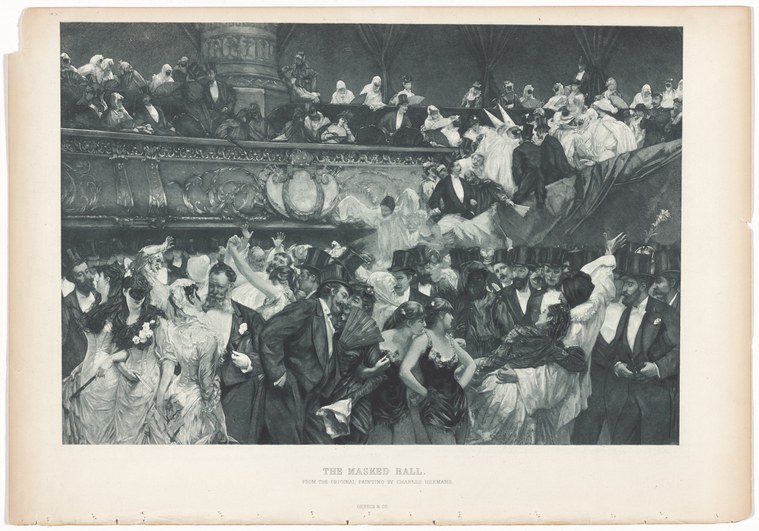
A crowded masked ball occupies an ornate interior, likely a ballroom or theater, depicted in a dramatic engraving with strong chiaroscuro. The composition divides into two registers: an upper gallery packed with spectators in formal dress, many wearing masks and hats, leaning over an elaborate gilded balustrade; and a lower floor thronged with dancers and revelers in costume. The figures below are caught in varied attitudes of movement and social interaction—some dancing in couples, others clustered in conversation, still others gesturing animatedly. The lighting concentrates on the whirling figures of the lower space, their white gowns and formal dark dress contrasting sharply against deep shadow. The architectural frame—visible columns, the ornate rail, draped fabrics—situates this as a grand public or semi-public event. The energy is palpable: bodies lean, turn, and interpenetrate across a packed floor, and the crowding itself becomes part of the spectacle, the masked anonymity enabling the social disorder that the formal dress and setting can barely contain.
The dancing
The dancers occupy a range of positions and partnerships. Some figures engage in coupled movement, though the press of the crowd makes discrete partnering difficult to discern; others stand apart, gesturing or in animated conversation. The women wear long, voluminous gowns typical of Gilded Age formal dress, their silhouettes creating a visual lightness that the engraver exploited. Men in dark coats and many wearing masks or dominoes provide visual ballast. Arms are raised, extended, and gestured expressively—the gestural language is one of animation and theatricality rather than the controlled frame of ballroom technique. Posture is upright but not rigidly formal; weight shifts and the bodies angle toward one another in ways that suggest the improvisation of social dance rather than choreographed precision.
The dance depicted
This depicts the social dance of a masquerade ball, the most celebrated public dance event of the Gilded Age. The masked ball was a theatrical social performance in which rank, gender, and identity were temporarily suspended; the masquerade permitted and encouraged a more fluid, flirtatious, and anarchic style of interaction than daytime society allowed. The dances themselves—likely quadrilles, waltzes, and cotillions—are not individually legible in this crowded composition, but the engraving captures the psychological atmosphere of masked dancing: the disinhibition, the close quarters, the mixture of spectation and participation, the pleasure of anonymity. The spectators on the gallery above are as important as the dancers below; the masked ball was a spectacle of social disorder made visible and contained within an architectural frame.
How it was made
This is an engraving, identifiable from the fine linear hatching that builds tone and shadow, the sharp contrasts between black and white, and the lack of color. Engraving allowed for reproduction and wide circulation; this print belongs to a well-established tradition of depicting society scenes and public entertainments for a middle-class audience. The technique's demand for high contrast and bold silhouettes suited the subject—the engraver has used the formal dress and masked costumes as graphic elements, the white gowns reading as near-white against the deeply worked background. The intricate surface detail and the skill required to render the architecture and the massed figures suggest this was made for an educated audience familiar with fine prints.
About this work
The Masked Ball is a Gilded Age social scene captured in engraving, likely from the mid-to-late nineteenth century. It records not a specific event but the type—the masquerade ball as a performance of social transgression and spectacle. The composition's divided structure, with spectators above and dancers below, emphasizes that the masked ball was as much about the visibility of disorder as the disorder itself. The work belongs to a long tradition of prints depicting high-society entertainments, a tradition that extends back to Hogarth and continues through the nineteenth century. It captures a particular moment in dance history when the waltz and other couple dances had opened social dancing to improvisation and private feeling, yet that emotion still unfolded within the rigid architecture of ballroom convention and formal dress.
How to look at it
Attend first to the structure of the composition: the division between watchers and dancers creates two distinct planes of social action. Notice how the engraver has rendered the density of the crowd through overlapping forms and the intensity of the hatching—the more crowded the space, the darker and more worked the engraving. Look at the individual gestures: raise an arm, turn a head, the angle of a spine—these record the micro-choreography of social flirtation and display. The masks themselves are worth studying; some are barely visible, others prominent, and their visibility or invisibility becomes part of the social performance. Finally, consider what is not shown: the music, the musicians, the specific dances being executed—this is a scene of social atmosphere, not balletic precision.
The period
The masked ball reached its peak popularity in the nineteenth century, though it has roots in Renaissance carnival and eighteenth-century aristocratic culture. By the Gilded Age, the masquerade had become a fixture of urban high-society life, a staged transgression that allowed the upper classes to play at social disorder while remaining firmly within an elite enclosure. The waltz, which dominates couples' dancing in this period, had been controversial for its closeness and intimacy; the masked ball provided a context in which that intimacy could be both indulged and disavowed—'I don't know who I am dancing with; therefore I am not responsible.' In art, the masked ball scene became a standard subject for society painters and printmakers, who used it to explore themes of identity, desire, and the transparency or opacity of the social body.
Where it lives
The work is held in the New York Public Library's collection of prints depicting dance. It is catalogued only as 'The Masked Ball,' without artist attribution, date, or medium specification; the medium and likely period are established from the image itself.
Dance in this work
Questions about this work
What is a masked ball and how is it different from other ballroom events?
A masked ball is a formal social dance event where participants wear masks and costumes, traditionally creating anonymity that permits a more playful, flirtatious, or transgressive atmosphere than unmasked society events. The mask was understood as a temporary suspension of social identity; one could dance more freely, speak to strangers, or violate normal protocols of courtship and class because one's masked identity was, in theory, unknown. Masked balls became hugely popular among the European and American upper classes in the eighteenth and nineteenth centuries, and were often associated with carnival season or special occasions.
What dances would have been performed at this ball?
The primary couple dances of the Gilded Age were the waltz, the quadrille, and the cotillion, all of which are consistent with the period suggested by the dress in the engraving. The quadrille was a structured dance for four couples in a square formation; the cotillion was a more elaborate, figure-based dance; the waltz was a rotating, intimate couples dance. While specific dances are not legible in this crowded composition, the close positioning of many couples and the fluid movement suggested by the gestures align with the waltz's dominance by the mid-nineteenth century.
Why are spectators shown on a gallery above the dancers?
The gallery seating suggests this may have been a masquerade held in a ballroom that incorporated a theatrical design, or possibly in a theater or opera house during a gala. The presence of spectators elevated above the dance floor emphasizes that the masked ball was a spectacle—not only a social event in which one participated, but a visual performance that one could observe from a distance. This architecture made visible the transgressive pleasure of the masked ball: the ordered watching of apparent disorder.
More dance artwork





