49 works in this view — arrow keys or swipe to move between them.
Dance in Art
The polka on 19th-century music covers
Unknown artist
- Collection:
- Prints depicting dance
- Source:
- New York Public Library
- Rights:
- Public domain — free to use, share and adapt.
- Recorded as:
- Public Domain
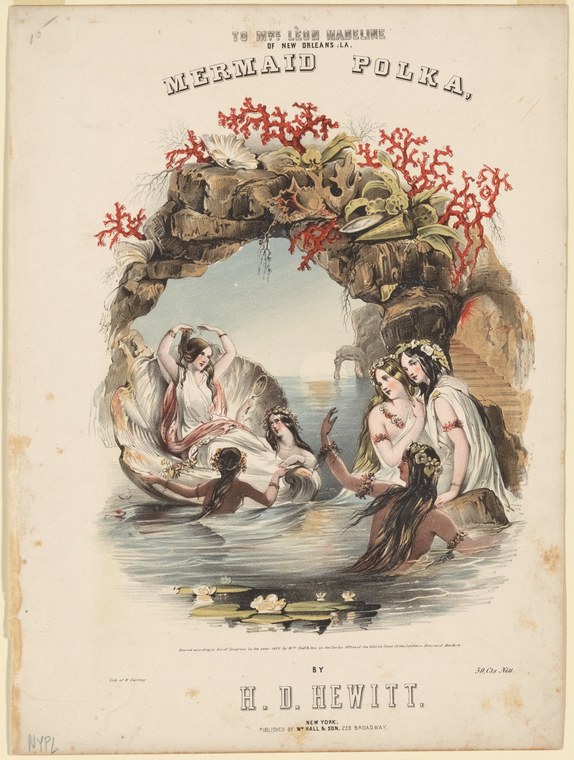
This object documents the polka craze and its intersection with Romantic ballet aesthetics in mid-19th-century popular culture. For historians of dance, it shows how a social dance was marketed and consumed as entertainment, and how music publishers understood the appeal of blending ballroom dance with theatrical fantasy to reach domestic audiences.
What you are looking at
A hand-colored lithograph shows a seaside grotto framing two pairs of figures at the water's edge. On the left, a woman in pale drapery leans toward the water; on the right, another woman in similar dress gestures expressively. Between them, two darker-skinned figures—one male, one female—emerge from or move through shallow water, their bodies partially submerged. Red coral formations arch overhead, framing the composition. The water is rendered in pale blue-green; the sky beyond is luminous and distant. The overall mood is Romantic and fantastical, evoking a scene of aquatic enchantment or courtship. The title "Mermaid Polka" and the publisher information (H. D. Hewitt, New York) appear at the base.
The dancing
The two seated or kneeling women on shore are arranged in elegant, open poses with raised arms and upturned faces, suggesting wonder or invitation. Their posture is languid and theatrical, characteristic of 19th-century Romantic ballet deportment. The two figures in the water are depicted in a more animated, dancing attitude—the male figure appears to be in a springing or turning position, while the female figure reaches upward. The composition suggests paired interaction across the land-water divide, with the shore-bound figures as witnesses or participants in a scenario of magical encounter.
The dance depicted
This is a musical score cover for a polka, a lively couple dance that became fashionable across Europe and North America in the 1840s–1860s. The title references the Romantic ballet trope of the mermaid—a supernatural or mythical female figure, most famously in *La Sylphide* (1832) and *Giselle* (1841). The image conflates the polka (a social, partnered ballroom dance) with ballet's ethereal, otherworldly aesthetic. The aquatic setting and the presence of darker-skinned figures suggest an exoticized, fantastical scenario typical of mid-19th-century entertainment imagery. However, the actual choreography of the polka—a fast, turning couple dance in 2/4 time—is not directly depicted here; instead, the cover trades on the cultural association of polka music with gaiety, exoticism, and Romantic fantasy.
How it was made
This is a hand-colored lithograph, a medium that allowed rapid, affordable reproduction of popular music covers in the 19th century. Lithography's ability to combine drawn line with tonal washes made it ideal for theatrical imagery. The hand coloring—applied to the printed stone—gives each impression slight variation and warmth. As a music-cover lithograph, this object was a mass-produced consumer item, circulated through music publishers and retail outlets to advertise and sell the composition to amateur pianists and music-making households. The quality of the draftsmanship and the naturalistic rendering of drapery and water suggest a skilled commercial artist rather than a fine-art engraver.
About this work
This is a lithographed cover for a polka composition published in New York in the mid-19th century. The polka was one of the century's most successful social dances, adopted across Europe and America as a symbol of modernity and gaiety. The cover does not depict actual polka dancing but instead wraps the music in Romantic ballet imagery—mermaids, magic, exoticism, and courtship—to market it to a middle-class audience hungry for fantastical entertainment. The image conflates ballroom dance, theatrical spectacle, and orientalist fantasy, revealing how these genres overlapped in popular culture and how music publishing used visual allure to sell sheet music.
How to look at it
Attend to the tension between the two worlds depicted: the two pale, refined women in elegant drapery represent the Romantic ballet aesthetic and bourgeois femininity, while the figures in the water represent exoticism, magic, and the "other." The artist has chosen a moment of stillness and anticipation rather than active dancing—a compositional choice that emphasizes spectacle and fantasy over movement. Note how the coral arch frames the scene like a stage proscenium, turning the natural grotto into a theatrical space. The hand coloring gives the work a precious, hand-finished quality that suggests luxury and bespoke artistic effort, despite its status as a mass-produced object.
The period
The polka emerged in Bohemia in the 1830s and swept across Europe and North America in the 1840s and 1850s, becoming the most fashionable couple dance of the era. It was celebrated for its speed, energy, and accessibility compared to the formality of the waltz. Simultaneously, Romantic ballet—with works like *La Sylphide* and *Giselle*—was at its height, emphasizing ethereal, supernatural female figures and exotic settings. By the 1850s–1870s, these two worlds of dance (ballroom and theatrical) were culturally distinct, but music publishers frequently used ballet imagery on polka covers to elevate the genre and appeal to aspirational audiences. The inclusion of exoticized, non-European figures reflects the period's orientalism and the entertainment industry's standard visual vocabulary.
Where it lives
This is a music cover housed in the New York Public Library's Prints collection, likely acquired as an example of 19th-century American popular music publishing and commercial lithography. Music covers like this were produced in vast quantities and are rarely preserved unless collected systematically.
Dance in this work
Questions about this work
Is this actually depicting a polka, or is it just fantasy?
It is not depicting the polka dance itself. Rather, it is a marketing image for a polka composition. Music publishers in the 19th century often used fantastical or theatrical imagery on covers to appeal to the emotions and aspirations of consumers, rather than to illustrate the actual social dance or its steps. This cover trades on the excitement surrounding the polka craze while evoking the glamour of Romantic ballet.
Why are some figures darker-skinned and in the water?
This reflects the period's use of exoticized and racialized imagery in entertainment marketing. The juxtaposition of pale, refined European women with darker-skinned figures placed in a fantastical aquatic setting was a common visual trope in 19th-century theatrical and commercial art, reinforcing hierarchies of beauty, refinement, and "otherness." The water setting may also invoke mythological or colonial contexts that were popular in Romantic-era fantasy.
What is the actual polka dance?
The polka is a fast, turning couple dance in 2/4 time, characterized by a hop-step-close pattern danced at speed. Couples move around the floor in a closed or semi-closed position, with frequent rotations. It originated in Bohemia and became wildly popular across Europe and America from the 1840s onward. It was celebrated as a democratic, energetic, and modern dance compared to the more formal waltz.
More dance artwork





