49 works in this view — arrow keys or swipe to move between them.
Dance in Art
The polka on 19th-century music covers
Unknown artist
- Collection:
- Prints depicting dance
- Source:
- New York Public Library
- Rights:
- Public domain — free to use, share and adapt.
- Recorded as:
- Public Domain
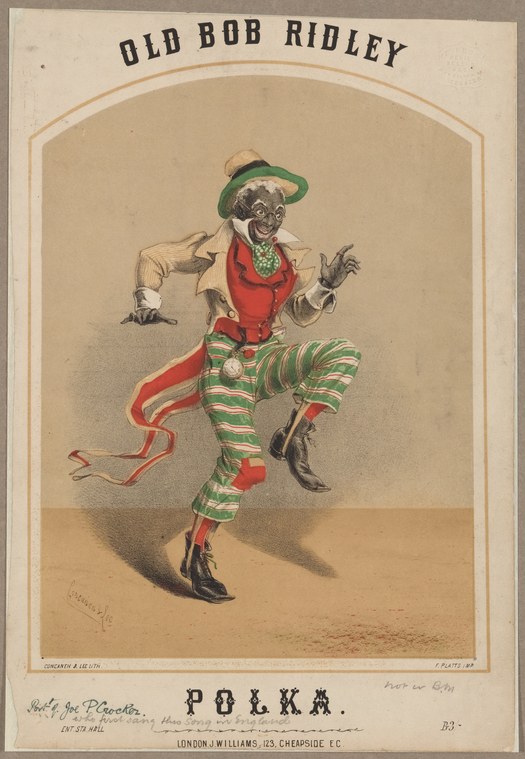
The image reveals the polka's dual existence in 19th-century culture: simultaneously a respectable social dance and a subject for comedic performance. It documents the visual language of popular entertainment—the caricature, the exaggerated posture, the use of makeup—and shows how stage performers transformed fashionable dances into comedy. For dance historians, it is evidence of how the same dance could be performed and interpreted across different contexts and audiences, from the ballroom to the music hall.
What you are looking at
A caricatured figure in theatrical costume dominates the composition, set against a plain tan background. The dancer wears a red jacket with green-and-red striped breeches, a green hat with a feather or plume, and black boots with exaggerated points. His face is painted dark with grotesque features—wide grin, prominent nose—in the style of 19th-century performance caricature or minstrelsy makeup. His posture is one of energetic, sprightly movement: one leg is raised and bent, the other planted, with arms spread in a gestural pose suggesting vigorous action. A red ribbon or scarf trails from his hand. The figure's exaggerated proportions, theatrical dress, and the comedic distortion of his features place this firmly in the tradition of popular entertainment graphics and music covers. The title and publisher information are printed directly on the sheet, identifying this as cover art for a musical composition.
The dancing
A single male figure, rendered with deliberate grotesque exaggeration typical of 19th-century theatrical caricature. His weight is shifted onto one planted leg while the other is lifted and bent, creating a pose of forward momentum and agility. His arms are raised and spread, one holding a ribbon or scarf, the other open in a gesture of abandon. The torso twists and pitches, suggesting the rotational energy of a vigorous, turning movement. This is not naturalistic choreographic form but rather a comic, recognisable caricature of energetic lower-body action.
The dance depicted
The work is titled 'Old Bob Ridley Polka,' identifying it as music cover art for a polka—a central European couples' dance that became wildly popular in Britain and America during the 1840s–1860s. The figure's costume, pose, and the comedic distortion all point to performance in a minstrelsy or popular music hall context rather than ballroom dancing. The exaggerated stepping action and the theatrical makeup suggest this may represent how the polka was performed or parodied in popular entertainment rather than in formal social dance. The specific identity of 'Old Bob Ridley' remains unclear from the image alone, though the work documents how the polka existed simultaneously as a fashionable social dance and as a subject for popular comedy and caricature.
How it was made
This is a chromolithograph or hand-coloured lithograph, printed by London publisher Williams. The technique allowed rapid, inexpensive circulation of music covers and sheet music graphics to a broad popular audience in the mid-to-late 19th century. The coloured printing and the prominence of the figure on the page are typical of music cover design: the image had to be eye-catching and legible at arm's length in a shop or home. The quality of line and the flatness of the colour planes are consistent with commercial lithography of the 1850s–1870s.
About this work
This is a music cover for a polka composition, 'Old Bob Ridley,' printed by a London publisher in the mid-19th century. The work captures the polka at the height of its popularity as both a fashionable social dance and a subject for popular comedy and caricature. It documents not the ballroom version of the dance but its performance in a minstrelsy or music hall context, where exaggeration, grotesque makeup, and theatrical parody transformed the dance into entertainment. The figure's sprightly, vigorous posture and the comic distortion of his features show how the polka's speed, bounce, and turning action could be rendered as popular spectacle.
How to look at it
Attend to the pose: the raised leg, the spread arms, the twisted torso all convey the energy and bounce of a fast turning movement. The artist has frozen a moment of vigorous action—neither the beginning nor the completion of a step, but the dynamic in-between. The grotesque makeup and the exaggerated proportions are not attempts at verisimilism but shorthand for 'performance' and 'entertainment'—the visual code that tells the viewer this is not a gentleman dancing the polka in a ballroom, but an entertainer caricaturing it for laughs. The red ribbon trails through the space, adding a sense of trailing, whipping motion. Look at how the legs, arms, and torso all work together to suggest continuous, propulsive action.
The artist
The work is unsigned and attributed to an unknown artist. It is typical of commercial graphic production for London music publishers in the mid-to-late 19th century, where illustrators created sheet music covers as standardised products rather than as individually signed artworks. The style and technique are consistent with the work of music cover illustrators of the period, though individual attribution is not possible from the image alone.
The period
The polka emerged in Bohemia in the 1830s and became a sensation across Europe and America from the 1840s onward. By the 1850s and 1860s, when this cover was likely printed, the polka was established as both a fashionable ballroom dance and a staple of popular entertainment. Music publishers flooded the market with polka compositions, and sheet music covers became a primary medium for visual entertainment and advertisement. Simultaneously, minstrelsy and music hall performance thrived, and the grotesque caricature style visible here reflects the performance conventions and racial imagery of mid-Victorian popular entertainment. The polka's rapid, bouncing rhythm and the prominence of turning made it visually distinctive and easy to parody or exaggerate for comic effect.
Where it lives
The work is held in the New York Public Library's prints collection, which focuses on visual culture including dance ephemera, sheet music covers, and theatrical graphics. It is documented as part of the Library's broader holdings of 19th-century popular entertainment materials. The publication information—'London: Williams, 125 Cheapside, E.C.'—identifies it as a commercial music publisher's product, typical of the thousands of polka compositions released during the dance's peak of popularity.
Dance in this work
Questions about this work
What is 'Old Bob Ridley'?
The title identifies this as a polka composition, likely named after a performer, entertainer, or character known in 19th-century music hall culture. 'Old Bob Ridley' appears to have been a stage persona associated with comedic performance. Without more detailed records, the specific identity and biographical details of the performer remain unclear, but the name was sufficient marketing for a sheet music cover aimed at amateur musicians and music hall audiences.
Why is the figure's face painted dark?
This reflects the conventions of 19th-century minstrelsy and music hall performance, where performers often used exaggerated makeup and caricatured racial imagery as shorthand for 'entertainment' and 'comedy.' The dark makeup, grotesque features, and overall caricature style were visual codes signalling that this was a comedic performance rather than a naturalistic representation of dance.
Is this showing how people actually danced the polka?
No. This is a caricature for theatrical and commercial purposes. The exaggerated posture, the grotesque makeup, and the comic distortion all signal that this is a parody or comic interpretation of the polka, not a depiction of ballroom dancing. The polka in fashionable society was danced with much less exaggeration. This shows how the dance was transformed and amplified for popular entertainment.
What was the polka, and why was it so popular?
The polka is a fast, bouncing couples' dance that originated in Bohemia in the 1830s. It became a sensation across Europe and America from the 1840s onward because of its speed, its syncopated rhythm, and its social inclusiveness—it was easier to learn than many ballroom dances and was danced in both fashionable society and popular venues. Its visual distinctiveness and energetic character made it a natural subject for parody and caricature.
More dance artwork





