49 works in this view — arrow keys or swipe to move between them.
Dance in Art
Les peines et les plaisirs de l'amour
Unknown artist
- Collection:
- Prints depicting dance
- Source:
- New York Public Library
- Rights:
- Public domain — free to use, share and adapt.
- Recorded as:
- Public Domain
This work demonstrates how Baroque court dance was embedded in allegorical and emblematic thinking, and how dance served as a visual language for expressing the abstract ideals of courtly love. For historians of dance, it provides evidence of how the body was positioned, how partners related in formal courtship, and what ideological work dance was expected to perform in aristocratic society. The engraving's circulation in print form means it shaped and reflected the cultural imagination of what courtly dance meant.
What you are looking at
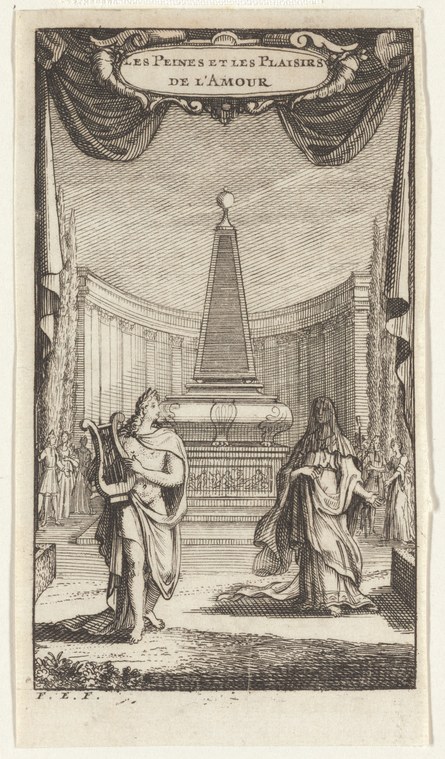
This engraving depicts an allegorical interior temple or shrine dedicated to love, the setting for an elegant dance or courtship ritual. Two figures occupy a shallow, columned space: on the left, a winged male figure (Cupid or Amor) stands in profile, gazing toward the right; on the right, a kneeling or seated female figure in classical drapery faces him. Between them rises a tall obelisk or altar, central to the composition and symbolic of devotion. The space is framed by heavy curtains or swags overhead and flanked by fluted pilasters. The floor is rendered in perspective with hatched shading, and the entire scene is rendered in fine, precise linework typical of seventeenth-century engraving. The title *Les Peines et les Plaisirs de l'Amour* (The Pains and Pleasures of Love) suggests this illustrates the emotional and physical experiences of courtly love.
The dancing
The male figure on the left stands upright with weight on both feet, his torso angled slightly toward his partner, one arm extended or gesturing in her direction; his wings identify him as divine or allegorical. The female figure on the right adopts a posture of submission or devotion—she is lowered in space, kneeling or seated, her body inclined forward with arms positioned to suggest either greeting, supplication, or the beginning of a dance gesture. The spatial relationship between them—with the obelisk as a formal divider—suggests ritual and restraint rather than close physical contact. Their positioning and arm work suggest a formal court dance protocol rather than social partnering.
The dance depicted
This image most likely depicts or allegorizes a courtly dance of the Baroque period, possibly a minuet or other formal court dance presented in mythological dress. The bilateral symmetry, the altar or obelisk as architectural anchor, and the formal postures suggest the structured, processional quality of Baroque court dances. However, the image is primarily allegorical and emblematic rather than a documentary record of actual movement. The two figures represent abstract forces—love and devotion, or the masculine and feminine principles of courtship—rather than named dancers. The dance, if present, is sublimated into gesture and spatial arrangement.
How it was made
This is an engraving, executed in fine black lines on a white ground, characteristic of seventeenth-century French or European reproductive and allegorical prints. The technique allowed for precise detail, tonal modulation through hatching and cross-hatching, and wide circulation through printing. The formal border framing the composition, the decorative cartouche containing the title, and the overall finish indicate this was a finished, published work intended for a literate, courtly audience. The level of finish and allegorical subject matter suggest this served both as an illustration of courtly ideals and as a decorative object for a collector.
About this work
This engraving presents an allegorical vision of courtly love as a structured, ritualized encounter between masculine and feminine principles, mediated by an obelisk and conducted within a formal architectural temple. The work sits at the intersection of Baroque court culture, allegorical emblem tradition, and the visual documentation of courtly dance and gesture. It belongs in a dance history because it encodes the values and formal protocols of Baroque court dance—restraint, geometry, hierarchical positioning, and emotional restraint—even though it does not depict an actual named dance or named dancers. The image suggests that Baroque dance was understood as a language of devotion and courtship played out through carefully regulated bodies and positions.
How to look at it
Observe the geometry of the composition: the obelisk dividing the space, the symmetrical flanking pilasters, the frontal presentation of the two figures. These formal choices encode the values of Baroque court dance—balance, proportion, and restraint. Notice the female figure's lowered position and the male figure's vertical stance; this height differential and postural asymmetry was a marker of courtly decorum and the social hierarchy of the period. The artist has frozen a moment of greeting or devotion rather than active movement, suggesting that in Baroque court dance, the meaningful moment was often one of pose and formal arrangement rather than dynamic motion.
The period
This work dates stylistically to the seventeenth century, when allegorical and emblematic prints were a major vehicle for circulating courtly ideals. Baroque court dance—the minuet, the sarabande, the courante—was reaching its height of formalization and codification during this period. Court dances were increasingly documented in dance notation manuals (Beauchamp-Feuillet notation was developed in the 1680s–90s) and in prints like this one that presented them within allegorical or narrative frames. The use of Cupid or Amor as a figure mediating human courtship reflects the Neoplatonic philosophy that saturated courtly culture. The print tradition allowed such idealized representations to circulate far beyond the court itself.
Where it lives
This work is held in the New York Public Library's collection of prints depicting dance. The print is identified by its title cartouche but carries no recorded artist attribution in the catalogue record.
Dance in this work
Questions about this work
Is this a real dance or a made-up scene?
The composition is allegorical and symbolic rather than documentary. However, the postures, spatial relationships, and formal arrangement reflect the actual protocols of Baroque court dance. The scene encodes real dance conventions—the geometry, the asymmetrical partnering, the restraint—within a mythological frame. It is an idealized or emblematic representation of how courtly partners related, rather than a record of a specific choreography.
What does the obelisk mean?
The obelisk is a classical symbol of stability, eternity, and devotion. In this allegorical context, it serves as an altar or shrine to love, around which the two figures enact their courtship ritual. Its presence in the center of the composition makes clear that this is not a naturalistic scene of two people dancing, but a formal, ritualized encounter mediated by an abstract principle or spiritual value.
Why is the woman kneeling or lowered?
The female figure's lower position reflects both the social hierarchy of courtly society (in which women were positioned as objects of devotion) and the formal conventions of Baroque court dance, in which partners often maintained asymmetrical, hierarchical positions. This posture would have been recognizable to a contemporary viewer as encoding feminine submission and masculine superiority within the courtship ritual.
What period is this from?
The style—the fine engraving technique, the allegorical subject, the classical drapery and architecture—places this in the seventeenth century, likely the mid- to late 1600s. This was the height of the Baroque court dance tradition in France and across Europe.
More dance artwork





