49 works in this view — arrow keys or swipe to move between them.
Dance in Art
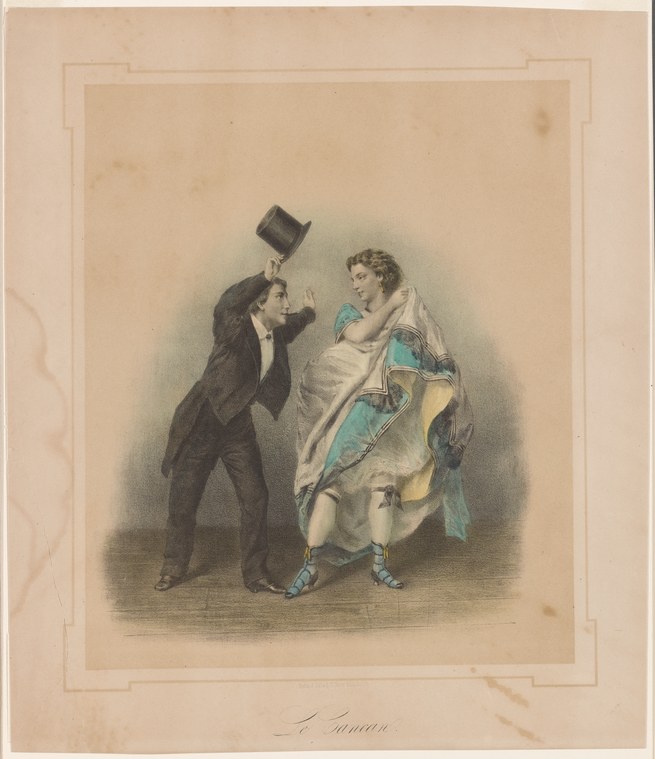
Le Cancan
Unknown artist
- Collection:
- Prints depicting dance
- Source:
- New York Public Library
- Rights:
- Public domain — free to use, share and adapt.
- Recorded as:
- Public Domain
The cancan was the first modern social dance to be explicitly condemned as immoral and to be defended as sexually liberating—a controversy that shaped how dance, gender, and modernity were understood in the nineteenth century and beyond. This print is evidence of how intensely the cancan was circulated in visual culture as a symbol and a scandal, making dance visible to a mass audience not primarily through performance but through satirical and erotic imagery.
What you are looking at
A man in dark formal dress—tailcoat, waistcoat, and top hat—leans forward toward a woman seated or reclining on his left. The woman wears a turquoise silk gown with a cream or white wrap or shawl draped across her body, and her blonde hair is styled up in the fashion of the 1840s–50s. Her posture is reclined, almost supine, with one leg extended; the man holds his top hat aloft in his right hand in a gesture that suggests surprise, delight, or theatrical exaggeration. The background is a soft, neutral wash with subtle shading that gives the figures volume without specifying a setting—no room furniture, no stage, no street, only the two bodies and the moment between them. The engraving is hand-colored with restrained pigment: flesh tones, the woman's turquoise dress, and the man's dark coat stand out against the pale ground.
The dancing
The man's posture is one of exuberant forward lean, his weight pushed off his back foot as he gestures upward with the hat—a pantomimic rather than balletic action. The woman reclines passively, her body weight supported, her leg extended in a line that suggests either a kicking or reclining pose. There is no closed hold, no frame of partnership in the ballroom sense; instead, the two are engaged in a moment of theatrical interaction or play, with the man as the active agent and the woman as the recipient or foil. The composition is intimate and frontal, drawn from a viewpoint that places the viewer as witness to a private transaction.
The dance depicted
The image is titled *Le Cancan* and depicts the moment or spirit of the cancan, the high-kicking social dance that emerged in Paris in the 1840s and became infamous for its loud, exuberant, and allegedly immodest movements—especially the high leg extensions and the exposure of women's undergarments. This print does not show a full dance floor or multiple couples, but rather captures the cancan's characteristic energy and the male-female dynamic: the woman's extended leg and reclined posture are shorthand for the cancan's signature high kicks and physically aggressive movement, while the man's astonishment registers the dance's shock value and theatrical transgression. The medium and style place this in the realm of popular satirical or theatrical imagery of the 1840s–50s, when the cancan was becoming a symbol of Parisian modernity and moral anxiety.
How it was made
This is a hand-colored engraving or lithograph (the print technique is not specified in the record, but the image shows the characteristics of hand-coloring over a line-printed base). The soft modeling of form, the fine hatching in the background, and the precision of line suggest engraving; the pale ground and the way color sits on top of the black line work favor that reading over etching. Hand-coloring allowed the artist to add chromatic information—the woman's striking turquoise dress—while maintaining the graphic clarity of the line. This technique was standard for popular theatrical and satirical prints in Paris during this period, suggesting an audience of middle-class readers, theatergoers, and people interested in current social and entertainment topics.
About this work
This is a hand-colored engraving of the 1840s–50s depicting a moment from the cancan, the anarchic Parisian social dance that became synonymous with female sexual liberation, male desire, and moral panic in the nineteenth century. Rather than showing the full spectacle of the cancan on stage or in a dance hall, the print isolates the dyadic encounter between a man and woman and uses the woman's extended leg and reclined posture as shorthand for the dance's most notorious feature: the high kick that exposed the leg and undergarments. The man's theatrically raised top hat signals surprise and delight. The image sits at the intersection of theatrical satire, social commentary, and erotic humor—genres in which the cancan was constantly represented in prints, lithographs, and illustrations from the 1840s onward. It belongs in a gallery of dance in art because it captures not the technical execution of a dance but the cultural sensation it created and the gendered dynamics it both expressed and provoked.
How to look at it
Pay attention to the woman's leg: it is extended high and at an angle that would be impossible in ballroom dancing or classical ballet, and the artist has frozen it in a position that reads immediately as the cancan's defining feature. Notice also the woman's reclined posture—almost supine—which contrasts sharply with the vertical, upright frame of ballroom partnership. The man's expression and gesture (the raised hat) are pantomimic and comedic rather than technical; they register amazement at what the woman's body is doing. The artist has chosen not a moment of synchronized steps or formal choreography, but a moment of transgression and spectacle, capturing the cancan not as a dance to be learned but as a scandal to be witnessed and commented upon.
The period
The cancan emerged in Parisian dance halls and social venues in the 1840s and gained rapid notoriety through the 1850s. By the time this print was made, it had become a symbol of Parisian modernity, working-class and lower-middle-class sociability, and female sexual agency—all of which provoked anxiety among the bourgeoisie and the establishment. The dance was frequently condemned as vulgar, indecent, and a threat to public morality; simultaneously, it was celebrated and consumed as entertainment, scandal, and proof of Paris's cosmopolitan vitality. In the visual arts, the cancan appeared constantly in prints, lithographs, paintings, and satirical journals, often exaggerating its leg-raising and the exposure of the female body for comedic and erotic effect. This print is part of that enormous output of cancan imagery that made the dance one of the most widely reproduced and discussed dances of the nineteenth century.
Where it lives
This print is held in the New York Public Library's collection of prints depicting dance. The record provides no date, artist, or medium specification, but the style and hand-coloring are consistent with French popular prints of the 1840s–50s.
Dance in this work
Questions about this work
What is the cancan and why was it so scandalous?
The cancan was a high-energy social dance that emerged in Paris in the 1840s, characterized by high kicks and energetic, sometimes violent leg movements. It was condemned by moral authorities because women's legs and undergarments were exposed during the kicks, and because it was danced primarily by working-class and lower-middle-class people (especially women) in dance halls and cabarets. The dance became a symbol of female sexual autonomy and urban modernity, which made it simultaneously celebrated and reviled.
Is this print showing an actual cancan performance or is it satirical?
It is satirical. The print isolates the male-female dyad and exaggerates the woman's reclined posture and the man's theatrical astonishment in order to comment on the cancan's shock value and its role in urban social and sexual culture. Real cancan performances involved groups of dancers, rhythmic music, and sustained sequences of high kicks; this image condenses the dance into a single transgressive moment for comedic and erotic effect.
What does the woman's extended leg tell us about how the cancan was understood?
The extended leg was the cancan's signature move and the source of its notoriety. By isolating and emphasizing the leg, the artist makes clear that the cancan's cultural meaning derived not from its musical accompaniment, social function, or technical difficulty, but from the female body's visibility and movement—and the scandal that visibility provoked.
More dance artwork





