49 works in this view — arrow keys or swipe to move between them.
Dance in Art
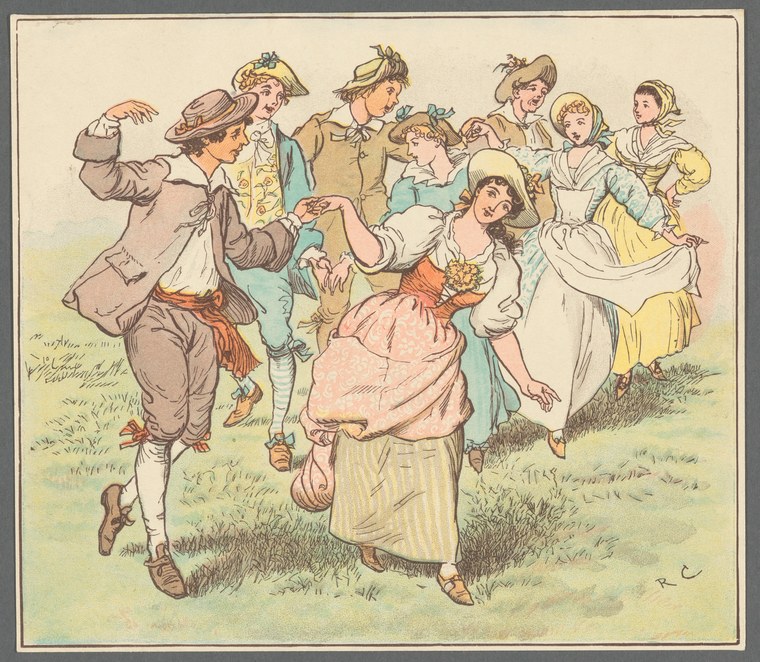
Four dancing couples in rustic costume
Unknown artist
- Collection:
- Prints depicting dance
- Source:
- New York Public Library
- Rights:
- Public domain — free to use, share and adapt.
- Recorded as:
- Public Domain
This image documents the visual language of pre-ballroom social dance—the postures, dress, mixed-gender ease, and outdoor setting that defined how people actually danced outside formal courts and theaters. For historians of folk dance and everyday life, it is rare evidence of the moment before rural dancing was codified into named styles or absorbed into ballroom culture.
What you are looking at
A lively outdoor gathering of young couples in rustic eighteenth-century costume, arranged in loose formation across a grassy meadow under soft, warm light. The composition centers on a woman in a pink skirt and white bodice, laughing and reaching toward a man in brown breeches who gestures playfully; around them, seven other figures—four women and three men—smile, watch, and participate in the moment. All wear simple country dress: the women in full skirts of pink, yellow, and pale blue with white caps or bonnets; the men in breeches, jackets, and hats. The figures overlap and vary in depth, creating a sense of spontaneous, unhurried movement rather than formal arrangement. The artist's hand-tinted wash gives the scene warmth and immediacy, with soft shadows on the grass suggesting late afternoon or early evening.
The dancing
The bodies are loose and naturalistic rather than balletic. The central woman stands with weight shifted to one leg, her body angled toward her partner in a posture of playful flirtation; her arms are raised and relaxed rather than held in strict frame. The man opposite her mirrors her ease, leaning slightly forward with one arm extended in invitation or greeting. The surrounding couples and observers stand in varied postures—some watching intently, others turned away or conversing—showing the moment before, during, or just after a dance figure rather than a single frozen pose. All the dancers appear grounded and weight-bearing, with no visible elevation or turnout.
The dance depicted
This depicts a country or folk dance, most likely a dance of courtship or social gathering from rural life in the late eighteenth or early nineteenth century. The setting, costume, and the mixed-gender social arrangement suggest a regional European folk tradition—possibly English country dance, a Regency-era cotillion, or a German/Northern European rural dance. The playful, informal posture and the presence of bystanders indicate a social context in which dancing served courtship and community bonding rather than spectacle. The woman's position as an object of attention and the man's gesturing suggest a figure in which he invites or directs her. Without clearer evidence of specific steps or hold, a more precise identification cannot be made, but the visual language is unmistakably that of rustic social dancing.
How it was made
This is a hand-colored engraving or aquatint, identifiable by the fine linear work visible in the figures and landscape, combined with watercolor or gouache tinting applied afterward. The printing technique allowed wide circulation—this is the kind of popular print produced for a middle-class market. The hand-coloring is uneven and charming, with the artist or a colorist working quickly; the soft edges and warm palette suggest either a deliberately intimate technique or the limitations of hand-application. The print medium made the scene reproducible and collectible, so it likely served both as documentation of rural custom and as entertainment.
About this work
A hand-colored print showing eight young people in rustic dress during an outdoor social dance, probably early nineteenth century. The scene captures the informality and flirtation of country dancing, with the figures arranged not in formal line but in a spontaneous moment of courtship and observation. This is folk or regional social dance as lived event rather than spectacle—the kind of dancing that occupied rural and small-town life across Europe and was increasingly documented, sentimentalized, and circulated through prints as industrial society made such customs seem quaint. The work belongs to the tradition of genre prints that captured folk life and courtship ritual, and to the visual archive of how ordinary people danced before the rise of standardized ballroom technique.
How to look at it
Pay attention to the postures and relative positions rather than any formal frame or hold. The artist has chosen the moment of invitation and response—the woman's laugh and reaching arm, the man's gesture—rather than a locked dance position. Notice how the surrounding figures are watching and waiting, which tells us this is a moment within a social event, not a finished figure. The informality of the dress and the outdoor grass setting are essential to the meaning: this is not ballroom, theater, or court, but community.
The period
This print dates most likely to the 1820s–1840s, a period when rural and folk customs were becoming objects of romantic interest as industrialization advanced. The Regency and early Victorian periods saw a surge in prints, watercolors, and literary works celebrating country life, rustic courtship, and folk tradition. This coincided with the codification of English country dance and the rise of quadrille and cotillion in urban ballrooms—forms that adapted folk figures into formal etiquette. The print captures that liminal moment when folk dance was still lived practice but increasingly viewed through a sentimental urban lens.
Where it lives
The print is held in the New York Public Library's collection of prints depicting dance, a general research collection that gathers images of dance across media, period, and geography. Without accession information or artist attribution in the catalogue, it survives as one of many similar popular prints from the nineteenth century.
Dance in this work
Questions about this work
What kind of dance is this?
It appears to be a country or folk social dance, most likely English country dance, a cotillion, or a regional European folk dance from rural life. The informal setting, mixed-gender participation, and playful courtship dynamics point to social dancing rather than theatrical or ballroom dance, though the actual steps are not visible in the image.
When was this made?
The catalogue does not record a date, but the style of dress, the hand-coloring technique, and the printmaking method all suggest the 1820s–1850s, during the Regency and early Victorian period when rural customs and folk life were popular subjects for prints and paintings.
Why are they dancing outdoors?
This reflects the reality of social dancing in rural and small-town life before industrialization made indoor halls and ballrooms the standard. Outdoor dances on feast days, holidays, or social occasions were common across Europe and the Americas, and the print documents that context.
Who made this print?
The artist is not recorded in the catalogue. It is a popular print, likely made by an engraver or printmaker working for a commercial publisher, rather than a famous artist—which explains why no attribution survived.
More dance artwork





