49 works in this view — arrow keys or swipe to move between them.
Dance in Art
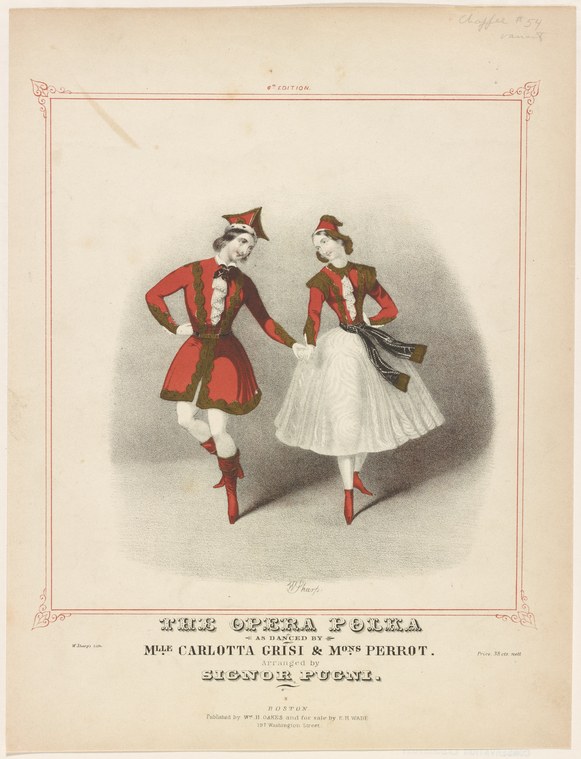
The opera polka as danced by Mlle. Carlotta Grisi and Mons. Perrot.: Arranged by Signor Pugni. 6th edition
Unknown artist
- Collection:
- Prints depicting dance
- Source:
- New York Public Library
- Rights:
- Public domain — free to use, share and adapt.
- Recorded as:
- Public Domain
Carlotta Grisi was a towering figure in Romantic ballet (the creator of the role of Giselle), and her participation in lighter theatrical dance genres like the Polka reveals the breadth of the 19th-century dancer's technical and performance repertoire. The polka itself represents a crucial moment when ballroom dance crossed into theatrical performance and became a vehicle for star performers; tracking such pieces shows how social and staged dance informed each other during this period.
What you are looking at
Two female dancers are shown in an elegant interior setting, posed mid-performance against a soft gray background that suggests stage lighting or atmosphere. Both wear the characteristic dress of mid-19th-century theatrical ballet: fitted red jackets or bodices with white lace trim at the front, paired with long white tulle skirts that fall to mid-calf. The figure on the left stands in profile with hands on hips in an assertive pose, while the figure on the right faces slightly toward the viewer with one arm extended and what appears to be a fan or shawl accessory in hand. Both wear red heeled shoes and red headpieces or bonnets. The composition is symmetrical and theatrical, presented as a promotional print announcing the dance's performers and creators.
The dancing
Both dancers are upright and poised rather than in dynamic motion. The left figure adopts a confrontational or flirtatious stance with hands placed at the hips, elbows bent outward—a pose of confidence or assertion. The right figure holds a more graceful line, with the torso slightly tilted and arm extended, suggesting a moment of turn or interaction. Neither figure shows the extended leg, pointed foot, or en pointe stance associated with classical ballet vocabulary; both are flat-footed and grounded, indicating a social or theatrical dance performed in character rather than in classical technique. The two are positioned as though in dialogue or courtship.
The dance depicted
This is a promotional print for the Polka as choreographed for theatrical performance, specifically a piece created for the dancers Carlotta Grisi and Lucien Perrot. The polka was a fashionable ballroom dance and theatrical novelty of the 1840s–50s, characterized by energetic hopping steps and a 2/4 tempo, often performed in character costumes rather than ballet dress. The arrangement was created by Signor Pugni, a major ballet composer of the era. The costumes and posed theatrical manner suggest this was a staged version with narrative or character elements rather than a pure ballroom performance, likely designed to showcase the dancers' personalities and technical facility in a lighter genre than full-length ballet.
How it was made
This is a color lithograph or hand-colored engraving, a commercial print medium suited to mass circulation of popular theatrical imagery. The technique is evident in the decorative border, the even tonal gradation of the background, and the careful hand-coloring of the costumes and faces. Such prints were inexpensive to produce in multiple editions and were sold as souvenirs to theater audiences, as marketing for performances, and as collectible images of celebrated performers. The inscription notes this is the 6th edition, confirming the work's commercial success and popularity. This format allowed wide distribution and made famous dancers recognizable to the public beyond those who could attend live performances.
About this work
This is a theatrical dance print documenting a stage version of the Polka as performed by two of the mid-19th-century's most celebrated dancers, Carlotta Grisi (the Italian ballerina famous for Giselle) and the French-Italian dancer Lucien Perrot. The work sits at the intersection of ballroom novelty and classical theatrical dance—the polka was fashionable across both contexts, and this version, arranged by the prominent ballet composer Signor Pugni, represents the kind of lighter, character-based theatrical piece that shared programs with full-length ballets. As a commercial print, it offers evidence of how famous dancers were marketed and consumed by the public, and how ballroom and theatrical dance vocabularies mixed during this period.
The image preserves a moment in dance history when the polka represented modernity, social pleasure, and theatrical spectacle simultaneously. Grisi and Perrot were international stars, and their association with this piece—reproduced across multiple editions—testifies to its success and to the appetite for images of named performers in specific, beloved roles.
How to look at it
Observe the careful attention to costume detail—the red jackets, white lace, red shoes, and headdresses all create a coherent theatrical character. Note that neither dancer is en pointe or in a classical ballet position; this is a social and character dance, not pure classical technique. The posed, almost static quality of the figures is typical of promotional prints of the era, which prioritize legibility and recognizability over capturing a moment of dynamic motion. The symmetrical composition and the theatrical framing (with decorative border) place this firmly in the tradition of theatrical publicity rather than documentary dance photography.
The artist
The lithograph is not signed by a visual artist in the visible record. The dance itself was arranged by Signor Pugni (also known as Léon Minkus or related to that circle), a celebrated ballet composer and arranger of the mid-19th century. The print was published in Paris as commercial theatrical merchandise, likely produced by a commercial printing house specializing in theatrical portraiture.
The period
The polka emerged as a craze in European ballrooms around 1844 and was rapidly adopted into theatrical performance throughout the 1840s and 1850s. By the late 1840s, when this print was likely produced (6th edition), the polka was established both as a fashionable social dance and as a theatrical novelty performed by major ballet dancers. This was the height of Romantic ballet, when Grisi herself was creating the iconic roles in works like Giselle (1841). The theatrical polka belonged to a broader mid-century trend of lighter, character-based dances that offered contrast to the ethereal, otherworldly aesthetic of Romantic ballet proper. Such pieces were also a way for theaters to advertise their stars and for audiences to consume images of famous dancers in specific, memorable roles.
Where it lives
This print is part of the New York Public Library's collection of prints depicting dance, held as theatrical ephemera and primary source material for the study of 19th-century performance culture. As a commercial print, it served dual functions: as theater publicity for audiences attending performances, and as a collectible souvenir of star dancers and celebrated roles.
Dance in this work
Questions about this work
Who were Carlotta Grisi and Lucien Perrot?
Carlotta Grisi (1819–1899) was an Italian ballerina and one of the defining figures of Romantic ballet; she created the title role in Giselle (1841). Lucien Perrot (1815–1910) was a French-Italian dancer and choreographer who was her frequent partner and collaborator. Both were major international stars of the mid-19th century, and their names on a print guaranteed its commercial appeal.
What is the polka and why did dancers perform it on stage?
The polka was a fashionable ballroom dance that emerged in the 1840s, characterized by brisk hopping steps in 2/4 time. Theatrical versions, like this one arranged by Signor Pugni, were mounted as lighter character pieces on ballet programs, allowing star dancers to showcase personality and technical facility in a more playful, contemporary genre than full-length ballets. It was also popular because it was current—audiences enjoyed seeing famous performers in fashionable, recognizable social dances.
Why is this a lithograph and not a photograph?
Photography was not yet established as a commercial medium for theatrical portraiture when this print was first produced (likely 1840s). Lithography and engraving were the standard techniques for creating reproducible images of performers and could be hand-colored to emphasize costume and glamour. Multiple editions (this is the 6th) could be printed affordably and sold as theatrical merchandise.
What does the 6th edition mean?
The notation indicates this print had been reproduced six times, suggesting strong demand and commercial success. Each edition would have been a fresh printing from the original stone or plate, with hand-coloring applied to each copy. This signals that the piece—and likely the performance itself—was popular with audiences and collectors.
More dance artwork





