49 works in this view — arrow keys or swipe to move between them.
Dance in Art
Les festes galantes
Unknown artist
- Collection:
- Prints depicting dance
- Source:
- New York Public Library
- Rights:
- Public domain — free to use, share and adapt.
- Recorded as:
- Public Domain
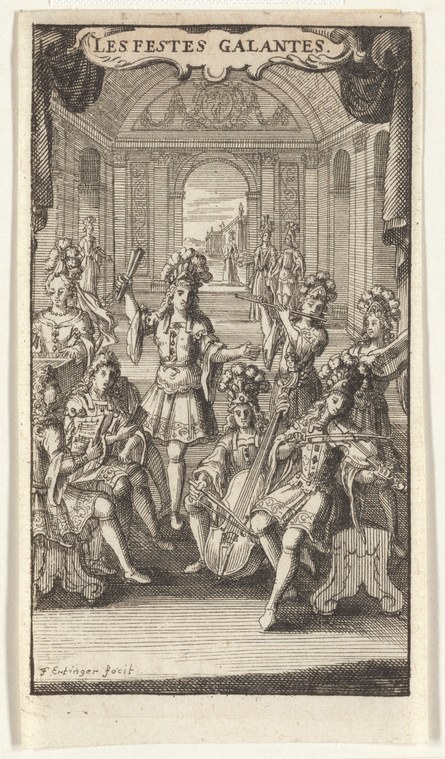
This engraving is one of the few surviving visual records of how Baroque court dances were actually executed by their practitioners, showing body position, dress, and the social arrangement of the ballroom with equal clarity. It demonstrates that Baroque dance was fundamentally a visual and social performance—not merely steps, but a complete choreography of dress, posture, and aristocratic comportment.
What you are looking at
A grand interior courtyard or gallery with classical columns and arched openings receding toward distant architecture. In the foreground, richly dressed figures execute a formal dance; the nearest pair occupies the center, with the woman's elaborate skirt with horizontal pleating caught mid-movement. Around them, other couples and single figures in court dress observe or participate—some seated, some standing in conversation, some clearly dancing. The lighting is even and architectural, typical of engraved interiors, with the background figures smaller and less detailed, emphasizing the foreground action. The title *Les festes galantes* (The Gallant Festivities) appears in a cartouche at the top.
The dancing
The dancers hold in closed or semi-closed positions typical of Baroque courtly dance, with upright posture and restrained arm movement. The nearest woman's weight appears to shift through her legs as her pleated skirt swings, suggesting gliding or smooth stepping rather than sharp footwork. The men are uniformed and hat-wearing; the women wear fitted bodices and full skirts. The spatial relationship between couples suggests synchronized or parallel movement rather than the complex interlocking figures of later ballroom forms.
The dance depicted
This depicts a formal court ball or galant entertainment of the 17th or early 18th century, almost certainly a minuet, courante, or other Baroque court dance. The refinement of dress, the architectural grandeur, and the title all point to aristocratic ballroom entertainment. The smooth, upright posture and the restrained arm gesture are consistent with the *dances of court*, which prioritized elegance and decorum. The print documents both the dance itself and the social function—the gallery serves simultaneously as ballroom and social theater.
How it was made
This is an engraving, identifiable from the fine parallel lines and cross-hatching used to model form and shadow, and the sharp, consistent line weight. The technique allowed multiple copies to circulate, making it a widely distributed document of court practice. The signature or artist mark appears at bottom left but is not fully legible in reproduction. The print's small format and refined execution suggest it was issued as a print series or bound collection, reaching a literate, courtly audience interested in the ideal of aristocratic comportment.
About this work
A documentary engraving of a formal court ball, almost certainly French or of French cultural influence, dated to the Baroque or early Rococo period (17th–early 18th century). It captures both the dance itself and its social context: the mingling of couples in a grand architectural setting designed to display rank, dress, and refinement. The work sits at the intersection of dance practice, social history, and courtly ideology—showing not just steps but the entire visual culture of the *galant* aristocracy. For historians of Baroque dance and courtly behavior, it is a detailed primary source.
How to look at it
Attend to the posture and arm carriage of the nearest dancers—they are remarkably still by modern standards, with the movement concentrated in the legs and the gentle sway of the skirt. Notice how the artist has arranged the composition to show both the dance's execution in the foreground and the social ritual surrounding it: the observers, the formal architecture, the hierarchy of attention. The foreground figures are rendered in detail; background figures and architecture recede in scale and finish, directing the eye to the central performance. This is the classic format of 17th- and 18th-century dance prints: instruction in movement rendered as social spectacle.
The period
The Baroque and early Rococo periods (roughly 1600–1750) saw court dance elevated to an art form central to aristocratic identity. The minuet, in particular, became the defining dance of refinement, codified in treatises by Raoul-Auger Feuillet and practiced by every person of rank. Engraved prints of court scenes and dances circulated widely, serving as both documentary records and aspirational models—especially valuable for provincial nobility and gentry eager to master the manners of Paris or Versailles. Dance prints were often issued in suites or albums, making them a popular collectible format.
Where it lives
The work is held in the NYPL's collection of prints depicting dance, catalogued as *Les festes galantes* with unknown date and artist. The engraving is small-format, consistent with a series of such prints or with a bound collection of galant entertainments.
Dance in this work
Questions about this work
What dance are they doing?
The refined posture, closed hold, and aristocratic setting point to a Baroque court dance—most likely a minuet, courante, or similar formal dance of the 17th or early 18th century. The title *Les festes galantes* suggests a fashionable gathering at which several such dances would have been performed in sequence.
Why are there so many people watching?
Court balls were public performance occasions for the aristocracy. Dancing was a display of rank, refinement, and breeding. The arrangement of dancers and spectators shows that this is as much a social gathering as a dance performance—the whole scene is the entertainment.
How do I identify the engraver?
There is a signature or mark at the bottom left of the print, but it is not clearly legible in standard reproductions. Researchers may be able to establish the artist through comparison with other prints of the period, or through the NYPL's catalogue records.
What is an engraving, and why was it used for dance documentation?
An engraving is a print made by incising a design into a metal plate (usually copper) and inking it. Because multiple copies could be pulled from a single plate, engravings were the mass medium of the 17th and 18th centuries. Dance prints circulated this way, spreading models of courtly behavior and movement across Europe.
More dance artwork





