49 works in this view — arrow keys or swipe to move between them.
Dance in Art
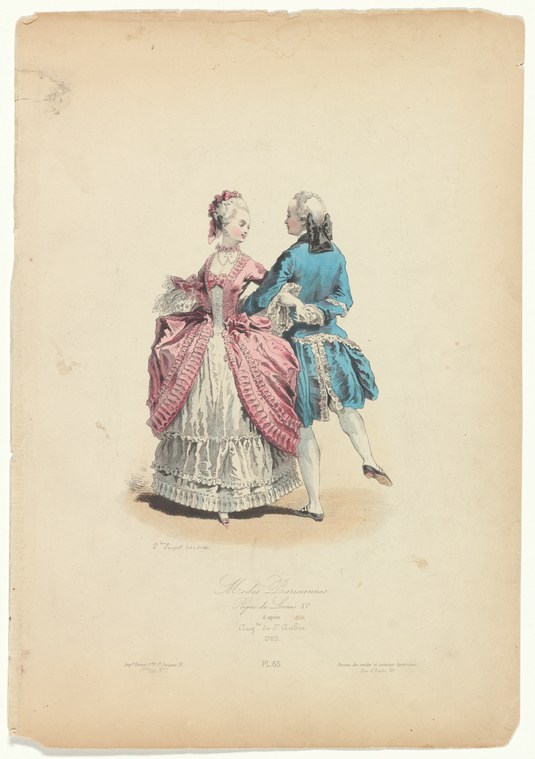
Modes parisiennes, règne de Louis XV: d'après Augte.de St. Aubin, 1763
Unknown artist
- Collection:
- Prints depicting dance
- Source:
- New York Public Library
- Rights:
- Public domain — free to use, share and adapt.
- Recorded as:
- Public Domain
For dance historians, this image is crucial evidence of the social world that minuets inhabited—not as abstract choreography but as lived courtship ritual where dress, posture, and negotiation were inseparable from the movement itself. The precision of Saint-Aubin's observation captures the material reality of aristocratic dance as social performance rather than art form. For fashion and social historians, it documents the silhouettes, ornament, and body shape that made 18th-century dance possible and necessary: the structured, corseted bodies and elaborate skirts that minuet choreography was designed to display.
What you are looking at
Two elegantly dressed figures occupy the foreground of this hand-colored engraving against a bare cream background. On the left, a woman wears a lavishly draped gown of rose-pink silk with deep folds cascading from the waist, layered over a cream-colored underdress with a gathered hem trimmed in lace. Her hair is styled high and ornamented with flowers or feathers, and her posture is graceful and composed. Beside her, slightly turned away, a young man in a vibrant blue coat faces her in conversation or flirtation; his coat is trimmed with gold embroidery and he wears a pale breeches and stockings typical of aristocratic dress. Their spatial relationship—close but not touching, bodies angled toward each other—suggests courtship or the prelude to dance rather than active dancing. The woman's arm position and the man's casual stance indicate a moment of social exchange rather than choreographed movement. The composition centers these two figures with theatrical clarity, emphasizing their costume and social status rather than any physical exertion.
The dancing
Neither figure is in an active dance posture. The woman stands with weight evenly distributed, her body relaxed, one arm positioned at her side while the other appears to gesture gently toward the man. The man's posture is more casual, with his body angled and his weight on one leg in an off-balance stance typical of social conversation rather than dance form. Their relative positions suggest they are about to dance or have just ceased dancing—a moment of courtship negotiation rather than active choreography. No classical dance frame or hold is evident.
The dance depicted
This is not a depiction of dance in progress but rather a social scene from the court of Louis XV, likely representing the prelude to or aftermath of a minuet or other formal court dance. The title references the work of Auguste de Saint-Aubin, whose fashion studies and theatrical scenes documented Paris aristocratic life. The dress—especially the woman's structured bodice, panniers (side hoops), and elaborate skirts—places this squarely in the mid-18th-century ballroom context where the minuet dominated formal entertainment. The couple's proximity and the woman's animated posture suggest flirtation or social negotiation, themes central to court dance culture where the dance itself was as much about courtship performance as movement. The engraving documents fashion and social custom rather than capturing a moment of executed choreography.
How it was made
This is a hand-colored engraving, likely a reproductive print after a drawing by or in the style of Auguste de Saint-Aubin. The technique allowed relatively affordable production and wide circulation among the upper classes interested in fashion documentation. The hand-coloring—applied after printing in the typical 18th-century fashion—gives the work its characteristic softness; the rose-pink and blue are carefully graded, and the flesh tones are delicately rendered. The use of light wash and stippling to create shadow and volume on the fabrics demonstrates both the engraver's technical skill and the print's purpose: to serve as a fashion record for the Paris elite. Such prints were collected in bound volumes and circulated among people of taste.
About this work
This work is a fashion and social history document from mid-18th-century Paris, depicting two aristocratic figures in the moment before or after participation in court dance. While not showing active choreography, it is invaluable for understanding the social context and material culture—the dress, deportment, and courtship rituals—that surrounded formal dance in the ancien régime. The work survives as part of a series of fashion plates that recorded Parisian haute society and its rituals. It is attributed to or copied from the work of Auguste de Saint-Aubin, an artist and draftsman celebrated for his precise social observation and fashion documentation. The engraving's circulation as a hand-colored print meant it shaped how Paris understood itself and was understood abroad.
How to look at it
Notice the precision with which Saint-Aubin has rendered the woman's dress: the way the pink silk catches light on the folds, the transparency of the fine lace at the hem, the structured bodice that forces an upright posture. Observe her arm position and the angle of her head—she is looking at the man with social intention, not passivity. Look at the man's stance: it is casual, almost lounging, suggesting he is the pursued rather than the pursuer. The artist has frozen a moment of social negotiation where the dance—or the possibility of dancing—creates the dramatic tension. The empty background isolates these two figures and their interaction, turning a fashion plate into a scene of psychological interest.
The artist
Auguste de Saint-Aubin (1736–1807) was a Parisian draftsman, engraver, and painter celebrated for his precise, witty depictions of Parisian social life, theater, and fashion. He worked in pen, watercolor, and engraving, often collaborating with printers and publishers to produce fashion plates, theatrical scenes, and social satire. His prolific output—thousands of drawings and prints—made him the visual chronicler of late-18th-century Paris. He was particularly skilled at capturing the texture and movement of silk, lace, and embroidery, and at conveying social psychology through minute detail in pose and gesture. His work circulated widely among the aristocracy and was also collected in bound volumes as luxury objects.
The period
By the 1760s, the minuet had become the dominant courtship dance of the European aristocracy, though its physical demands and aesthetic were being challenged by faster, more exuberant forms like the contredanse. The ball or soirée dansante was the primary arena in which aristocratic men and women negotiated marriage, alliance, and social standing. Fashion became increasingly elaborate and costly in this period—women's panniers (side hoops) reached extreme width, creating silhouettes that made athletic movement nearly impossible and confined women's movement to stylized gliding and turning. Saint-Aubin's work documents this exact moment when that aesthetic reached its peak. In art, the 1760s saw an explosion of prints documenting contemporary fashion and society; these were affordable luxury goods consumed by the upper middle classes and nobility alike.
Where it lives
This work is held by the New York Public Library as part of its collection of prints depicting dance. It is a reproductive engraving, likely one of many prints in a series on Parisian fashion and society, distributed in the 1760s or later as a luxury commodity for the aristocratic market. Such prints were often bound into albums or portfolios by collectors.
Dance in this work
Questions about this work
Are these two people dancing?
No. They are shown in a moment before or after dance—a social and courtship negotiation characteristic of the minuet era. The woman's posture and animated expression suggest flirtation or invitation, but no active choreography is depicted. For the aristocracy, the negotiation and presentation were as important as the dance itself.
What does her dress tell us about how she danced?
Everything. The structured bodice, narrow waist, and wide side hoops (panniers) meant the minuet was danced from the waist up, with the skirt and lower body kept relatively still. Movement was constrained to elegant turning and gliding rather than jumping or running. This dress made athletic dance nearly impossible.
Is this by Auguste de Saint-Aubin?
The title credits Saint-Aubin as the source (d'après Auguste de St. Aubin), meaning this engraving was made after a drawing by him. The work shows his characteristic precision and interest in fashion and social psychology. Whether it is engraved by him or by another hand from his design is not recorded.
Why would a fashion plate matter to dance history?
Fashion and dance are inseparable in this period. The silhouette—the body shape created by corsetry and panniers—determined what movement was possible and desirable. Saint-Aubin's meticulous rendering of fabric, posture, and social interaction shows us the material and social reality that choreography was designed for, not just the steps themselves.
More dance artwork





