49 works in this view — arrow keys or swipe to move between them.
Dance in Art
Peasants dancing
Unknown artist
- Collection:
- Prints depicting dance
- Source:
- New York Public Library
- Rights:
- Public domain — free to use, share and adapt.
- Recorded as:
- Public Domain
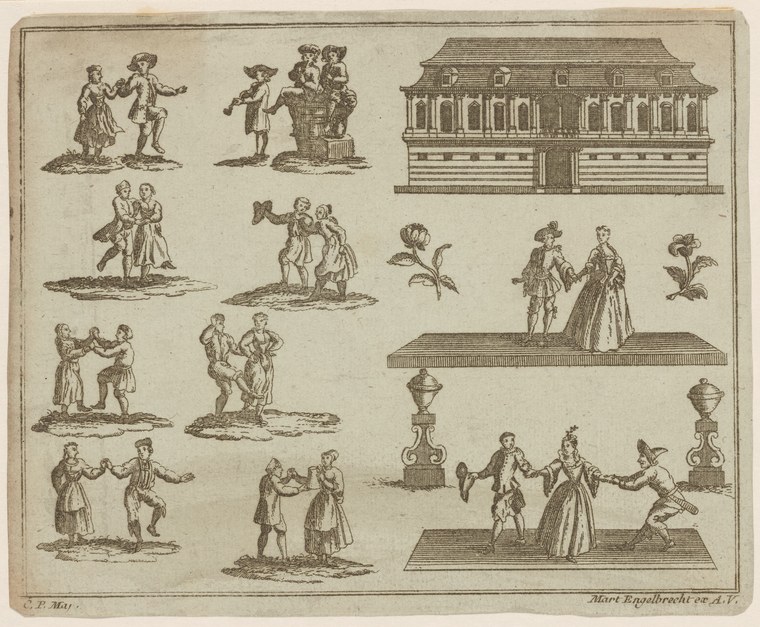
This print is one of the few surviving visual records of how peasant dances were actually performed in the 17th century, before folklorists systematized them or ballroom culture formalized country dances. It shows the dance as a social and courtship ritual embedded in rural life, not as an abstracted choreographic form—a perspective often lost in later theatrical or instructional sources.
What you are looking at
This is a composite engraving showing peasant dances and social customs, arranged as a reference sheet with multiple vignettes. The upper right features a substantial stone or brick building with classical proportions—a manor house or inn—that anchors the composition as the likely venue. Around it are scattered twelve separate scenes of rural figures in 17th-century dress: men in breeches, doublets, and wide-brimmed hats; women in long skirts and bodices. The figures are engaged in various paired and group interactions—some clearly dancing, others courting, embracing, or gesturing in conversation. Two potted plants and two ornamental urns appear as spacers, suggesting a formal pedagogical arrangement. The figures are rendered in fine hatching typical of Northern European engraving, with careful attention to fabric texture and social rank. The overall tone is documentary yet somewhat satirical, capturing the manners and amusements of rural life.
The dancing
The dancers appear in closed holds—man and woman facing each other with hands joined or placed at waist and shoulder—consistent with couple dances of the period. Several pairs show the man leading with his right arm extended, the woman's left arm raised. Postures vary from upright and formal to more relaxed and flirtatious. Some figures are shown mid-gesture with arms raised or extended outward in emphatic movements. The scale and spacing suggest these are social dances for courtship and entertainment rather than theatrical performance. Group scenes show three or four figures in loose formation, and there is no evidence of complex choreography or trained technique—these are vernacular social dances.
The dance depicted
These are peasant or country dances typical of rural Northern Europe in the 17th century, likely German or Dutch given the building style and dress. The image documents social courtship dances that served as entertainment at village gatherings, fairs, and celebrations. The closed couple-hold and the mix of paired and group formations align with early modern folk dances and country dances that preceded the formalization of baroque court dance. The artist appears to have understood the basic mechanics of the dances: the lead-and-follow structure, the central role of hand contact, and the social context of rural festivity. Without written captions (if they existed, they are illegible at this resolution), the specific regional or named dances cannot be determined with certainty.
How it was made
This is a copper-plate engraving, recognizable by the fine parallel hatching lines that model form and shadow, and the crisp black lines that define contours. The technique allowed precise reproduction and wide circulation through printing; the uniformity and finish suggest a commercial print intended for a popular or instructional audience. The arrangement of separate vignettes on a single plate—a common format for reference sheets, collections of customs, or satirical studies—implies this was either part of a series on rural life or a standalone pedagogical print. The NYPL classification as a prints collection confirms this is a multiple, not a unique work.
About this work
This engraving documents rural couple and group dances of early modern Northern Europe, presented as a composite reference sheet of peasant customs and social practices. The figures in their 17th-century dress, the rural setting, and the informal, flirtatious character of the interactions place this firmly in the tradition of dance documentation for social rather than court or theatrical purposes. The work serves as a visual record of how ordinary people danced, courted, and amused themselves—a valuable historical document of vernacular movement and social ritual that would otherwise leave no trace. For dance historians, it provides rare visual evidence of the bodily practices and social contexts that fed into later formalized European dance traditions.
How to look at it
Notice the consistency of the couple-hold across multiple pairs: the artist understood the basic mechanics of leading and following in social dance. Observe also the variety of arm positions and the gestural, sometimes exaggerated quality of the movements—these are not the controlled, geometric lines of baroque court dance, but the looser, more expressive movements of social dancing. The inclusion of the manor house or inn situates these dances in their actual context, not in an abstract or theatrical space. The juxtaposition of dance with other social interactions—courting gestures, group merriment—emphasizes dance as one among several forms of rural sociability rather than a distinct art form.
The artist
The engraver is not named in the catalogue record. The style, subject matter, and technique suggest a 17th-century Northern European printmaker working in the tradition of customs and genre prints. Such works were often produced anonymously or attributed loosely; they served a commercial market for images of regional dress, customs, and folk life. The signature or mark may be present but illegible in reproduction.
The period
This print dates from an era when European court dance was becoming increasingly formalized and imported from Italy and France, while rural and urban folk dances remained vigorous and diverse. The 17th century saw growing interest among educated Europeans in documenting vernacular customs as a form of cultural record—partly ethnographic curiosity, partly satirical interest in the contrast between courtly refinement and rural earthiness. Printed collections of dances, manners, and customs became popular during this period, especially in the Netherlands and German-speaking regions.
Where it lives
This print is held in the NYPL's collection of prints depicting dance, suggesting it was acquired or catalogued as a dance document. The collection itself is a selective archive of visual evidence on dance practice and culture across media and periods.
Dance in this work
Questions about this work
What dances are shown here?
The print does not appear to name specific dances, so their identities cannot be stated with certainty. They are generically peasant or country dances of the 17th-century Northern European type—couple dances and group dances performed at village gatherings. If captions or a title page existed, they may have identified regional or named dances, but these are not visible in the current image.
Is this a satirical image mocking peasants?
The tone is ambiguous. The careful, dignified rendering of the figures suggests respectful documentation, but the exaggerated gestures and the framing as curiosities (grouped on a page like specimens) may carry a subtle satirical edge typical of Northern European prints. The intent was likely to record and entertain urban viewers with images of rural custom.
What can this tell us about how people actually danced?
The image shows the basic social structure of the dances—couple-hold, lead-and-follow, mixed-group formations—and the context in which they occurred. It reveals that peasant dances involved close physical contact and were integrated into courtship and social ritual. However, a still image cannot show the actual steps, rhythm, or quality of movement, so the full choreography remains unknown.
How was this image made and distributed?
It is a copper-plate engraving, a technique that allowed multiple prints to be pulled from a single plate and sold or distributed widely. This format made it an affordable, reproducible document of customs suitable for a popular or instructional market.
More dance artwork





