49 works in this view — arrow keys or swipe to move between them.
Dance in Art
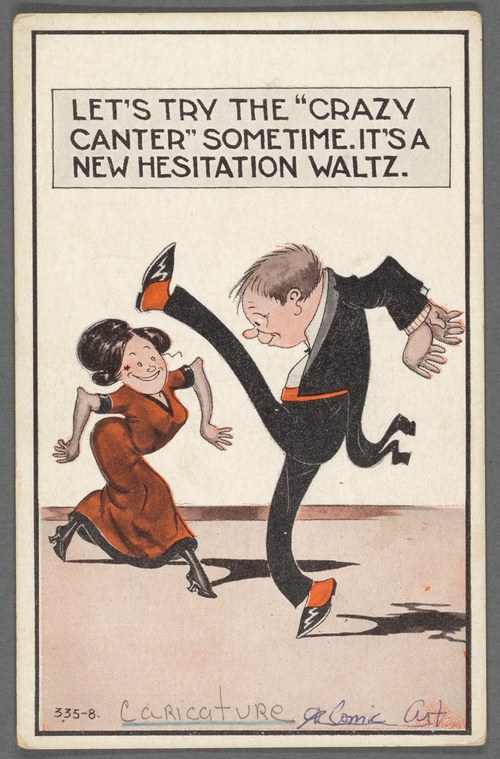
Let's try the "crazy canter" sometime. It's a new hesitation waltz
Unknown artist
- Collection:
- Prints depicting dance
- Source:
- New York Public Library
- Rights:
- Public domain — free to use, share and adapt.
- Recorded as:
- Public Domain
The hesitation waltz was a historically significant dance innovation of the 1910s-1920s, representing the influence of jazz and syncopation on European ballroom technique; this cartoon documents both the dance itself and contemporary attitudes toward it. For historians of dance, popular culture, and gender, the image is also evidence of how new dances spread to mass audiences through commercial print media, and how women's bodies in particular were depicted in relation to male-led novelty.
What you are looking at
A man in formal black tailcoat and a woman in a rust-red dress are caught mid-waltz, their bodies angled sharply across the frame in an exaggerated, comedic posture. The man's right leg is kicked high and his torso leans backward at an extreme angle, his arms spread wide for balance, while the woman kneels or crouches low, her body following his lead in the dance. The setting is minimal—a plain wooden floor and neutral background—which focuses all attention on the peculiar, almost slapstick quality of their movement. The artist has drawn this as a hand-colored cartoon, using a loose, expressive line and bright accent colors (orange-red on the woman's dress, the man's shoes) against the cream paper. The text above reads "LET'S TRY THE 'CRAZY CANTER' SOMETIME. IT'S A NEW HESITATION WALTZ." The composition emphasizes the absurdity of the moment: the man's exaggerated lean and high kick suggest loss of control or deliberate parody, while the woman's submissive crouch reads as either following his lead or reacting to his clumsiness. The spatial relationship between them—close, partnered, but wildly off-balance—is the whole joke. This is a glimpse of a dance being performed badly, or being performed as a deliberate novelty.
The dancing
The two dancers are in a partnered hold, though the hold itself is dissolving into chaos. The man's frame is completely broken: his right leg is kicked upward, his torso tilts back sharply, and his arms are flung wide rather than held in the structured frame a waltz demands. The woman is below him spatially, her body curved downward, her knees bent or kneeling, her head turned toward him. Neither dancer has the upright posture, closed hold, or controlled frame that defines waltz technique. The artist has understood ballroom partnership—they are clearly in relation to each other, not dancing separately—but has deliberately exaggerated the departure from proper form to create a visual punchline.
The dance depicted
This is a waltz, specifically identified in the text as a 'hesitation waltz'—a real variant of the waltz in early 20th-century ballrooms, characterized by pauses and syncopated timing rather than the smooth, continuous 3/4 motion of classical waltz. The image dubs it the 'crazy canter,' suggesting both a playful novelty dance and a deliberate parody of proper waltzing technique. The hesitation waltz was danced in fashionable circles in the 1910s and 1920s as a modern, jazz-influenced alternative to traditional forms. This cartoon captures the moment when such novelty dances were being introduced, mocked, and debated in popular culture. The exaggerated postures suggest either incompetence or intentional clowning—both readings were available to contemporary viewers.
How it was made
This is a hand-colored cartoon or comic illustration, likely a color lithograph or similar print medium suited to mass reproduction. The catalogue number (535-8) and attribution mark ("CARICATURE COMIC ART") suggest it was produced as a commercial cartoon, possibly for a newspaper, postcard, or comic publication. The technique—bold line drawing with selective hand-coloring—allowed for rapid production and wide circulation. The style is loose and gestural rather than precisely detailed, which suits the comedic intent: the distortion serves the joke rather than pursuing anatomical accuracy. This mass-market format means the work was intended to be seen, understood, and enjoyed by ordinary readers, not specialists—making it a primary document of how ordinary people understood and joked about new dances.
About this work
This is an early 20th-century cartoon illustrating a 'hesitation waltz'—a real ballroom novelty dance that introduced syncopation and pauses into the classical waltz form. The image captures the moment when modern dances were filtering into mainstream ballrooms and popular consciousness, and when they were being treated with a mixture of curiosity and mockery. The exaggerated, off-balance postures of the dancers are deliberate comedy: the artist has understood the ballroom partnership and the basic form, but has distorted both for comic effect, suggesting either the chaos of learning a new dance or the intentional silliness of the novelty itself. The work belongs in a dance gallery because it documents both a real dance form and the cultural moment in which it circulated. It shows how dance innovations reached ordinary people through mass media, and how those innovations were received—not as high art or serious technique, but as amusing spectacle. The cartoon is also evidence of the artist's visual literacy in dance: the fact that the exaggeration is legible as exaggeration means the original form (proper waltz technique) is being referenced and understood.
How to look at it
Attend to the moment the artist chose: not the beginning or end of a movement, but the peak of exaggeration—the highest point of the man's leg kick, the deepest point of the woman's crouch, the moment when the frame is most visibly broken. This is the moment of maximum visual comedy and maximum departure from proper technique. The artist has also made a choice about the woman's response: she is not resisting the man's wildness, but following it submissively, which comments on gender dynamics in partnered dance. Notice too how the artist has kept the floor and background minimal, white, and featureless—all visual information is concentrated in the bodies and their relationship.
The artist
The artist is not recorded in the catalogue. The signature and printing mark suggest this was produced by a commercial cartoonist or comic artist working in the early 20th century for reproduction in newspapers or periodicals. The style is consistent with American and European comic illustration of the 1910s-1920s, when such publications regularly mocked new dances and social fashions. The loose, confident line and deliberate distortion indicate a trained artist working at speed for a mass audience.
The period
The hesitation waltz emerged in the 1910s as ballroom dancing was rapidly modernizing under the influence of syncopated jazz, faster tempos, and American popular music. Older waltz forms were being displaced by newer, more energetic dances (foxtrot, one-step, two-step), and the hesitation waltz represented a hybrid attempt to modernize the waltz while retaining its basic form. At the same time, ballroom dancing was becoming a widespread popular entertainment for the middle classes, disseminated through dance halls, instruction manuals, and popular media. Cartoons like this one were a common way of processing and ridiculing these innovations: dance was trendy, amusing, and slightly transgressive in Victorian and Edwardian society, and comic illustrations allowed readers to laugh at the excesses while remaining curious about them.
Where it lives
The work is held in the Prints collection of the New York Public Library as part of their collection of prints depicting dance. The catalogue number (535-8) and the printed attribution mark ("CARICATURE COMIC ART") suggest it was acquired as part of a broader collection or donation of commercial cartoon and comic art, possibly from a single publication or publisher.
Dance in this work
Questions about this work
What is a hesitation waltz?
A hesitation waltz is a variant of the standard ballroom waltz that introduces pauses and syncopated timing, breaking the smooth 3/4 rhythm of classical waltzing. It emerged in the 1910s as ballroom dancers experimented with jazz influences and faster musical tempos. The hesitation waltz attempted to modernize the traditional waltz while keeping its fundamental character as a partnered, rotating dance.
Why is this cartoon funny?
The humor comes from the extreme exaggeration of the dancers' postures: the man's leg is kicked impossibly high, his torso leans back to a dangerous angle, and the woman is crouched nearly to the floor. These postures violate every rule of ballroom technique—upright frame, controlled movement, proper hold. The cartoon suggests either that the dancers are wildly incompetent, or that the 'crazy canter' is intentionally ridiculous. Either way, it invites readers to laugh at the spectacle of new dances.
When was this made?
The catalogue record does not provide a date, but the style of the cartoon, the fashion of the clothing, and the reference to the hesitation waltz as a novel dance all point to the 1910s or early 1920s. This was the period when the hesitation waltz was being introduced to ballrooms and when comic illustration was a primary means of discussing new dances in mass media.
Is this a real dance or a made-up joke?
The hesitation waltz is a real ballroom dance, but this cartoon exaggerates it wildly for comic effect. The artist understood the actual dance form well enough to distort it deliberately. The 'crazy canter' label in the text suggests that while the hesitation waltz was a genuine innovation, it was also treated with skepticism and amusement in popular culture—new dances were often mocked before being widely accepted.
More dance artwork





