49 works in this view — arrow keys or swipe to move between them.
Dance in Art
Four dancing couples in rustic costume
Unknown artist
- Collection:
- Prints depicting dance
- Source:
- New York Public Library
- Rights:
- Public domain — free to use, share and adapt.
- Recorded as:
- Public Domain
This image preserves a glimpse of how dance was understood and depicted in popular visual culture—not as a technical or theatrical art but as a spontaneous social practice embedded in village life and celebration. The verse and image together document the relationship between musician and dancer in folk tradition: the fiddler as a paid service provider whose labor made community dancing possible.
What you are looking at
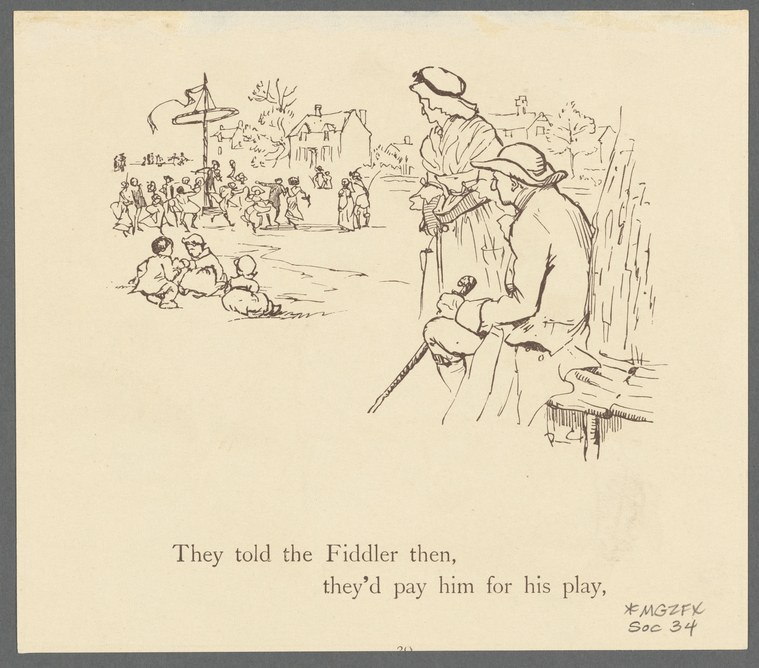
A pen-and-ink sketch depicts a village festival or fair where four couples dance in the foreground while a crowd gathers in the background near buildings and a cross or maypole structure. The composition is divided between the intimacy of the dancing pairs in the immediate foreground—rendered with lively, loose linework—and the bustle of spectators and architecture behind. The dancers wear rustic or working-class costume: the women in long skirts and bonnets or hats, the men in period breeches and coats. The setting is unmistakably rural and festive, with the graphic energy of the sketching suggesting movement and spontaneity. The text below—"They told the Fiddler then, / they'd pay him for his play"—anchors the image as an illustration from a narrative work, likely a ballad or children's story about a village musician.
The dancing
All four couples stand in social dance formation with partners facing or at angles to one another, weight centered and upright in the postures characteristic of folk and country dance. The nearest couple at left adopts a close, engaged stance; the other pairs are similarly positioned for conversation-distance partnering. The bodies are rendered with gestural fluidity—the artist captures the relaxed yet animated carriage of social dancers rather than the formal frame of ballroom or theatrical dance. No pointe work, turnout, or technical precision is evident; the movement reads as recreational and social.
The dance depicted
This is a depiction of rural social dance, most likely English country dance or a generic 'village dance' of the 19th century. The context—a village fair or market with a crowd gathering to watch—and the costume suggest a folk or regional tradition rather than a named or codified style. The accompanying verse identifies a fiddler as the musician, confirming the association with vernacular music-making and community celebration. The image captures the social and communal aspect of folk dancing: the pairs are participants in a public gathering, watched and encouraged by onlookers, with music provided by a hired musician who will be paid for his performance.
How it was made
This is a pen-and-ink sketch on paper, likely executed as an illustration for a printed text. The loose, economical linework and the absence of fine detail or tonal gradation suggest rapid drawing suited to reproduction—possibly for letterpress or wood-block printing, though the fine pen line also indicates it may have been engraved or reproduced photomechanically. The sketch's fluency and the assured placement of figures suggest a practiced illustrator's hand. The technique allows for narrative clarity and movement without the labor of full modeling, making it ideal for book or periodical illustration.
About this work
This is an illustration to a verse narrative—likely a ballad or children's poem about a village festival and a traveling musician. The image captures a moment of folk dance in a rural English setting, showing four couples dancing in a market or fairground while villagers watch and a fiddler prepares to be paid for his performance. It is a document of 19th-century attitudes toward rural festivity and music-making, showing dance as a communal, casual social practice rather than a staged or professional art. The sketch is characteristic of book and periodical illustration of its era, using gestural drawing to convey both the specificity of rural costume and the liveliness of an informal gathering.
How to look at it
Observe the contrast between the careful, detailed rendering of the buildings and crowd in the background and the fluid, loose sketching of the dancing figures—the artist prioritizes movement and gesture over architectural precision. The positioning of the couples demonstrates the social nature of the dance: they are not arranged in a formal line or symmetrical pattern, but rather scattered through the foreground in pairs, suggesting a moment captured from a living event. Notice how the pen line varies in pressure and pace, creating a sense of the dancers' animation and the energy of the scene.
The artist
The artist is not recorded. The style and context suggest a professional illustrator working in Britain in the mid-to-late 19th century, likely for book or periodical publication. The assured linework and narrative clarity indicate trained practice in illustrative work.
The period
This work belongs to the 19th-century romanticization of rural and folk culture, particularly in Britain. As industrialization and urbanization accelerated, village festivals and country dances were increasingly subjects of nostalgia in literature and visual art. The representation of folk dance in popular illustration often emphasized the picturesque and communal aspects of rural life, even as those practices were becoming less central to village experience. The costume and setting suggest the early-to-mid 19th century, when such imagery was common in gift books, ballad collections, and children's literature.
Where it lives
This work comes from the New York Public Library's collection of prints depicting dance. The archival reference 'Mgzfk Soc 34' suggests it is catalogued as part of a larger assemblage of dance imagery, possibly organized by social or historical category.
Dance in this work
Questions about this work
What kind of dance is this?
The image shows rural social dance of the 19th century, likely English country dance or an informal village festival dance. The couples are engaged in partnered social dancing, not a named or choreographed style. The presence of a fiddler and the setting in a village fair or market indicate this is communal, recreational dance rather than staged performance.
What does the verse tell us?
The text—'They told the Fiddler then, they'd pay him for his play'—identifies the musician as a paid service provider. This reflects a common feature of folk music and dance in rural communities: the musician was often a traveling or semi-professional figure who earned money by providing music for village celebrations and dances.
Why is this illustration important to the history of dance?
It documents how dance was understood in popular culture outside of elite, theatrical, or codified traditions. The image shows dance as a social, communal practice inseparable from village life, music-making, and festivity. It also preserves a visual record of 19th-century attitudes toward folk and rural culture during a period of rapid social change.
More dance artwork





