49 works in this view — arrow keys or swipe to move between them.
Dance in Art
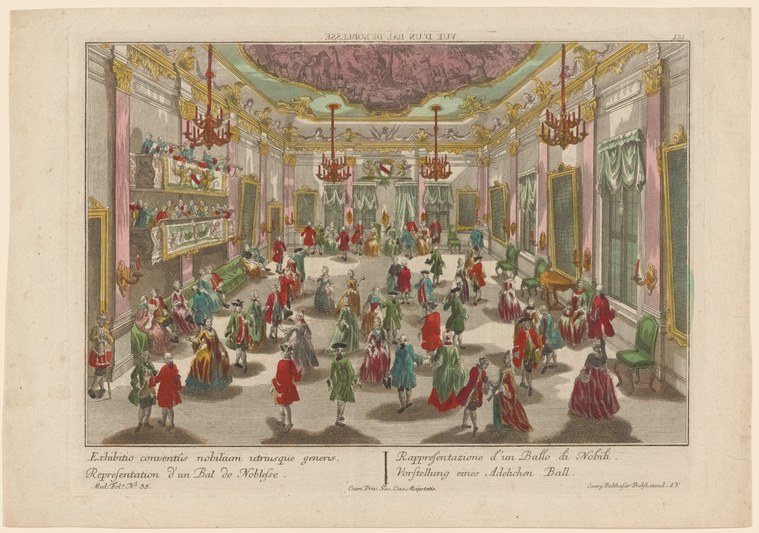
Rappresentazione d'un ballo di nobili ...
Unknown artist
- Collection:
- Prints depicting dance
- Source:
- New York Public Library
- Rights:
- Public domain — free to use, share and adapt.
- Recorded as:
- Public Domain
This is a rare surviving image of how Baroque court dance was actually staged and witnessed—not as isolated technique but as a social ritual framing courtship, hierarchy, and display. The inscription suggests it documented a specific real event, making it evidence of dance's role in court ceremony, not merely artistic fantasy. For historians and dancers, it reveals the visible decorum expected of noble bodies: the spacing, the dress, the controlled gesture, and the structured spectatorship that defined the social meaning of dance.
What you are looking at
A grand interior ballroom or palace hall, rendered in hand-colored engraving, shows a formal dance gathering of the nobility. The space is lavishly appointed with a coffered and frescoed ceiling in soft blues and pinks, crystal chandeliers, and tall green-framed doorways set into pink walls with gilt ornament. A substantial crowd of aristocratic figures in rich dress—reds, greens, yellows, and flesh tones—fill the floor and line the walls. In the center foreground, three to four couples are actively dancing in paired formation, their bodies turned toward one another and skirts and coat-tails splayed by motion. Spectators cluster at the left side, watching from a raised gallery or platform. The floor is rendered in pale gray, creating clear spatial recession into the depths of the hall. The overall effect is one of ordered, ceremonial festivity: the dancers occupy a privileged central space while the crowd observes, yet all are part of a unified social performance.
The dancing
The active dancers in the foreground stand in closed or near-closed couples facing one another or angled toward their partners. The women's full skirts flare outward, caught mid-turn or sway. The men are upright, gesturing with arms and shoulders in the formal, controlled manner typical of court dance. Most figures maintain vertical posture and deliberate arm carriage; there is no sprawl or abandon. The supporting figures are smaller and more schematic, standing in conversational groups or rows, watching the spectacle. The scale and positioning of the central dancers—larger, more individually rendered, occupying the floor—marks them as the primary performers.
The dance depicted
This depicts a formal court or nobility ball, most likely from the 17th or early 18th century based on dress and architectural style. The paired formation, controlled carriage, and structured spatial arrangement are consistent with Baroque court dance—particularly the minuet or a similar processional dance of the period. The presence of spectators, the layered social hierarchy (dancers, close watchers, background crowd), and the palace setting all confirm this as a social occasion governed by dance etiquette. Without more specific iconographic markers (musical instruments, particular clothing, inscribed naming), the exact dance cannot be pinned down, but the idiom is unmistakably historic-baroque ballroom spectacle.
How it was made
This is a hand-colored engraving or etching, executed with fine cross-hatching for tonal modulation and architectural perspective. The inscription at the base appears to be in Italian, and the style of the print—the precision of the lines, the soft palette of hand-applied watercolor or gouache, the shallow picture plane with stacked depth—is typical of 17th- or 18th-century European court documentation prints. Engravings like this were made to circulate images of aristocratic ceremonies and celebrations among the nobility and educated classes, creating a visual record and propaganda of refined court life. The technique allowed fine detail and repeatable multiple impressions.
About this work
This hand-colored engraving documents a formal ball or dance gathering of the nobility, likely in an Italian or northern European court. The scene captures the visual language of Baroque court spectacle: hierarchical social space, controlled paired dancing, architectural splendor, and the mingling of active performers and spectating aristocrats. It belongs in a gallery of dance imagery because it records not the steps themselves but the social and ceremonial framework in which noble dance was embedded—a context essential to understanding why dance mattered in courtly life. The print served as a kind of souvenir or propaganda, circulating an image of refined leisure and social order among those who aspired to such status.
How to look at it
Notice the careful centering and frontality of the main dancing couples and the way the architectural perspective draws the eye into the depth of the hall. The artist has frozen a moment of forward motion and rotation—skirts and coattails in mid-flare—yet the overall pose is restrained and posed, not caught off-guard. This is not candid observation but an idealized representation of decorous behavior. Pay attention to the social zones: who stands where, who watches, and how the active dancers occupy the space as if on a stage within the larger hall. The hierarchy of scale and color marks the dancers as the spectacle; everyone else is audience.
The period
This engraving dates to the era of high Baroque courtly culture, when dance was integral to aristocratic life and court ceremonies were carefully orchestrated and documented. In Italy, northern Europe, and the French and English courts, the minuet and other paired court dances were the height of social fashion and a marker of refinement. Dance masters and court ceremonial advisors choreographed these events; engravings like this one served to broadcast images of courtly splendor and propriety to a wider audience, reinforcing the idea of the court as the seat of cultured civilization. The presence of spectators and the formal arrangement reflect the performative nature of courtly existence itself.
Where it lives
The work is held in the New York Public Library's collection of prints depicting dance. It is a hand-colored engraving with an inscription in Italian at the base; the collection source indicates it is a historical document from continental European courtly culture, likely from the 17th or 18th century.
Dance in this work
Questions about this work
What dance are they doing?
The engraving does not name the specific dance, but the paired formation, formal carriage, and palace setting indicate a Baroque court dance, probably a minuet or similar processional form. Without a clear inscription or other identifying markers, the exact dance cannot be determined, but the visual language is that of aristocratic courtly ceremony.
Why are some people dancing and others standing still?
This was typical of court balls: at any given moment, one or a few couples would take the floor to dance while others watched. Spectating was itself part of the social event—a chance to observe and be observed, to assess fashion and deportment. The hierarchical arrangement of watchers and dancers reinforced social rank.
Is this a real event or an imaginary scene?
The Italian inscription at the base suggests this documents a specific real occasion or ceremony, though the engraving is clearly idealized and composed for aesthetic and propagandistic effect. It is likely a record of an actual court ball, rendered in the formal language of courtly spectacle.
Who is the artist?
The artist is not recorded in the catalogue. The style and subject matter indicate a European courtly engraver of the 17th or 18th century, but no signature or attribution is visible or documented.
More dance artwork





