49 works in this view — arrow keys or swipe to move between them.
Dance in Art
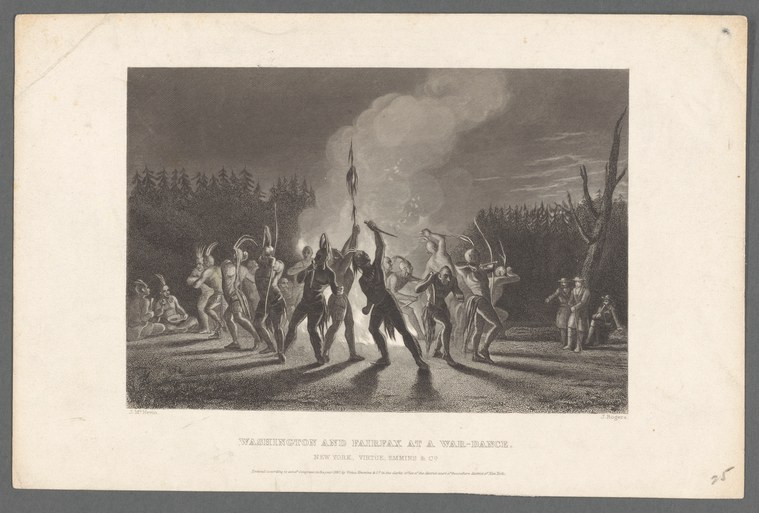
Washington and Fairfax at a war-dance
Unknown artist
- Collection:
- Prints depicting dance
- Source:
- New York Public Library
- Rights:
- Public domain — free to use, share and adapt.
- Recorded as:
- Public Domain
This work preserves a visual record—however mediated by European artistic convention—of how Indigenous war dances were perceived, represented, and circulated as images during the early American period. For dance historians, it documents the aesthetic and kinetic vocabulary colonists found noteworthy enough to commission and engrave: the emphasis on weapons, firelight, circular formation, and expansive, high-energy movement. The presence of Washington and Fairfax, whether factual or invented, anchors the image to a specific historical moment and raises questions about authenticity, spectacle, and how colonial encounters were mythologized in visual culture.
What you are looking at
A nighttime scene in an open clearing surrounded by dense forest, lit by firelight from a central bonfire. Two figures in the center—identified in the title as Washington and Fairfax—stand elevated on what may be a platform or raised ground, their bodies in dynamic, athletic postures with arms raised. They are surrounded by a ring of Indigenous dancers in various poses of motion: some with raised spears or weapons, others with arms extended or bodies twisted in vigorous movement. The dancers wear minimal clothing and appear unclothed or nearly so, their bodies rendered in strong chiaroscuro. The composition radiates outward from the central fire; figures in the foreground are more detailed and sharply lit, while those receding into shadow and forest become progressively less distinct. The overall effect is of intense, synchronized movement captured in a moment of peak energy.
The dancing
The central figures of Washington and Fairfax dominate through elevation and the artist's focus; both adopt high, open arm positions suggesting excitement, authority, or participation in the spectacle. Their bodies are upright and alert. The surrounding dancers adopt varied stances—some with legs in wide strides suggesting weight transfer, others with spears or raised arms creating diagonal lines across their bodies. The postures are athletic and expansive rather than contained, with visible torso rotation and extended limbs. The grouping suggests concentric circles of dancers, though the engraving's technique makes precise footwork indecipherable.
The dance depicted
This is titled as a "war-dance" and the imagery—weapons, firelight, nighttime setting, and the vigorous, radiating formation—aligns with Indigenous North American ceremonial or martial dances of the kind historically performed and observed during the 18th century. The presence of Washington and Fairfax (colonial-era figures) as spectators or participants frames this as a documented encounter or romanticized representation of Indigenous performance. The dance itself cannot be precisely identified from the image alone, but the formal elements—the circular or radial arrangement, the emphasis on weapons, the high energy—are consistent with accounts of war dances or victory dances in Eastern Woodlands traditions. Whether this represents an actual event or a imaginative reconstruction is unclear from the image.
How it was made
This is an engraving, identifiable by the linear hatching technique used to create shadow, tone, and texture throughout the composition. The fine parallel lines are particularly visible in the rendering of the forest, the bodies, and the sky. Engraving allowed precise detail and permitted mass production, making this work circulate as a printed image in periodicals, collections, or bound volumes. The technique is well-suited to narrative and historical documentation, which may explain its choice for depicting a scene framed as a historical encounter. The monochromatic medium emphasizes silhouette and dramatic contrast between the firelit figures and the dark forest.
About this work
This engraved print depicts a nighttime scene titled "Washington and Fairfax at a War-Dance," showing two colonial-era figures witnessing or participating in an Indigenous North American dance. The composition centers on a large fire around which numerous dancers move in dynamic poses, many holding weapons or spears, arranged in radiating circles. The print belongs to a genre of 18th and early 19th-century European and American imagery documenting or imagining encounters between colonists and Indigenous peoples, often framing such dances as spectacles of exotic vitality or martial prowess. The engraving technique and its historical subject matter situate it within illustrated histories, travel narratives, or collections of costume and ethnographic imagery aimed at a educated, literate audience curious about the colonial frontier.
How to look at it
Attend to the composition's radial structure: the bonfire acts as a point of origin from which dancers project outward, their bodies creating diagonal lines and varied angles that suggest simultaneous, coordinated movement. The artist has chosen a moment of high intensity—all figures are in action, none at rest. Notice how the engraving technique uses dense hatching in the forest to create an enclosing darkness that frames the lit dancers, intensifying the sense of spectacle and ceremony. The elevation of Washington and Fairfax and their central placement, despite the title naming them, make them observers as much as subjects; the real focus is the dancers' bodies and their weapons.
The period
This engraving likely dates to the late 18th or early 19th century, a period of intense fascination in Europe and America with Indigenous cultures of North America. Such imagery appeared in illustrated histories, travel accounts (real and imagined), and ethnographic collections following the American Revolution and westward expansion. The romanticized aesthetic—the firelight, the nudity, the weaponry, the radial composition—reflects Enlightenment-era conventions for depicting the "exotic" or "savage" other. War dances and other Indigenous ceremonies held particular appeal as subjects, both as evidence of martial prowess and as markers of cultural difference. George Washington's presence suggests this may have been created or circulated in the decades following the American Revolution, when his military campaigns and frontier encounters were being memorialized in popular imagery.
Where it lives
This engraving is held in the New York Public Library's collection of prints depicting dance, which gathers visual representations of dance from various periods and cultures. The cataloguing information is minimal, with artist, date, and publication details not recorded in the available metadata.
Dance in this work
Questions about this work
Was this scene actually witnessed by Washington and Fairfax?
The print is titled to suggest so, but whether it documents a real historical event or represents a later imaginative reconstruction cannot be determined from the image alone. Many 18th and 19th-century engravings depicting Indigenous life were created long after the events they claimed to show, or were entirely fictional. The composition and style suggest it was made for a narrative or historical publication rather than as an eyewitness record.
What Indigenous nation or region is this meant to represent?
The engraving provides no specific tribal markers, costume details, or geographical context that would identify a particular nation or region. The generic treatment—minimal clothing, weapons, circular dance formation, firelight—suggests a generalized or stereotyped vision of "Indigenous dance" rather than a specific ethnographic study. The presence of Washington suggests a connection to the Eastern Woodlands or Mid-Atlantic region, but this is inference rather than evidence from the image.
What kind of dance is actually shown?
The title names it a "war-dance," and the composition—the weapons, the nighttime setting, the intense energy and varied weaponry—supports that classification. War dances in Eastern Woodlands traditions often involved circular or radial formations, calls and cries, and the brandishing of weapons, all elements the engraver has emphasized. However, the artistic convention and European perspective of the image mean it should be read as a representation of how colonists understood or wished to visualize such dances, not as an ethnographic record of actual choreography or movement vocabulary.
More dance artwork





